From Moscow’s promises to Brussels’ euros: a diplomatic u-turn under scrutiny
Since taking power, Burkina Faso’s military leadership has consistently framed its foreign policy around a bold narrative: severing ties with Western partners and embracing new alliances, particularly with Russia. Yet recent high-level meetings in Brussels tell a different story one that raises a critical question: can Ouagadougou’s anti-Western posturing survive in a financial reality that still demands European support?
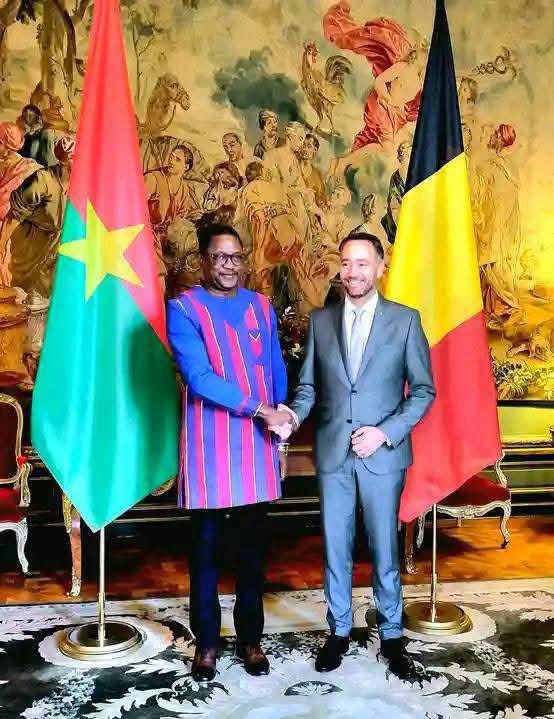
On November 4 and 5, 2026, Burkina Faso’s Foreign Minister Karamoko Jean Marie Traoré traveled to Belgium, where he met first with EU High Representative Kaja Kallas, then with Belgian Deputy Prime Minister and Foreign Minister Maxime Prévot. The timing could not have been more symbolic. Just days earlier, the regime had participated in the Russia-Africa Economic and Humanitarian Forum in Moscow, touting new strategic partnerships with its supposed alternative to the West.
RUSSIA’S PLEDGES: GRAND STATEMENTS, BUT WHERE’S THE MONEY?
The transition government has positioned its pivot toward Moscow as the cornerstone of a new economic and security order, a departure from decades of Western cooperation. During the Moscow forum, the most tangible outcome was a memorandum of understanding between the Confederation of Investment and Development Bank of the Alliance of Sahel States (AES) and Russia’s VEB.RF. Yet beneath the diplomatic fanfare lies a sobering truth: signing a memorandum is not the same as securing funding.
The agreement outlines a framework for future investments and trade exchanges, but concrete financial flows remain hypothetical. To date, Ouagadougou has not disclosed any substantial Russian funds directed toward addressing Burkina Faso’s pressing needs whether in security, infrastructure, or social services. The question looms large: can a single external partner realistically replace the financial lifelines once provided by Europe and its institutions?
THE BUDGETARY GAP THAT REFUSES TO CLOSE
Burkina Faso’s 2026 budget paints a stark picture of financial strain. Projected revenues of 3.43 trillion CFA francs fall short of the 3.92 trillion CFA francs in expenditures, leaving a deficit of 486.8 billion. The International Monetary Fund forecasts a budget deficit of 4% of GDP for 2026 figures that underscore the sheer scale of financing gaps the government must bridge.
These pressures make it clear that access to external funding is not merely an option; it is a necessity. The critical issue is whether the Russian partnership can deliver the resources Burkina Faso desperately needs, or if Ouagadougou must continue relying on the very Western partners it has publicly rejected.
Brussels’ quiet return as the provider of last resort
The November meetings in Brussels left little room for ambiguity. Belgium reaffirmed its commitment to provide €40 million in development aid to Burkina Faso from 2027 onward, channeled through Enabel, the Belgian development agency. This pledge underscores a fundamental reality: despite rhetorical breaks, Burkina Faso’s leadership still seeks and needs European financial engagement to sustain its national ambitions.
The discussions extended beyond symbolic diplomacy. The Burkinabè delegation engaged with senior European Commission officials and operational cooperation bodies, including Enabel and Bio Invest. These conversations centered on consolidating financial support for national priorities, signaling that Burkina Faso’s future development may depend as much on Brussels as it does on Moscow.
THE PARADOX OF SOVEREIGNTY: DOUBLESPEAK IN FOREIGN POLICY
The tension between Burkina Faso’s public stance and its private negotiations reveals a deeper challenge. No country can afford to turn its back on viable financial partners purely for ideological reasons. The real dilemma lies in how to reconcile domestic rhetoric with practical necessity.
How can a government justify telling citizens that the West is an existential threat, while simultaneously negotiating loans and grants from Western institutions to fund schools, hospitals, and security operations? If Brussels remains indispensable, why foster the illusion of a definitive rupture? Conversely, if Russia is genuinely the transformative partner Ouagadougou claims, where are the verifiable projects, concrete investments, and disbursed funds?
Sovereignty, ultimately, is not measured in anti-Western slogans. It is demonstrated through the ability to mobilize resources, finance development, and meet the needs of the population. Until Burkina Faso can present tangible results from its pivot toward Moscow, its citizens and the international community are justified in asking: what has this new alignment actually delivered?
RESULTS OVER RHETORIC: THE ONLY CURRENCY THAT MATTERS
This diplomatic pivot reveals an inconvenient truth: economic diversification is essential, even when it contradicts political messaging. Burkina Faso has every right to pursue partnerships with Russia, Belgium, the European Union, or any other nation. Yet such choices must be reflected in deeds, not just declarations.
The Burkinabè people deserve clarity. They need to know whether their government’s pivot has translated into real financial support, new infrastructure, or improved public services. As Ouagadougou continues to court Brussels for aid, the pressing question remains unanswered: after betting heavily on Moscow, what concrete benefits has Burkina Faso gained from its new strategic partner?
By AMINA SALEY — Journalist