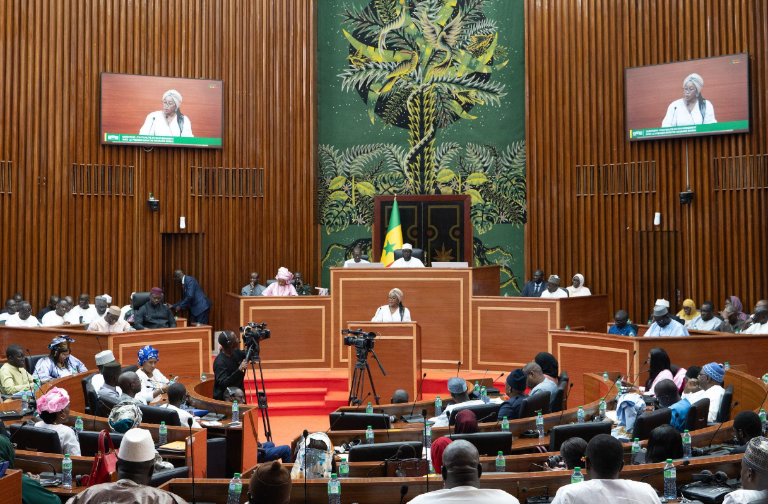
As Senegal braces for the crucial plenary vote on the revised budget law, a surprising roadblock has emerged—one that could plunge the government into a fresh institutional crisis. The Prime Minister, Ahmadou Al Aminou Lô, is now scrambling to mend fences with his own parliamentary majority, particularly members of the Pastef party, whose rejection of the draft law in committee has sent shockwaves through the political landscape.
What’s at stake for Senegal’s government?
With parliament’s decisive vote looming, the stakes couldn’t be higher. The Senate’s rejection of the budget adjustment bill by Pastef lawmakers—despite their shared political allegiance with the ruling party—has exposed deep fissures within the governing coalition. Is this the beginning of a new chapter of friction between the executive and its parliamentary allies, or can the Prime Minister avert a potential stalemate?
The bill, set for a plenary vote on October 27, already faces an uphill battle. Having been rejected in committee last Friday, October 23, the proposed law now carries the weight of political uncertainty, threatening not just budgetary stability but the very credibility of the government’s decision-making process.
Why is the government’s own majority turning against it?
The committee’s rejection wasn’t just a symbolic protest—it was a clear signal that the government’s budgetary choices are failing to win over even its closest allies. Given Pastef’s numerical dominance in parliament, their opposition could derail the entire legislative process, leaving the government exposed and its economic strategy in disarray.
The timing couldn’t be worse. In a climate of economic strain, the government’s inability to secure parliamentary backing for its revised budget raises pressing questions: Why are lawmakers from the same political camp resisting a law that should, in theory, align with their shared priorities? Is this a clash over fiscal priorities, or does it reflect deeper skepticism about the government’s approach to public finance management?
Budget negotiations or political power play?
At the heart of this dispute lie the fundamental trade-offs that define every budget bill: balancing economic imperatives with political realities. For Prime Minister Lô, the challenge is twofold. First, he must justify the government’s fiscal adjustments in a time of constrained resources. Second—and more critically—he must persuade his parliamentary allies that these sacrifices are necessary, even when they come at a political cost.
The revised budget isn’t just a financial document; it’s a statement of values. It reflects the government’s vision for public spending, tax policy, and economic resilience. But when that vision clashes with the expectations of the ruling party’s own lawmakers, the result is a high-stakes negotiation where neither side can afford to blink first.
Can compromise bridge the divide?
With no clear consensus in sight, the Prime Minister is banking on dialogue. His strategy hinges on intensive negotiations with Pastef lawmakers to identify common ground before the plenary vote. The goal? To find a middle path that preserves the integrity of the budget while addressing the concerns of rebel MPs.
Yet the risks are substantial. For the government, a second defeat would undermine its authority and cast doubt on its ability to steer the country through economic turbulence. For Pastef lawmakers, maintaining their opposition could serve as a warning shot to the executive—demonstrating their readiness to assert parliamentary independence, even at the cost of institutional gridlock.
Lessons for Senegal’s political future
Beyond the immediate budget battle, this episode exposes a broader dilemma facing Senegal’s political class. How can a government reconcile the need for disciplined policy execution with the realities of parliamentary democracy? Can lawmakers balance loyalty to the ruling party with their constitutional duty to scrutinize legislation?
These questions go to the core of Senegal’s democratic resilience. As the October 27 vote approaches, the government’s next moves—and the response of Pastef lawmakers—will reveal whether Senegal’s institutions can weather this storm or if the country is drifting toward a new era of political confrontation.
The stakes couldn’t be clearer: will dialogue prevail, or will the revised budget law become another flashpoint in an increasingly heated political climate?