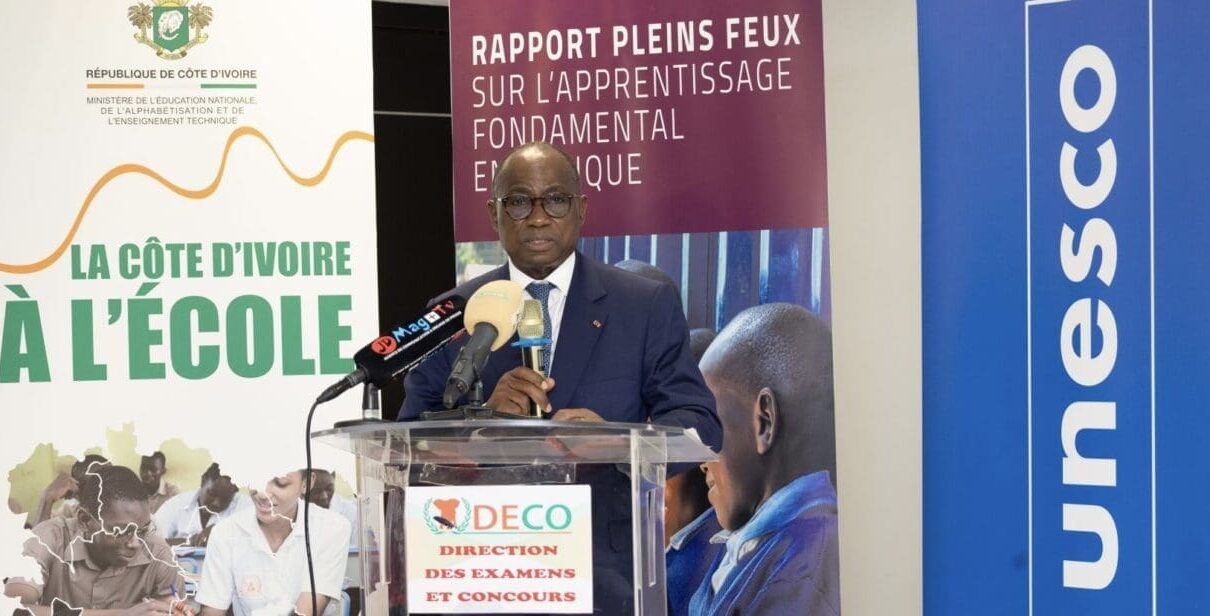
The «Pleins Feux» project, unveiled in Abidjan in April 2026, is the latest milestone in Côte d’Ivoire‘s ongoing effort to modernize its education system under the leadership of President Alassane Ouattara. Supported by global partners, this initiative aims to optimize the governance of public education policies, ensuring long-term improvements in learning outcomes for all students.

Building a stronger foundation: expanding access and improving quality
Côte d’Ivoire faces a growing demand for education as the country’s population exceeds 30 million, with a significant youth demographic driving enrollment rates upward. To meet this challenge, the government has prioritized education as a cornerstone of development, aligning its efforts with the UN’s Sustainable Development Goal 4 (SDG 4) and the 2030 Agenda. Over the past decade, successive reforms have focused on enhancing both access to and quality of education, particularly in underserved rural areas.
The «Pleins Feux» initiative builds on these foundations by addressing systemic inefficiencies in policy implementation, rather than focusing solely on infrastructure or teacher recruitment. This forward-thinking approach positions Côte d’Ivoire as a regional leader in educational innovation.
teacher recruitment and infrastructure: scaling up for the future
Since 2011, Côte d’Ivoire has significantly expanded its teaching workforce, hiring over 69,000 primary school teachers and more than 30,000 secondary educators. Recent efforts have prioritized science and technology disciplines, with an additional 1,800 teachers deployed in mathematics and physics to meet both labor market demands and the country’s economic transformation goals.
Investments in school infrastructure have also accelerated, particularly in rural regions where geographic barriers often discourage enrollment. New school constructions across the country are reducing travel distances and dropout rates, while initiatives like the opening of the CAFOP Boundiali in northern Côte d’Ivoire are strengthening teacher training programs. In 2026, nearly 68,000 candidates competed for just 7,000 teaching positions, underscoring the high demand for quality education and professional development opportunities.
Creating inclusive learning environments
Beyond teacher recruitment and infrastructure, Côte d’Ivoire is prioritizing the improvement of school conditions to enhance learning outcomes. Between 2011 and 2025, starting salaries for primary school teachers increased by over 30%, while secondary teacher salaries rose by up to 15%, making the profession more attractive and helping to stabilize teaching teams.
The government is also fostering an inclusive education system by providing adapted learning materials for students with disabilities and implementing preventive measures to address challenges like teenage pregnancy in schools. These efforts aim to reduce dropout rates and ensure that all students, regardless of background, have the opportunity to succeed academically.
The «Pleins Feux» project: a focus on governance and efficiency
Unlike previous initiatives that concentrated on expanding access or building schools, the «Pleins Feux» project targets the critical but often overlooked challenge of education system governance. Launched in Abidjan in April 2026, this two-year initiative was developed in partnership with UNESCO, the African Union, and the Global Education Monitoring (GEM) Report. It builds on pilot programs conducted in Côte d’Ivoire, Ghana, and Ethiopia to strengthen the capacity of policymakers and educational leaders in implementing effective public education strategies.
International partners have praised Côte d’Ivoire‘s progress in foundational learning, and the «Pleins Feux» project is designed to sustain this momentum. By leveraging diverse partnerships—ranging from global organizations to regional and private sector stakeholders—the initiative ensures a comprehensive approach to educational transformation. This collaborative model positions Côte d’Ivoire as a model for other nations seeking to modernize their education systems.