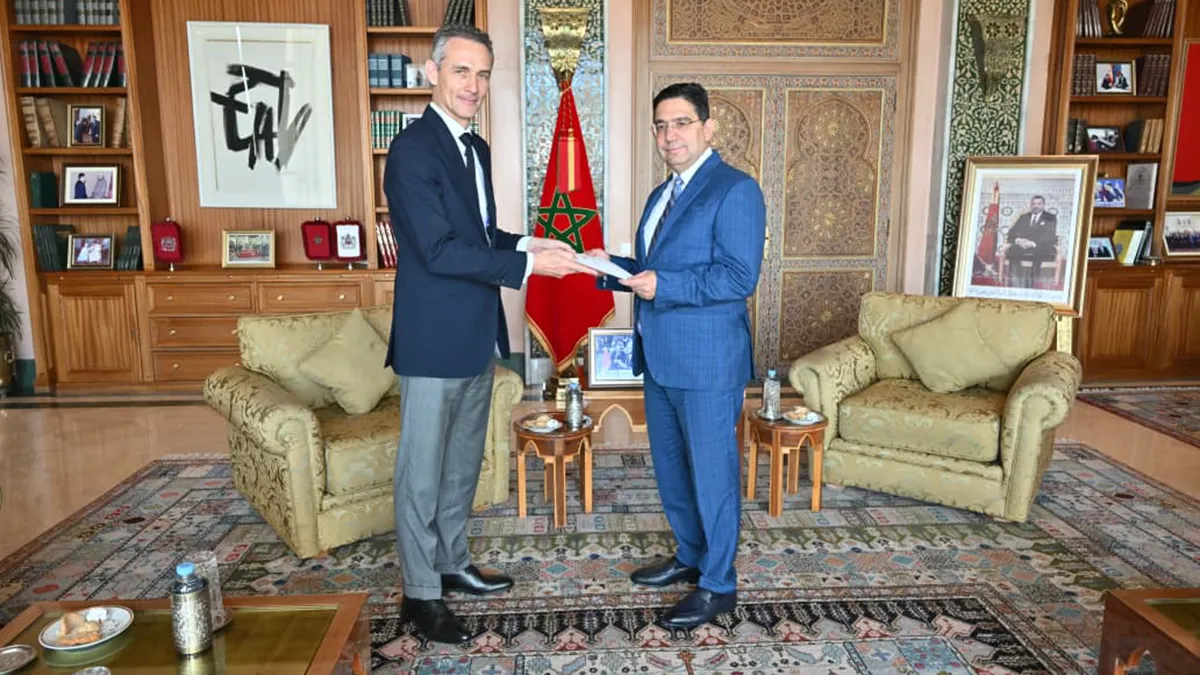
France and Morocco forge strategic partnership through new ambassador Philippe Lalliot
The arrival of France’s new envoy marks a pivotal moment in bilateral relations, with a mission to strengthen economic ties and secure investments ahead of the 2030 World Cup.
- The Sahara factor and the strategic shift in relations
- Investments, infrastructure, and focus on 2030
- Challenges of a new bilateral framework
The appointment of Philippe Lalliot as France’s ambassador to Morocco is no ordinary diplomatic posting. Following his official presentation of credentials to Morocco’s Foreign Minister, Nasser Bourita, Lalliot now faces the critical task of rebuilding a relationship strained by years of political friction and economic uncertainty.
This transition symbolizes more than just the start of a new diplomatic mission—it represents a deliberate effort to reset the bilateral agenda, aligning both nations with shared geopolitical and economic objectives. The stakes are high: France seeks to reassert its influence in North Africa, while Morocco positions itself as a key player in regional stability and development.
This shift comes after a period of heightened tensions, including France’s decision to drastically reduce visa issuance for Moroccan citizens, a move that exacerbated diplomatic gridlock and eroded mutual trust. The absence of high-level exchanges during this time underscored the depth of the rift, leaving both sides to navigate a landscape of missed opportunities and unmet expectations.
The Sahara factor and the strategic shift in relations
A defining moment arrived in 2024 when Emmanuel Macron publicly endorsed Morocco’s autonomy plan for the Western Sahara, aligning France with Rabat’s long-held position. This endorsement was more than a diplomatic gesture—it was a geopolitical realignment that reinforced Morocco’s strategic leverage in the region.
The move was particularly significant given France’s permanent seat on the UN Security Council and its role within the European Union. It signaled a clear departure from previous ambiguity and a commitment to a deeper partnership with Morocco, one rooted in mutual strategic interests.
In the aftermath, bilateral engagement flourished. High-level visits resumed, economic cooperation accelerated, and long-stalled projects found new momentum. The French president’s state visit to Morocco in late 2024 served as a public endorsement of this thaw, with both leaders emphasizing the importance of adapting their relationship to the realities of a changing Africa and Mediterranean.
Yet this rapprochement was not merely a return to the past. Both nations had recalibrated their foreign policies during the years of estrangement. Morocco, in particular, had diversified its alliances, strengthening ties with the United States, Gulf monarchies, and African governments. This strategic pivot allowed Rabat to navigate a more complex international environment with greater autonomy.
For France, maintaining distance from Morocco became increasingly untenable. The cost of disengagement—both politically and economically—was rising, and the shifting sands of regional alliances demanded a more proactive approach.
Investments, infrastructure, and focus on 2030
Lalliot assumes his post at a critical juncture. The economic dimension of the relationship is paramount. French companies remain the largest foreign investors in Morocco, dominating key sectors such as automotive, rail transport, banking, energy transition, and public infrastructure. Morocco also serves as a gateway for French businesses seeking to expand into sub-Saharan Africa, reinforcing its role as a regional hub.
This economic interdependence is set to deepen further with Morocco’s ambitious plans to host the 2030 FIFA World Cup alongside Spain and Portugal. The mega-event presents a golden opportunity for French firms in construction, engineering, and hospitality, with projects already in motion to upgrade infrastructure and modernize facilities.
The appointment of Lalliot, a seasoned diplomat, follows a period of economic realignment. His predecessor, Christophe Lecourtier, was later named head of the French Development Agency (AFD) in Morocco, underscoring France’s commitment to leveraging economic cooperation as a cornerstone of the renewed partnership.
The AFD plays a central role in financing Morocco’s public investment plans, which are accelerating in preparation for 2030. This financial engagement reflects a broader strategy: to intertwine economic growth with diplomatic stability, ensuring that both nations benefit from the momentum of the upcoming tournament.
Challenges of a new bilateral framework
While the diplomatic climate has improved, the relationship is still evolving. Both countries are recalibrating their roles in a rapidly changing regional landscape. France is seeking to redefine its presence in Africa after setbacks in its traditional spheres of influence, while Morocco continues to expand its diplomatic footprint across the Atlantic and Mediterranean.
Security cooperation, migration management, Sahel stability, and trade remain central to the bilateral agenda. These areas offer clear opportunities for collaboration, but they also carry the potential for friction. The true test of Lalliot’s tenure will be his ability to sustain the partnership through inevitable divergences.
Past crises have shown that economic ties alone cannot guarantee stability. Divisions arise when one party feels the other no longer understands or respects its core priorities. The new ambassador will need to navigate these complexities carefully, ensuring that the relationship remains resilient in the face of future challenges.