Gabon harnesses science to boost food sovereignty
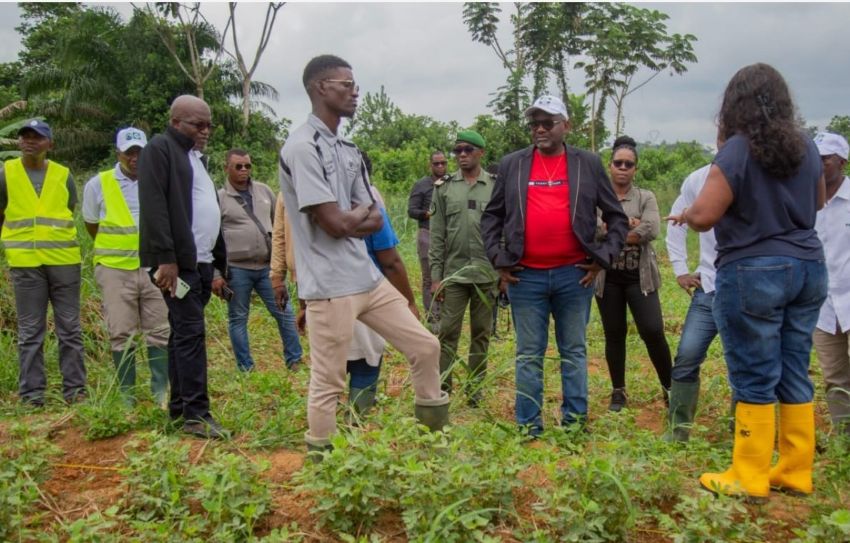
Libreville, June 8, 2024 — A bold initiative is taking shape in Gabon, where science and innovation are becoming key drivers of national economic strategy. As the country aims to slash food import costs by 2027, the battle for agricultural self-sufficiency is being fought not in markets or ports, but in the experimental fields of the National Center for Scientific and Technological Research (CENAREST) in Kougouleu.
The recent visit by the Minister of Higher Education, Scientific Research, and Government Spokesperson, Charles Edgar Mombo, to this facility underscores a fundamental shift: research is now directly fueling economic transformation and national sovereignty. With food imports still draining significant foreign exchange reserves, the ability to produce essential livestock feed locally has become as critical as mining or energy development.
Research as a national engine
The government’s clear goal is to build a robust poultry sector capable of meeting domestic demand while gradually reducing reliance on imported feed. At the heart of this strategy lies a critical challenge: the production of maize and soybeans—the primary ingredients in poultry feed. Until these staples are cultivated locally, the sector’s autonomy remains precarious.
At Kougouleu, CENAREST researchers are tackling this head-on. Eleven maize varieties are undergoing rigorous testing to identify those best suited to Gabon’s unique soil and climate conditions. The focus isn’t just on yield—it’s about finding seeds that can sustain a growing domestic poultry industry over the long term.
Soybean research is also advancing, with eleven varieties introduced through international partnerships with Malawian research centers. Complementary trials are underway in Nyanga Province, particularly in Tchibanga, to assess performance across Gabon’s diverse ecosystems. This approach marks a turning point: science is no longer a detached academic pursuit but a direct contributor to economic development.
Building an integrated agricultural value chain
The government’s strategy hinges on a simple yet powerful idea: producing essential inputs locally to cut production costs and boost the competitiveness of Gabonese farmers. This aligns with a broader trend across Africa, where food import dependence remains a major economic vulnerability.
Gabon, however, holds significant advantages—fertile land, abundant water resources, and favorable climates for multiple crops. Minister Mombo highlighted these strengths, emphasizing the potential already evident in CENAREST’s work. He praised researchers’ dedication and underscored the national higher education system’s role in supporting the president’s strategic vision.
Beyond agriculture, this shift carries political weight. Science is no longer confined to producing knowledge; it is now a frontline tool for achieving national priorities.
The road ahead
Progress is promising but not without hurdles. Researchers stress the need to expand experimental plots to enhance trial quality and scale up production volumes. The leap from scientific experimentation to industrial output is often the most daunting phase.
Financing remains a critical challenge, demanding substantial investments in modern infrastructure, accessible funding mechanisms, and better-organized value chains. Yet for the first time in decades, Gabon appears to be aligning research, agriculture, industry, and economic sovereignty into a cohesive strategy.
The minister’s visit to Kougouleu symbolizes this paradigm shift. In this new vision, food independence won’t stem solely from administrative decisions or investments—it will emerge from laboratories, research centers, and scientific innovation. By 2027, if targets are met, Gabon could prove that in Africa, food sovereignty is built as much by scientists as by farmers—a quiet but potentially transformative evolution for the country’s economic future.

Related Articles