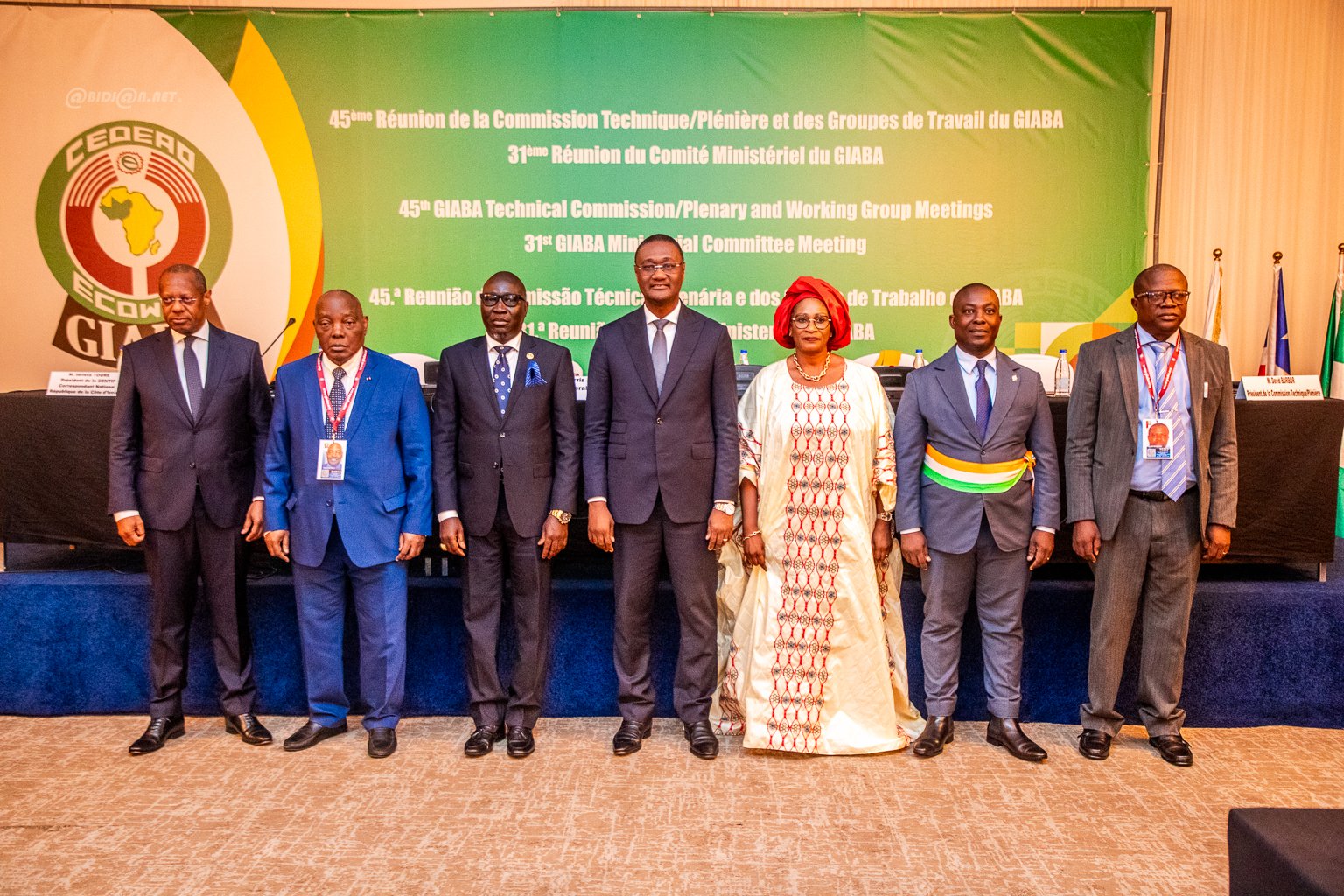
The 45th technical commission and 31st ministerial meeting of the Intergovernmental Action Group against Money Laundering in West Africa (GIABA) opened in Côte d’Ivoire on May 18, 2026, in Cocody, bringing together regional experts, CEDEAO representatives, technical partners, and international observers.
Co-hosted by Côte d’Ivoire, this high-level gathering serves as a key platform for assessing and coordinating anti-money laundering and counter-terrorism financing (AML/CTF) policies across West Africa. During the week-long session, delegates will review mutual evaluation follow-up reports, analyze typology studies from the Risk, Trends and Methods Working Group (RTMG), assess activities of the Financial Intelligence Units Forum (FCRF), and discuss technical assistance mechanisms for member states.
Speaking on behalf of Côte d’Ivoire’s Minister of Economy, Finance and Budget, Minister Moussa Sanogo highlighted the country’s unwavering commitment to strengthening regional financial crime prevention frameworks. ‘Under President Alassane Ouattara’s leadership, Côte d’Ivoire has adopted a methodical, determined and transparent approach to fulfilling its regional responsibilities,’ he stated.
He emphasized ongoing structural reforms aimed at aligning national systems with FATF standards, noting encouraging progress despite the growing sophistication of transnational criminal networks. ‘No country can succeed alone. Our effectiveness relies on information sharing, mutual trust, and sustained political will,’ he stressed, calling financial crime prevention ‘a fight for development, economic stability, and peace.’
Minister Sanogo also underscored the critical role of financial system integrity in boosting regional economic attractiveness and safeguarding both domestic and foreign investments.
Hafsat Abubakar Bakari, Chair of GIABA’s Technical Commission, commended Côte d’Ivoire’s advancements in financial governance and data interoperability for AML/CTF compliance. She pointed to significant technical progress across member states, driven by legislative improvements and modernized Financial Intelligence Units.
However, she warned of emerging threats from cutting-edge technologies—such as generative AI, deepfakes, and synthetic identities—that criminal networks exploit to bypass traditional customer due diligence (KYC) controls. ‘Our detection systems, reporting rules, and investigator training must evolve to counter these new risks,’ she urged.
Bakari also stressed the need for greater transparency around ultimate beneficial ownership as a cornerstone of GIABA’s third-round mutual evaluations. She praised recent progress by Burkina Faso, Mali, and Nigeria—all recently removed from the FATF’s grey list—and encouraged continued technical support for Côte d’Ivoire to accelerate its own exit from the list.
The regional gathering is expected to yield actionable recommendations to reinforce prevention, detection, and enforcement mechanisms against illicit financial flows across the CEDEAO bloc, amid escalating security and technological threats in West Africa.