When a state-run television channel directs its resources toward advancing a political agenda, settling personal scores, or silencing dissent rather than fulfilling its primary role as an information provider, it risks eroding the very trust citizens place in public media.
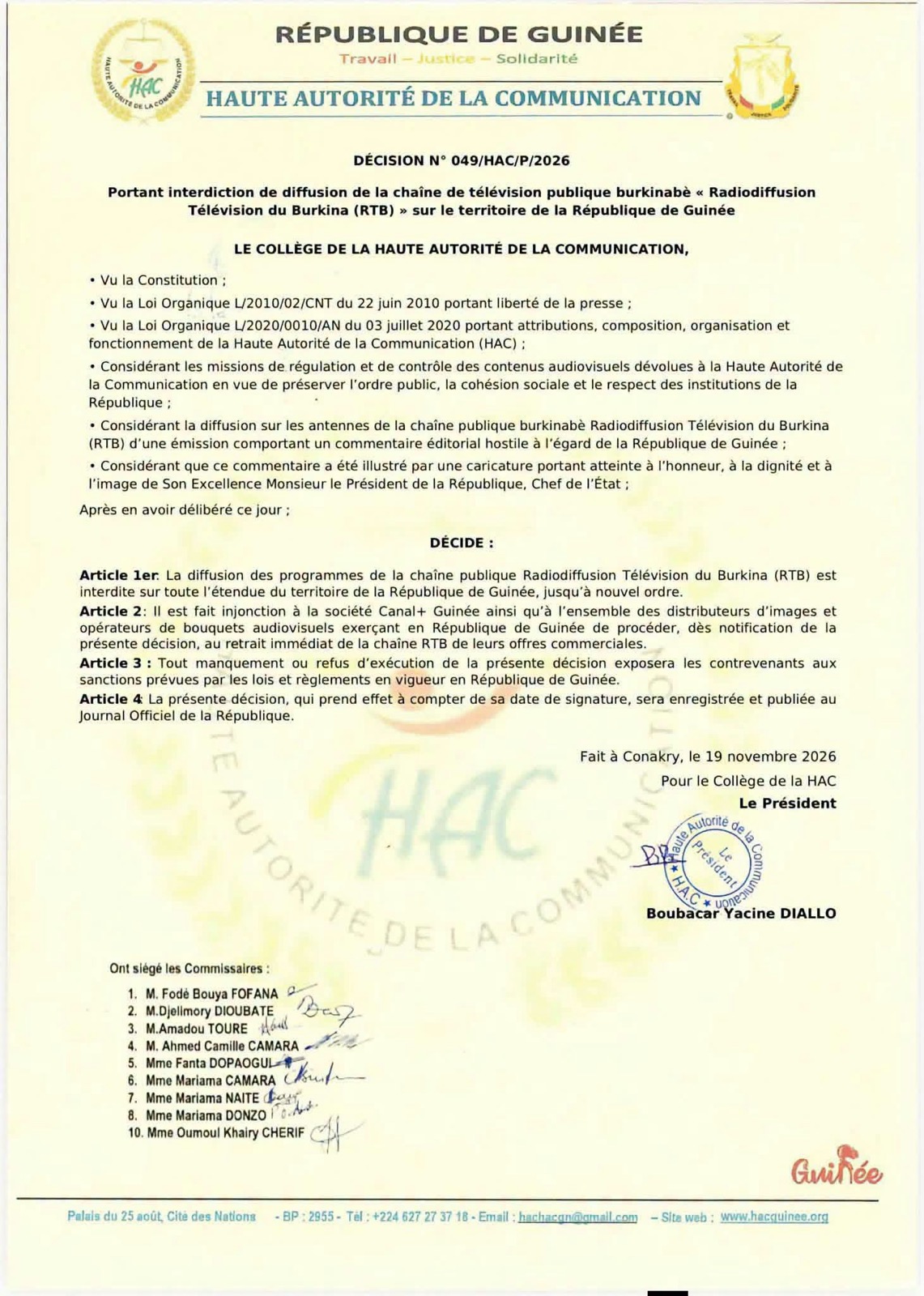
The decision by Guinea’s High Authority of Communication (HAC) to suspend broadcasts of Burkina Faso’s Radiodiffusion Télévision du Burkina (RTB) across the nation raises a pressing issue: what purpose remains for a public broadcaster when its content appears indistinguishable from political advocacy?
Under the leadership of Captain Ibrahim Traoré, RTB was intended to serve as an impartial public audiovisual service, bound by journalistic integrity, balanced reporting, and respect for diverse perspectives. Yet, when political narratives overshadow factual reporting, the distinction between news and propaganda grows dangerously thin.
When journalism yields to political messaging
True public service broadcasting requires more than the transmission of information; it demands rigorous verification of facts, exposure to multiple viewpoints, and the freedom for audiences to form their own conclusions. Systematic disparagement, targeted attacks, and one-sided commentary represent not just a failure of professional standards but a betrayal of the public’s right to truth.
A state-owned television channel must never be co-opted as a regime’s mouthpiece. It belongs to the people, not the leader in power, and its mission must remain the pursuit of the common good regardless of the political climate.
Beyond borders: the broader stakes for African media
This ban serves as a reminder of a deeper concern within African public media: can institutions truly champion national sovereignty and dignity while reducing journalism to a tool for political endorsement?
Media sovereignty cannot be invoked to justify misinformation. Public broadcasters must uphold their role as guardians of transparency, not propagators of state-aligned narratives. The episode in Guinea underscores the fragility of this balance and the urgent need to reclaim the integrity of public information services.
Accountability in the age of politically driven broadcasting
Civil society, regulatory bodies, and citizens alike must demand more from public broadcasters than political allegiance. A media outlet that prioritizes propaganda over truth undermines democratic values and weakens the social contract between government and the governed.
The HAC’s decision to block RTB signals a moment of reckoning not only for Burkina Faso’s media landscape but for the wider expectation that public broadcasters serve the public, not the powers that temporarily hold it.
By AMINA SALEY — Journalist