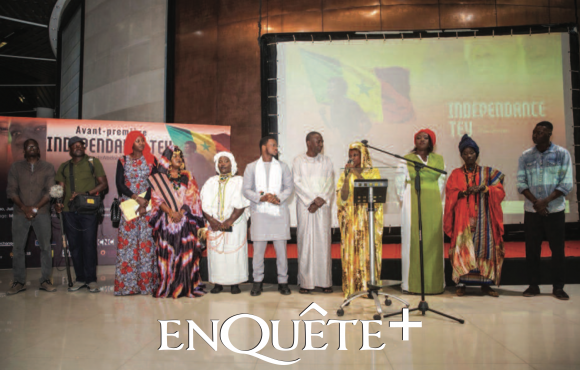
When cinema becomes a mirror of struggle: Independence Tey lights up Dakar
The Musée des Civilisations Noires in Dakar was more than just a venue for the unveiling of Independence Tey. On that evening, the documentary by Senegalese filmmaker Abdou Lahat Fall transformed into a living archive—one that captured not only the political upheavals of a nation but also the raw emotions of its people. The screening, organized by Sine Films and Wawkumba Film in collaboration with FRAPP, the Directorate of Cinematography, and the museum itself, drew a full house of artists, activists, and citizens hungry for reflection.
What unfolded was not merely a film presentation but a collective experience—a fusion of art, politics, and generational dialogue centered on Senegal’s turbulent years between 2019 and 2024. The audience witnessed more than a documentary; they were immersed in a narrative that had already left its mark on the Cinéma du Réel festival’s Front populaire section.
The evening begins with fire: Leuz Diwan G sets the tone
The evening’s opening act was anything but conventional. Rapper Leuz Diwan G took the stage with a performance that blended sharp political commentary, pulsating urban rhythms, and unapologetic resistance anthems. His set was a declaration: Independence Tey was not going to be a detached political analysis but a visceral exploration of a Senegal in transformation, where every voice—especially the youth’s—mattered. The raw energy set the stage for what was to come: a documentary that dared to ask difficult questions about sacrifice, commitment, and the cost of change.
A film rooted in reality: four voices, one struggle
Abdou Lahat Fall’s Independence Tey marks his powerful return to the documentary genre after the acclaimed Migrants, Migrer: The Impossible Return (2018). This time, he embeds himself within the FRAPP movement, documenting the aspirations, fractures, and contradictions of a generation determined to reshape Senegal. The film follows four key figures—Abdoulaye, Bentaleb, Guy Marius Sagna, and Félix—each representing a different facet of activism and its personal toll.
Convictions versus reality: The documentary peels back the layers of political idealism to reveal the human stories behind the headlines. Abdoulaye embodies the idealistic youth, ready to fight for a better Senegal, yet his journey takes a heartbreaking turn when family pressure forces him to leave for Canada, leaving behind dreams and a country still in flux. Bentaleb’s story is one of direct confrontation with state repression—arrests, imprisonment, and the ever-present threat of violence that many activists faced during the years of protest. Guy Marius Sagna’s trajectory raises critical questions about the compromises required when activism enters the political arena, while Félix, the veteran unionist, represents the enduring spirit of those who laid the groundwork for today’s struggles.
The film captures the seismic shifts in Senegal’s political landscape: the oil scandal that ignited nationwide outrage, the mass protests, the pre-election tensions, the crackdowns, and the eventual historic 2024 presidential victory of the opposition. Yet, beyond the headlines, Independence Tey is a deeply personal story. It asks: What does it truly cost to stand up for what you believe in? How do families cope with the uncertainty of a child’s activism? And what happens when the line between resistance and compromise blurs?
The filmmaker’s dilemma: art, activism, and the search for balance
How does one capture a movement’s essence without slipping into propaganda? This question looms large over the film. Abdou Lahat Fall, who began documenting FRAPP in 2019 after the explosive oil contract scandal, admits the challenge: “Filming a movement you believe in is never straightforward.” His approach was one of immersion paired with critical distance. The film’s voice-over often challenges the choices of the movement’s leaders, particularly Guy Marius Sagna’s pivot into electoral politics. This duality—engaged yet critical—gives Independence Tey its depth, transforming it into a nuanced reflection on activism’s complexities rather than a one-sided tribute.
The result is a documentary that feels both intimate and universal. It’s not just about Senegal; it’s about the human condition in times of upheaval. Citing Frantz Fanon’s words—“Each generation must, in relative opacity, confront its mission: to fulfill it or betray it”—the film resonates with anyone who has ever questioned the price of standing up for justice. Independence Tey becomes a mirror for a generation tired of injustice, refusing fatalism, and seeking its own path to liberation, six decades after Senegal’s independence.
A cinematic masterclass in authenticity
Visually, Independence Tey eschews dramatic flourishes in favor of quiet observation. The camera lingers on faces, captures unguarded moments, and lets contradictions breathe. Protests unfold alongside hushed strategic discussions; moments of triumph are juxtaposed with personal doubts. There’s no glorification, only humanity. The film’s strength lies in its refusal to sanitize the movement or its protagonists. Instead, it embraces their flaws, hesitations, and disagreements, making the story all the more compelling.
This authenticity has not gone unnoticed. Independence Tey has already carved its place in the international documentary landscape, selected for prestigious programs like Cinéma du Réel, and supported by institutions such as Sentoo, Produire au Sud, DocA, and the Durban FilmMart. Funding from entities like the CNC, FOPICA, the Francophonie Image Fund, Procirep-Angoa, and Tenk further underscores its significance. Such recognition highlights the growing influence of Senegalese documentary filmmaking on the global stage.
A film that transcends the screen
The Dakar premiere of Independence Tey was more than an event—it was a communal reckoning. The audience left not just with a film to watch but with a conversation to continue. Independence Tey is a testament to the power of cinema as a tool for memory, dialogue, and hope. It’s a portrait of a people in motion, still believing—despite setbacks and sacrifices—that another future is within reach. In the words of the film itself, it’s a story of a generation fighting to define its own independence, long after the nation’s first.