Why recent jihadist attacks raise critical questions about Burkina Faso’s security strategy
As militants execute near-daily ambushes across key regions, a question looms over Burkina Faso: is the country’s counterinsurgency approach losing ground to increasingly bold jihadist operations? The latest claims by the Group for the Support of Islam and Muslims (JNIM) — linked to Al-Qaeda in the Sahel — underscore the growing unpredictability of the conflict, even in areas with heavy military presence.
The JNIM’s double offensive on Wednesday targeted both an armored vehicle near Fada N’Gourma and a civilian defense unit in Bam Province, resulting in three casualties and the seizure of automatic weapons. While these assertions remain unverified, they reflect a persistent and evolving threat that continues to destabilize large parts of the country.
How improvised explosive devices are reshaping the battlefield in eastern Burkina Faso
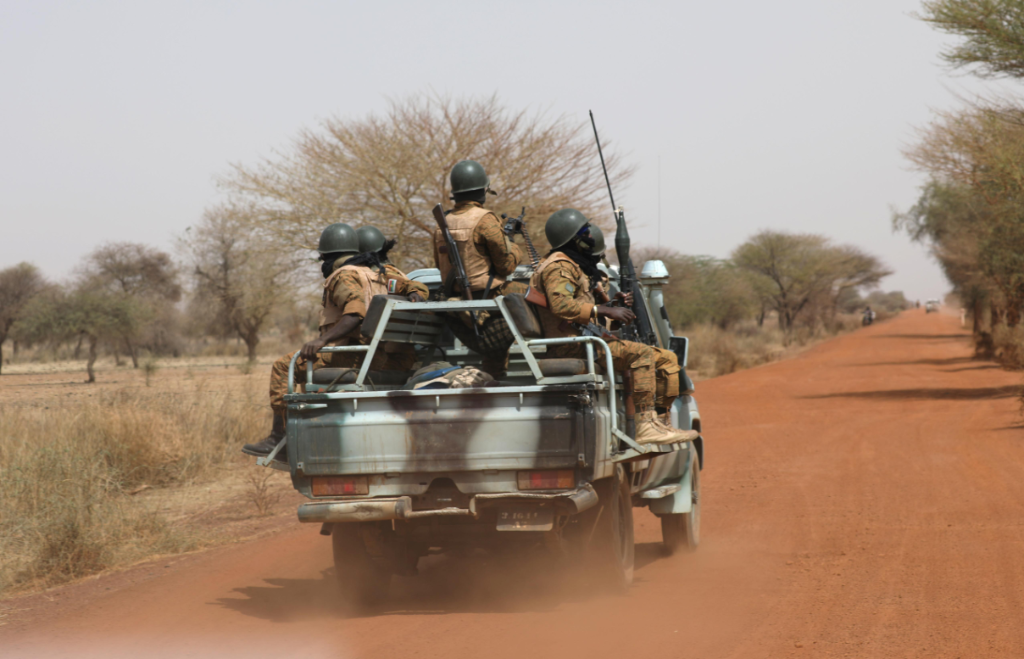
In a strategic communication released this week, the JNIM claimed responsibility for detonating an improvised explosive device against a Burkinabè military armored vehicle just outside Fada N’Gourma, a key transit hub in the East Region. The attack highlights a disturbing trend: jihadist groups are increasingly leveraging explosive devices to counter the mobility of state forces, even when armored protection is in place.
Fada N’Gourma’s location — at the crossroads of major transportation routes — makes it a prime target not only for ambushes but also for broader efforts to disrupt economic lifelines. The surrounding areas have seen heightened insecurity, with armed groups exploiting gaps in surveillance and patrol coverage. Although full confirmation of the armored vehicle’s destruction is still pending, reports suggest significant material damage, raising concerns over the long-term resilience of military convoys.
The invisible war: when IEDs dictate movement across the Sahel
Improvised explosive devices are no longer just a tactical nuisance; they have become a strategic weapon. In the Sahel, these devices are increasingly used to:
- Disrupt supply lines — forcing the military to reroute or delay operations
- Reduce the effectiveness of armored vehicles — despite their protective design
- Weaken civilian morale — by creating an atmosphere of constant fear and unpredictability
While the Burkinabè military continues to adapt, the frequency and precision of these attacks demonstrate that jihadist groups are honing their tactics, often adapting faster than countermeasures can be implemented.
Three civilian defenders killed in Bam: what it means for local security
In a separate operation, the JNIM announced it had ambushed a unit of the Volontaires pour la Défense de la Patrie (VDP) in Bam Province, killing three members and seizing automatic weapons. The VDP, a civilian auxiliary force mobilized to support the national army, plays a vital role in rural defense but remains vulnerable to targeted strikes.
The loss of weapons, if confirmed, raises immediate concerns about the circulation of military-grade arms across conflict zones. Such incidents not only weaken local defense capabilities but also risk fueling further violence, as captured weapons may be redistributed within armed networks.
Although the exact location, circumstances of the attack, and nature of the seized weapons remain unverified, the event underscores the broader challenge facing Burkina Faso: protecting both its forces and civilian allies in terrain increasingly dominated by militant influence.
The escalating human cost of Burkina Faso’s unrelenting insurgency
Beyond the immediate military impact, the crisis has triggered a humanitarian emergency. Over the past several years, violence attributed to jihadist groups has spread across multiple provinces — including the East, North, and Center-North — displacing thousands, disrupting agriculture, and crippling essential services.
Consequences for civilians are severe:
- Communities cut off — villages become isolated due to blocked roads and heightened ambush risks
- Critical services suspended — schools close, health centers operate with limited capacity, and markets struggle to function
- Displaced populations surge — families flee in search of safety, often settling in overcrowded camps with limited resources
As the conflict grinds on, access to food, clean water, and medical care remains a daily struggle. Humanitarian organizations face mounting obstacles in delivering aid, compounded by security risks and restricted access.
Can Burkina Faso regain control? Balancing force with protection and presence
The JNIM’s latest attacks force a fundamental question: can military operations alone restore stability, or does the solution require a deeper transformation in how security is delivered? The persistent violence suggests that defeating armed groups demands more than firepower — it requires intelligence, trust-building, and the restoration of state authority in affected zones.
For authorities, the priorities remain clear:
- Securing transportation corridors — to restore economic flows and civilian movement
- Protecting civilian defenders and communities — especially in rural and remote areas
- Re-establishing public services — ensuring schools, clinics, and markets can function safely
While military operations continue, success hinges on more than just defeating militants — it depends on rebuilding trust, proving deterrence, and demonstrating that the state can protect its citizens in the long term. Until then, the cycle of ambushes and reprisals continues, and the human cost keeps rising.
In the absence of independent verification, the claims made by the JNIM serve as a stark reminder: the battle for Burkina Faso’s future is far from over. And for those living on the frontlines, every day without durable security is another step toward uncertainty and loss.