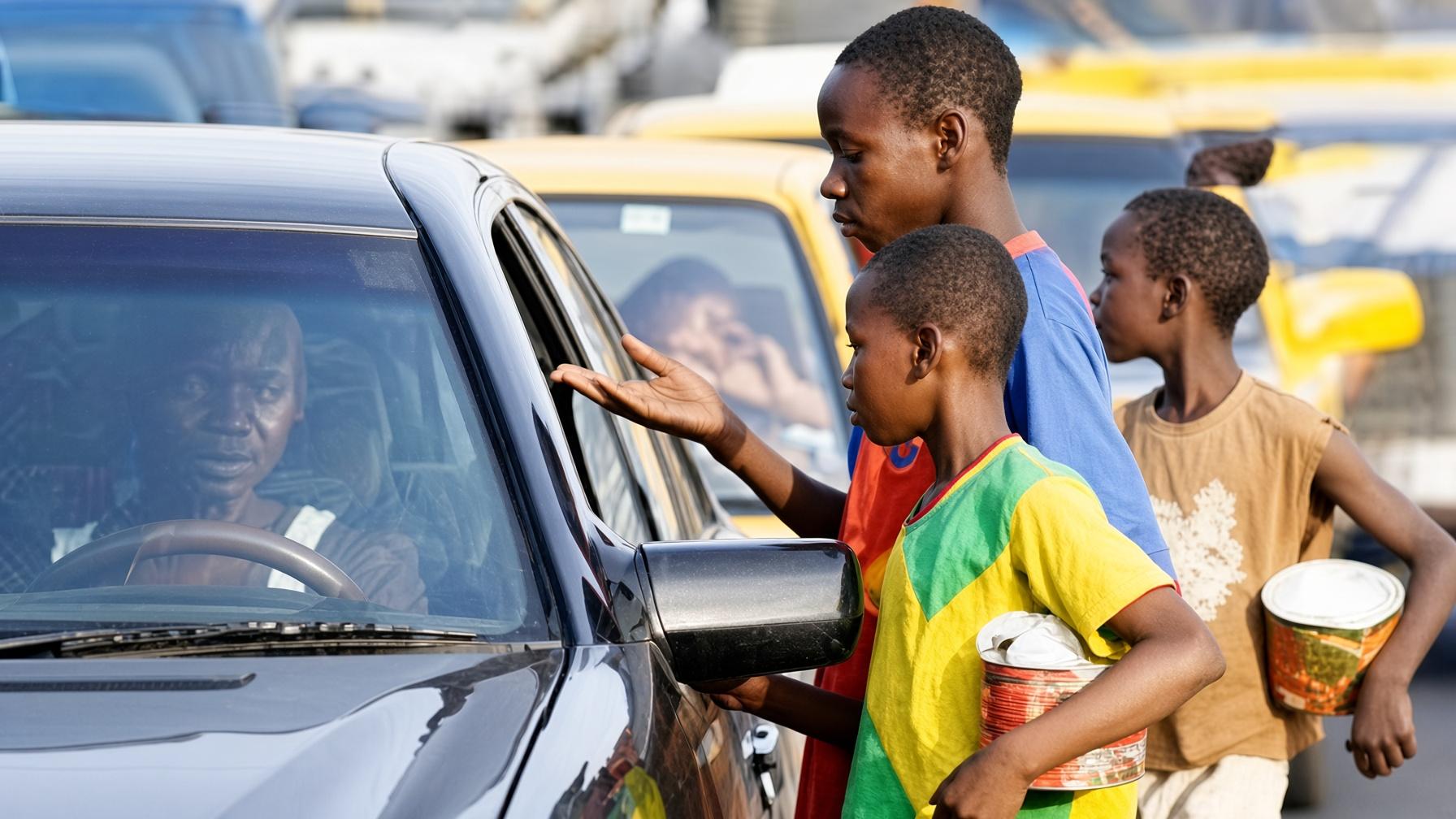
In Bamako, the sight is now an unrelenting, deafening reality. At major intersections, outside government buildings, and before places of worship, thousands of children, people with disabilities, and elderly individuals beg for alms while the public looks away. Despite repeated pledges and public awareness campaigns by the transitional authorities, Mali’s battle against street begging continues to collapse under the weight of the crisis. This sprawling phenomenon lays bare the structural failures of a government adrift, unable to protect its most vulnerable citizens.
The urban plague spreading through Bamako’s streets
In Mali’s capital, begging is no longer a marginal issue—it has become a permanent fixture in the urban landscape. At every traffic light, swarms of young children, often talibés sent by unscrupulous Quranic teachers, dart between vehicles, risking their lives in the chaos. Others, left to fend for themselves, join the desperate tide, multiplying the ranks of the street-bound in plain sight.
The state’s promised interventions—removing children from the streets and bolstering social care—have proven hollow. Rare cleanup campaigns or awareness drives led by the Ministry of Women, Children, and Family fail to gain traction. Without sustainable shelters, sufficient funding, or rigorous follow-up, those intercepted are often back on the streets within hours, absorbed back into the cycle of neglect.
Governance failures: the root cause of Mali’s begging epidemic
The crisis stems not from circumstance, but from deliberate neglect. Mali’s inability to curb street begging reflects deep-seated governance failures and a crumbling socio-economic foundation:
- Collapse of basic social services: Chronic underinvestment in education and social protection has left millions of families in extreme vulnerability. When families cannot afford school fees or access quality free education, many children are abandoned to the streets, where they fall prey to exploitation.
- Unregulated traditional education: Informal Quranic schools operate in near-total opacity. Children are routinely exploited for forced begging, with authorities turning a blind eye under the guise of cultural or religious sensitivity, refusing to enforce laws or penalize violators.
- Misappropriation of public funds: While security spending and institutional maintenance consume massive budgets, allocations for human development and poverty reduction remain pitifully low. Essential social services are starved of resources.
- Corruption and institutional decay: Social programs, often funded through public coffers or international aid, are plagued by opacity and mismanagement. Funds meant for vulnerable groups vanish into bureaucratic morass, diverted by corruption or poor oversight, never reaching those in need.
A ticking time bomb for social and national security
The government’s failure to address this crisis is not merely a humanitarian issue—it is a looming national security threat. Tens of thousands of street children, trapped in illiteracy, abuse, and destitution, are prime targets for criminal networks and armed groups proliferating across the Sahel. Without intervention, these children become recruits, weapons, or informants in a cycle of violence that threatens regional stability.
By ignoring the scale of the disaster and relying on empty rhetoric rather than concrete action, Mali’s leadership is deepening its impasse. Street begging is merely the most visible symptom of a broken social contract. Until there is profound reform in governance and a genuine political will to enforce laws, Mali’s youth will continue to wander its streets, condemned to beg for survival.