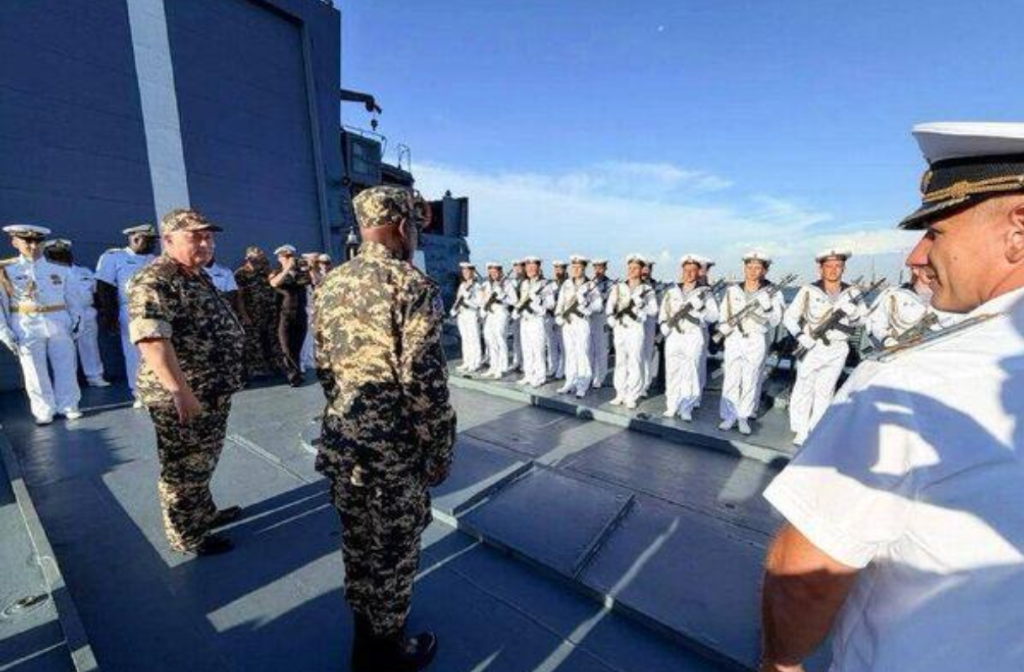
The docking of a Russian naval vessel in Walvis Bay on October 20, 2026, was officially framed as part of a maritime training campaign. Yet beyond the stated goal, this stopover reveals deeper strategic motives tied to naval presence, military diplomacy, and Moscow’s quest for influence across the African continent.
What does this Russian naval stopover in Walvis Bay really signal?
The Perekop, a Russian Baltic Fleet training ship, arrived in Walvis Bay after a seven-day voyage covering over 1,800 nautical miles. Authorities insist the mission is educational, training future naval officers in navigation, route planning, and long-distance sailing.
Such explanations align with the ship’s designated role, but maritime training is never purely academic. Escales provide opportunities for diplomatic engagement, port familiarization, and relationship-building—elements that can extend well beyond the classroom.
Is walvis bay becoming a key logistics hub for russian naval operations?
Walvis Bay occupies a strategic location on Africa’s southwestern Atlantic coast, serving as a critical node for Southern African maritime trade. Its deep-water port supports refueling, maintenance, and logistical support for passing vessels.
For Russia, maintaining strong ties with Namibian port and naval authorities could streamline future ship movements, reduce operational costs, and enhance long-range naval deployments. Without permanent bases in Africa, Moscow relies on strategic port visits and access agreements to project naval power.
Analysts note that while Walvis Bay’s infrastructure is valuable, there is no evidence of a negotiated long-term basing agreement. Only time—and repeated operational visits—would confirm whether this location evolves into a logistical anchor rather than a temporary stop.
Diplomatic signaling through naval visits
The presence of a military vessel is more than a training exercise—it functions as a diplomatic signal. The Perekop’s arrival facilitated high-level meetings between Russian naval representatives, Namibian military officials, and embassy staff.
Such interactions reinforce bilateral defense ties and provide Moscow with a platform to assert its presence in a region where Western influence has traditionally dominated. For Namibia, these engagements may reflect a broader foreign policy strategy aimed at diversifying partnerships.
How does this fit into Russia’s broader african strategy?
Russia has increasingly focused on deepening defense cooperation across Africa, emphasizing arms sales, military training, and logistical support. These efforts serve dual purposes: advancing practical military interests while positioning Moscow as a global power counterbalancing Western dominance.
Naval escales play a pivotal role in this strategy, offering symbolic and practical benefits. They affirm Russia’s reach beyond traditional maritime zones, reinforce diplomatic networks, and create opportunities for future cooperation—even when no immediate agreement is reached.
What are the limits of this naval engagement?
While the Perekop’s visit marks a visible Russian presence, it does not confirm a shift toward permanent military infrastructure in Namibia. A single training mission, even with diplomatic discussions, cannot be equated with a strategic base or covert operations.
True indicators will emerge in the aftermath: repeated Russian naval visits, formal access agreements, or sustained logistical support structures. Until such evidence appears, assessments must remain cautious—acknowledging the potential for deeper engagement without assuming its realization.
The bigger picture: naval power projection in africa
Russia’s African naval activities are not isolated incidents but part of a coordinated effort to expand influence through presence and partnership. Each port call, training campaign, and defense agreement reinforces Moscow’s standing as a maritime actor outside traditional spheres.
Namibia’s Walvis Bay, though not yet a permanent fixture in this network, demonstrates the evolving dynamics of global naval power. The long-term implications will depend on how both Russia and regional states choose to develop these engagements—whether as transient opportunities or foundational elements of a broader strategic alignment.