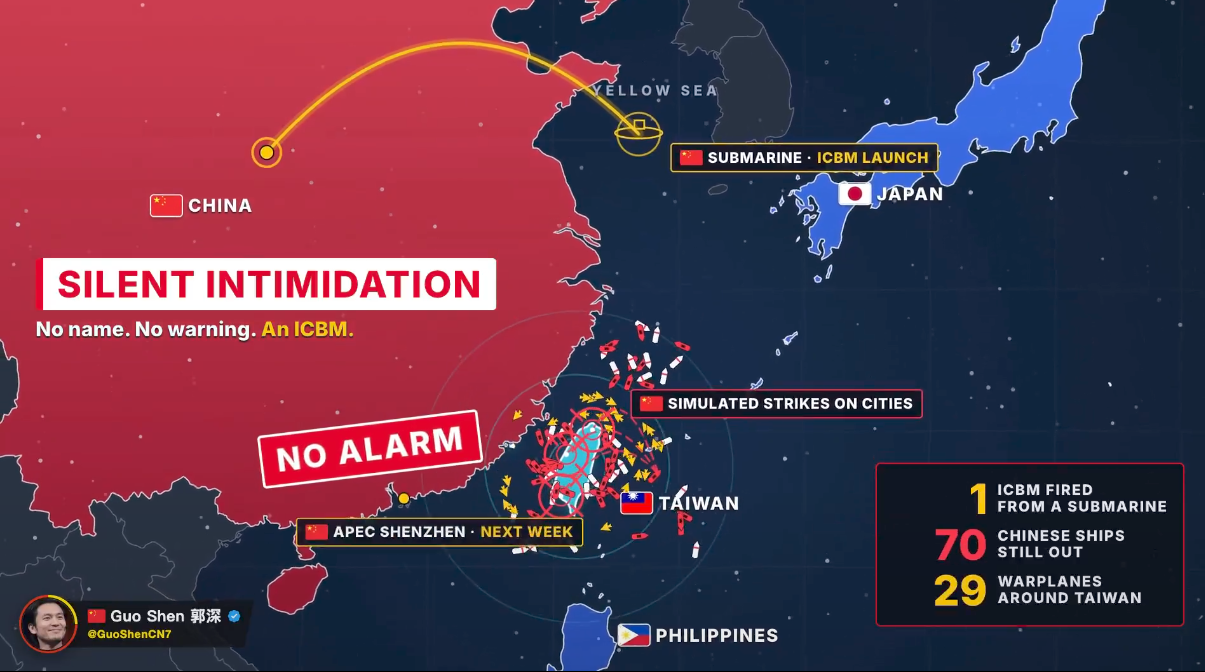
As tensions escalate in the Western Pacific, a critical question arises: Could recent military maneuvers near Taiwan be a prelude to a larger confrontation? In early November, over 100 Chinese naval and coast guard vessels were deployed in a sweeping military operation around Taiwan and neighboring waters. The timing of this massive show of force, combined with the appearance of a specialized U.S. aircraft, has left analysts and policymakers grappling with its true purpose.
China’s unprecedented naval display near Taiwan
Taipei’s defense officials confirmed the mobilization of more than 100 Chinese warships and coast guard vessels in a coordinated naval exercise that extended far beyond the Taiwan Strait. This operation, conducted without prior official announcement, marked one of the most extensive naval displays by Beijing in recent years. Ships from all three of China’s main naval commands—Northern, Eastern, and Southern—participated, indicating a high level of strategic coordination.
According to defense sources, these maneuvers included simulated attacks on military targets and coastal cities, raising concerns about China’s readiness to impose a blockade or restrict maritime access to Taiwan. Such a scenario would allow Beijing to cut off the island’s supply lines and limit external military support, exerting immense pressure without necessarily launching a full-scale invasion.
Could China be rehearsing a strategy of isolation?
Military analysts point out that these exercises resemble a blueprint for anti-access/area denial (A2/AD) tactics. By controlling key maritime and air corridors, China could effectively deny Taiwan the ability to import critical resources or receive reinforcements. The Institute for the Study of War has highlighted how such maneuvers could serve as a rehearsal for a potential blockade, a strategy that would have devastating economic and strategic consequences for Taipei.
For Japan, which lies just across the East China Sea, these developments are equally alarming. The proximity of the exercises to Japanese waters underscores the regional stakes, with Tokyo and Washington both closely monitoring Beijing’s next moves.
What role is the U.S. playing in this high-stakes game?
Amidst the naval buildup, a distinctive aircraft entered the picture. On November 15, reports emerged of a WC-135R Constant Phoenix—an aircraft operated by the U.S. Air Force and nicknamed the “Nuclear Sniffer”—flying from Okinawa toward the southwestern approaches of the Taiwan Strait. Equipped to detect traces of radioactive particles in the atmosphere, this aircraft is typically deployed to monitor nuclear tests or identify radiological incidents.
While no official confirmation has been provided regarding its mission, the timing of its deployment has fueled speculation. Was it dispatched to gather intelligence on China’s recent military activities? Or was it simply part of routine surveillance in a region where nuclear and conventional capabilities increasingly intersect? The absence of clear explanations only deepens the uncertainty surrounding U.S. intentions.
Taiwan: The flashpoint that could reshape global security
The stakes extend far beyond the Taiwan Strait. The island plays a pivotal role in global supply chains, particularly in the production of advanced semiconductors, which are essential to industries from smartphones to defense systems. A prolonged crisis or military blockade could disrupt these flows, sending shockwaves through the global economy and exacerbating tensions between superpowers.
Beijing has long maintained that Taiwan is a core part of its territory, and while it has not yet ruled out the use of force, diplomatic efforts remain ongoing. For Taipei, maintaining autonomy hinges on deterring aggression while avoiding provocation that could escalate into conflict. The recent naval exercises and U.S. surveillance activities only complicate this delicate balance.
Navigating a tinderbox: What comes next?
At present, there is no evidence to suggest that a Chinese invasion is imminent. However, the scale of the naval deployment, the rehearsal of blockade scenarios, and the heightened U.S. surveillance all point to a region on the brink. The Western Pacific has become a theater of strategic confrontation, where every movement is scrutinized, and miscalculations could have consequences far beyond the immediate area.
One thing is clear: the dynamics around Taiwan will continue to shape the power struggle between Beijing and Washington for years to come. Whether through naval exercises, aerial surveillance, or diplomatic maneuvering, the stage is set for a high-stakes showdown that could redefine global security.