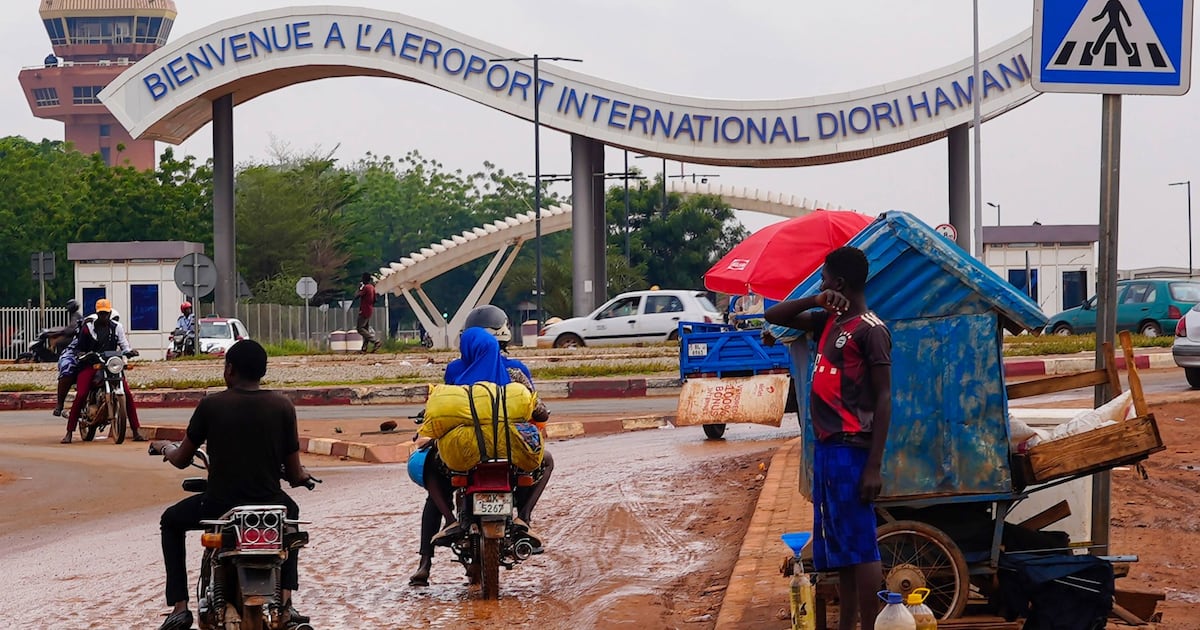
In a rare strike on Niger’s capital, the area around Diori Hamani international airport in Niamey was rocked by heavy gunfire and explosions shortly after midnight between January 28 and 29. The Islamic State in the Sahel (EIS) claimed responsibility for the assault two days later through its propaganda arm, AMAQ.
According to Nigerien authorities, the attack was repelled after approximately one hour following a combined air and ground response. The official report, which cannot be independently verified, stated that twenty attackers were killed, eleven were captured, and four Nigerien soldiers sustained injuries. On February 2, Russia’s Ministry of Foreign Affairs confirmed that personnel from the Africa Corps, a unit under the Russian Ministry of Defence, were involved in securing the site alongside Niger’s forces.
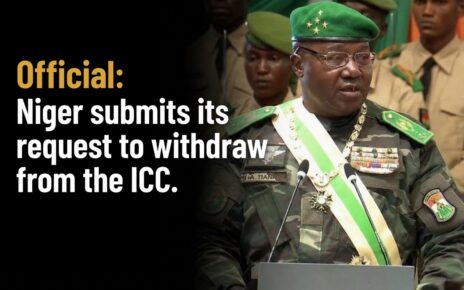
The head of the junta, General Abdourahamane Tiani, praised what he called “the professionalism of the Russian partners” operating within their designated “security sector” at the airport complex. This area includes the critical Air Base 101, a cornerstone of Niger’s military infrastructure.
EIS releases propaganda video of the attack
Further escalating the situation, the Islamic State in the Sahel released a video on February 2, purportedly filmed during the raid. The footage, bearing the AMAQ logo, depicts dozens of armed militants, some on motorcycles, advancing through the airport’s military zone.
The video shows assailants moving toward hangars, opening fire, and starting blazes. Two small aircraft and a helicopter are seen with damage; this equipment is consistent with assets used by the Nigerien army in its fight against jihadist groups. Satellite imagery taken after the incident corroborates the presence of partially scorched areas near the runway.
The footage then pans to the civilian section of the airport. The attackers are seen filming commercial airplanes parked on the tarmac, including aircraft from Asky and Air Côte d’Ivoire. Nigerien officials had previously acknowledged damage to three civilian planes and mentioned that “damaged equipment, including a munitions stock, caught fire,” without providing further details.
Niamey emerges as a new jihadist frontline
While Niger has been grappling with violence from both the Al-Qaïda-affiliated Group for the Support of Islam and Muslims (JNIM) and EIS in its western and southeastern regions for a decade, direct attacks on the capital have been exceptional. This latest incident follows a JNIM claim for the destruction of a military vehicle just east of Niamey, signaling increasing pressure on the central government. This event provides crucial context for any in-depth Sahel analysis in English.
This surge in jihadist activity coincides with a significant overhaul of Niger’s security alliances by the ruling military regime. Since the coup on July 26, 2023, Niamey has pivoted towards Moscow while severing ties with several Western partners. Following the mandated departure of French forces in late 2023, the United States also withdrew the majority of its military presence in 2024, although diplomatic channels remain open.
Sweeping accusations and diplomatic friction
In a confrontational speech, General Tiani accused France, Bénin, and Côte d’Ivoire of having “sponsored” the attack. These allegations were immediately condemned by both Abidjan and Cotonou. In response, Côte d’Ivoire summoned Niger’s ambassador, protesting what it termed “grave” statements that could harm bilateral relations.
Approximately 300 Italian soldiers, part of the Italian Support Mission in Niger (MISIN), are also stationed at the site. Italy’s Minister of Defence, Guido Crosetto, affirmed that his troops “were not involved in any way” in the fighting, emphasizing that their security remains the highest priority.
A highly sensitive location
Beyond its symbolic importance, Niamey’s airport is a hub of strategic assets. It serves as an air base, the headquarters for the joint military force of Niger, Mali, and Burkina Faso, and a storage site for a significant shipment of uranium concentrate. This uranium stock, the subject of a dispute with the French group Orano, could potentially be transferred to Russia, as Niamey has yet to finalize a logistical solution for its transport. Such developments are key for those following West Africa insider news.
Despite the attack, air traffic resumed the following day, and a sense of normalcy quickly returned to the surrounding neighborhoods. However, the event marks a significant turning point. By striking the logistical and military heart of the capital, EIS demonstrated its disruptive capabilities. Simultaneously, the direct involvement of Russian forces confirms Niger’s security realignment, a move that risks fueling further regional tensions and is a focal point of current Sahel politics.