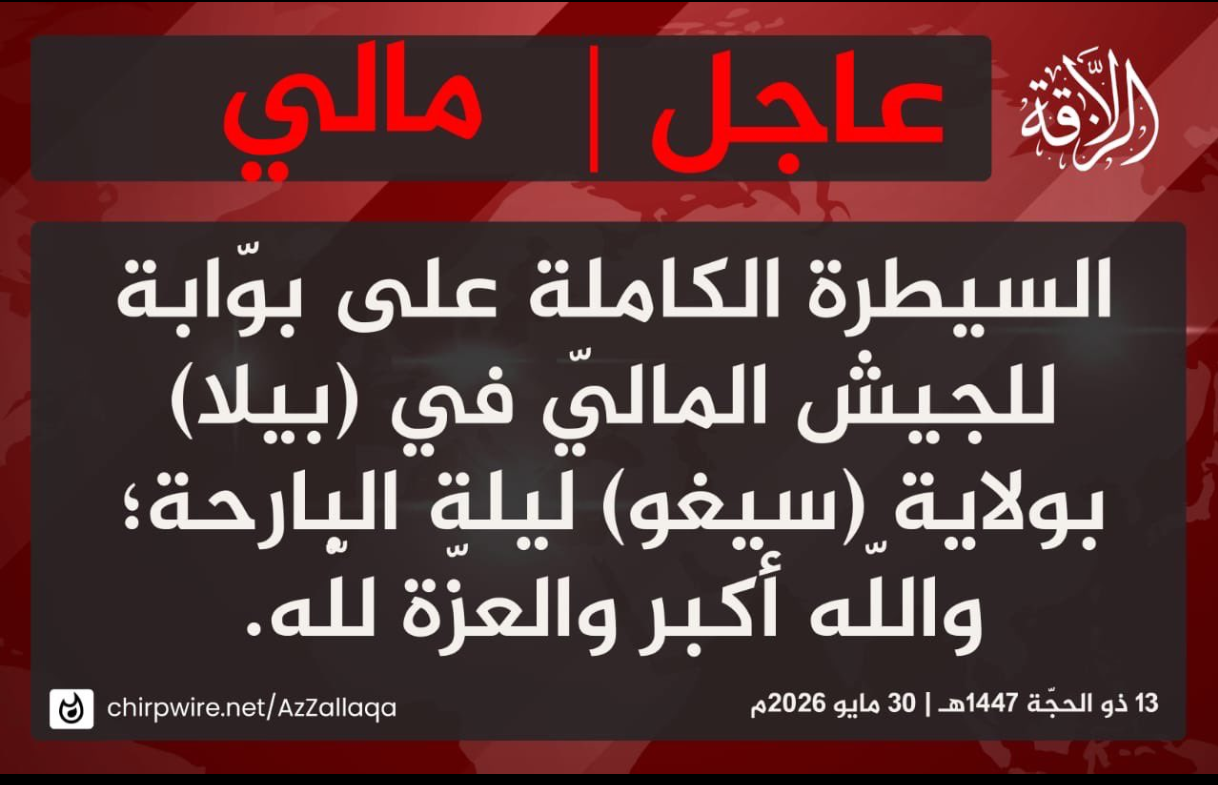
Night of terror in Ségou: jihadists seize military post, leaving devastation in their wake
Between the 29th and 30th of May, the Support Group for Islam and Muslims (JNIM), an al-Qaïda-linked militant faction, launched a daring assault on a Malian military outpost in the Ségou region. According to the group’s propaganda channels, their fighters overwhelmed the position, seizing control temporarily and making off with a substantial cache of weapons and ammunition.
The attack underscores the growing boldness of jihadist groups in Mali’s heartland, where insecurity has escalated despite military rule in Bamako. While local reports confirm intense overnight clashes, the full extent of the damage—both in terms of military losses and civilian casualties—remains shrouded in uncertainty. What is clear, however, is that this latest strike exposes the persistent vulnerability of even the most heavily fortified zones in central Mali.
Security strategy in tatters: why the Russian partnership is failing
The Malian junta’s promise of a decisive military victory has been repeatedly undermined by the realities of an asymmetrical war. Since the abrupt departure of Western forces and the integration of Russian military advisors and mercenaries—often associated with the Wagner Group—the situation has only deteriorated. Airstrikes and large-scale operations have failed to curb the mobility and resilience of jihadist cells, which continue to exploit gaps in the country’s defenses.
The JNIM’s ability to carry out coordinated raids, such as the one in Ségou, highlights the limitations of this approach. Rather than gaining ground, the Malian army and its Russian allies appear increasingly overwhelmed, unable to predict or prevent the next assault. The result? A widening security void that shows no signs of being filled by Bamako’s current strategy.
Food as a weapon: how jihadists weaponize famine in Mali
The security vacuum is not just a military concern—it is a humanitarian catastrophe in the making. The Ségou region, once a vital agricultural hub due to its proximity to the River Niger, now faces severe food shortages as a direct consequence of the conflict. Fields lie fallow, livestock markets are looted, and roads are frequently blocked by improvised explosive devices (IEDs), cutting off supply routes to urban centers.
Civilians, caught between armed groups and state neglect, are paying the heaviest price. With no access to their land and no reliable aid reaching them, hunger has become yet another tool of war. The Malian state’s failure to address this crisis—despite its focus on military campaigns—has left thousands on the brink of starvation, with little hope of immediate relief.
Displacement crisis: civilians flee as violence and hunger spread
The dual threats of violence and famine have triggered mass internal displacement in Mali. Entire villages in the Ségou region have been emptied as families flee toward perceived safer havens, often Bamako or other urban areas. These displaced populations now languish in overcrowded, makeshift camps, lacking even the most basic sanitation and medical facilities.
Women and children bear the brunt of this crisis, abandoned by a state that prioritizes military expenditures over social services. With local NGOs stretched to their limits, the humanitarian toll continues to mount, painting a grim picture of a nation sinking deeper into chaos with each passing day.
Beyond the battlefield: the junta’s losing battle for Mali’s future
The JNIM’s latest attack in Ségou serves as a stark reminder: the junta’s narrative of a strengthening military is colliding with the harsh truth of a war that refuses to end. By relying solely on military force and an ineffective foreign partnership, Bamako has neglected the broader pillars of stability—protecting civilians, restoring essential services, and combating hunger.
Unless a holistic strategy is adopted—one that addresses both security and human needs—the fabric of Malian society risks unraveling entirely. The cost of inaction is already visible: a country trapped in a cycle of violence, displacement, and despair, with no clear path to recovery in sight.