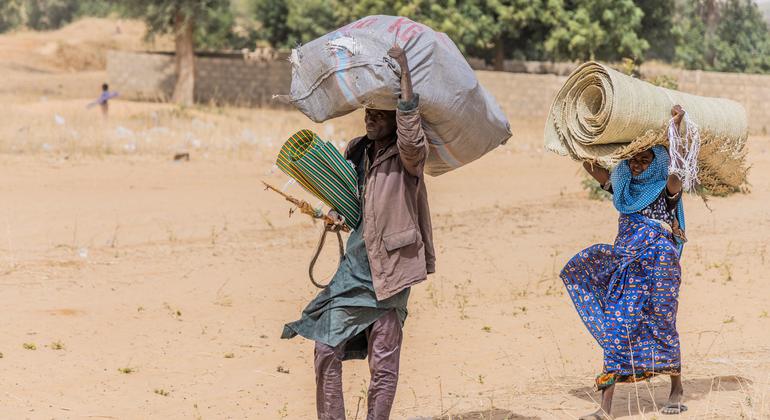
Nigeria faces an escalating wave of violence that transcends religious divides, thrusting the nation into a humanitarian emergency that receives far too little global attention. Recent months have seen a surge in attacks on schools, villages, and worshippers—whether in churches or mosques—prompting the United States to launch targeted airstrikes on Christmas Day against jihadist positions in the north. Washington framed the operation as protection for Christian communities, but the broader reality reveals a far more complex and devastating crisis.
a crisis that defies religious boundaries
While headlines often highlight attacks on Christian communities, the violence in Nigeria is not confined to any single group. More than 40,000 people have lost their lives since the insurgency began in 2009, with the vast majority of victims being Muslims targeted in mosques. In Maiduguri, a city at the heart of the conflict, a pre-Christmas attack struck an area near both a mosque and a market, killing worshippers as they left prayer. The United Nations cautions against framing the violence as a targeted “Christian genocide”, emphasizing that the threat is indiscriminate and widespread.
Mohamed Malik Fall, the UN’s humanitarian coordinator in Nigeria, underscores this point: “Security is a challenge that no longer affects just one region—it’s a national crisis.”
from boko haram to banditry: a crisis that has evolved
The conflict originated in Nigeria’s northeast with Boko Haram, a jihadist group whose insurgency has since splintered into factions, including the Islamic State’s West Africa Province. Nearly two decades later, the violence has metastasized. Over two million people remain displaced, with entire generations growing up in camps, disconnected from education, healthcare, and economic opportunities. Thousands of schools and health centers lie in ruins, and fertile farmlands have become inaccessible, pushing millions toward food insecurity.
Meanwhile, the northwest has seen the rise of criminal gangs—labeled “bandits” by authorities—who engage in mass abductions, looting, and extortion. Zamfara, Katsina, and Sokoto states have been particularly hard-hit, with nearly a million people displaced. In central Nigeria, clashes between farmers and herders, fueled by climate change and land disputes, have triggered further displacement. Even the southern regions are not spared, where separatist movements and oil-related sabotage add to the instability.
With approximately 3.5 million internally displaced persons, Nigeria accounts for nearly 10% of Africa’s total displaced population.
humanitarian needs outpace funding and support
Beneath the security crisis lies a humanitarian emergency of staggering proportions. In the northeast alone, 7.2 million people require assistance, including 6 million in severe or critical need. Acute malnutrition threatens over 3.5 million children under five, with long-term consequences for cognitive development and education. Cholera and meningitis outbreaks, compounded by recurring droughts and floods, further strain a weakened healthcare system.
Yet funding has plummeted. A few years ago, the humanitarian response plan exceeded $1 billion annually. In 2024, it dropped to $585 million, and last year fell to just $262 million. Projections for this year suggest it may not even reach $200 million.
a call for local leadership and sustainable solutions
Nigeria’s paradox is striking: one of Africa’s largest economies is grappling with a humanitarian disaster of its scale. The UN stresses that while international support is vital, the primary responsibility lies with Nigeria’s government. The focus must shift from emergency aid to sustainable development—helping communities regain economic independence rather than fostering dependency.
As Mohamed Malik Fall notes, “No community thrives on aid alone.” The goal is not to give fish, but to teach how to fish—empowering Nigerians to rebuild their lives with dignity and resilience.