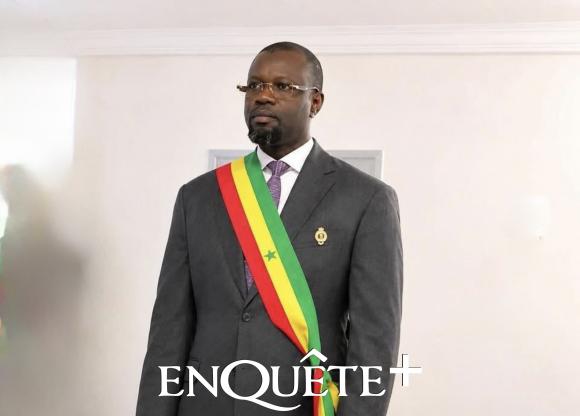
Opposition challenges Sonko’s reintegration and election as Assembly president
The opposition in the National Assembly has escalated its legal battle by filing a petition with the Constitutional Council to challenge Ousmane Sonko’s reintegration as a deputy, a prerequisite for his election as President of the Assembly. The move marks a new institutional confrontation with far-reaching implications.
Constitutional violations alleged
In a joint statement, a coalition of opposition lawmakers asserted that Sonko’s reintegration violated constitutional provisions, specifically Article 54, which governs parliamentary mandates and government positions. They argued that his prior role as Prime Minister created an incompatibilité (incompatibility) that automatically terminated his parliamentary seat upon assuming government duties. The opposition contends that his subsequent reinstatement contravenes the principles of separation of powers and constitutional governance.
The petitioners further emphasized procedural irregularities, claiming they were denied access to critical documents—including the reinstatement decree and the plenary session minutes of May 26—despite formal requests. These documents were obtained only after serving formal summons, a process the opposition described as an obstruction of democratic transparency.
A political earthquake reshapes the Assembly
Sonko’s dramatic return to the Assembly unfolded against a backdrop of political upheaval. Dismissed as Prime Minister on May 22, he was swiftly re-elected as a deputy and, within days, secured the Assembly presidency with 132 out of 133 votes. The vote, boycotted by opposition lawmakers, was denounced as an unconstitutional maneuver by critics who warned of institutional overreach.
Legal ambiguity clouds the path forward
Legal scholars remain divided on the merits of the opposition’s case. While some argue Article 54 does not explicitly address reinstatement or suspension, others point to Article 123 of the Assembly’s internal regulations, which permits the replacement of deputies appointed to government roles. A critical unresolved question is whether lawmakers possess the standing to file such a petition directly with the Constitutional Council—a power traditionally reserved for the President of the Republic. The presidency has yet to confirm any involvement in the matter.
The Constitutional Council now faces a pivotal decision: whether to accept the opposition’s petition and, if so, how to interpret the constitutional and procedural disputes at the heart of this institutional crisis.