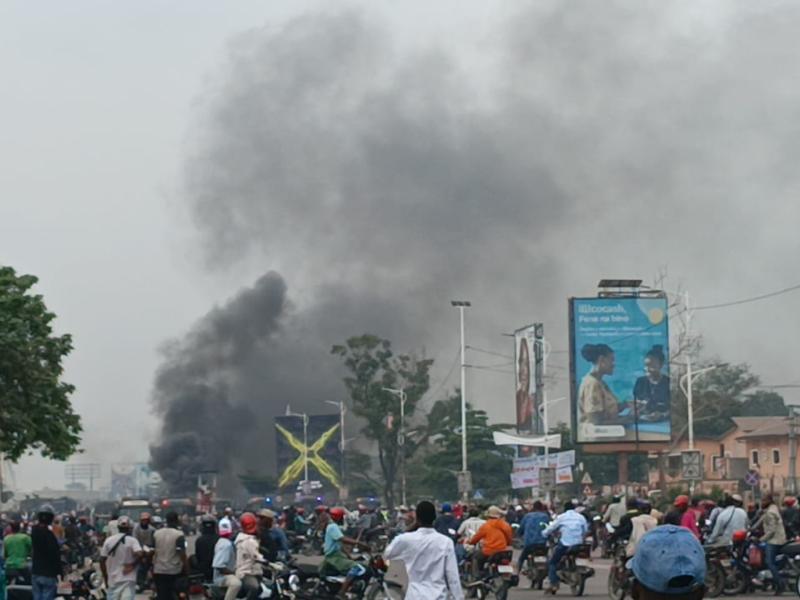
The Democratic Republic of Congo is bracing for a tense political showdown as the Coalition article 64 (C64) prepares to stage a major demonstration on July 22 in Kinshasa. The march, which will culminate at the Palais de la Nation, demands the resignation of President Félix Tshisekedi, accusing him of constitutional betrayal following revelations about his plans to amend the 2006 constitution.
The political landscape has become increasingly volatile, with two prominent figures within the presidential majority—Augustin Kabuya and André Mbata—publicly clashing over the appropriate response to the opposition’s planned protest. Kabuya, Secretary-General of the ruling Union pour la démocratie et le progrès social (UDPS), has urged party members to avoid the march routes, calling for normal business operations instead. His stance has drawn sharp criticism from Mbata, Permanent Secretary of the Union sacrée de la nation (USN), who has openly endorsed counter-protests across Kinshasa and all 25 provinces.
a clash of strategies and egos
Mbata, currently on an official visit to Yaoundé, Cameroon, issued a strongly worded statement on July 13, instructing all USN-affiliated parties, associations, and individuals to mobilize against what he describes as an attempted coup d’état. His call for counter-mobilization was met with immediate pushback from Kabuya, who released a terse communiqué just 48 hours later, urging UDPS members to disregard the opposition’s protest entirely.
Mbata’s fiery response
In a scathing rebuttal, Mbata accused Kabuya of overstepping his authority, asserting that the USN cannot be reduced to a single party’s agenda. “A premature and clumsy statement by the head of a party, political grouping, or association within the USN only represents that individual,” Mbata declared. He further condemned the silence of the presidential platform, arguing that the opposition’s actions threaten the legitimacy of a democratically elected leader.
Kabuya’s directive for UDPS members to stay away from the march routes has only fueled Mbata’s defiance. The Permanent Secretary emphasized that the USN’s official communications should come exclusively from its spokesperson, reinforcing his position as the platform’s sole authorized voice.
old wounds resurface
The simmering rivalry between the two leaders is not new. In April 2024, Mbata publicly opposed Kabuya’s candidate during the gubernatorial election in Sankuru Province, throwing his support behind Jules Lodi Emongo instead. The election outcome—a victory for Emongo—marked a significant setback for Kabuya, who retaliated by instructing UDPS members to stop paying dues to Mbata, claiming he was no longer authorized to collect them.
The latest episode underscores the deepening fractures within the Union sacrée de la nation, a coalition that was once united behind President Tshisekedi’s agenda. With the 2028 elections looming and Tshisekedi’s second and final term drawing to a close, internal power struggles are threatening to destabilize the ruling alliance.
As Kinshasa awaits the C64 march, the political climate remains charged, with both sides digging in their heels. The coming weeks will be critical in determining whether the ruling majority can present a united front—or if the cracks within it will widen further.