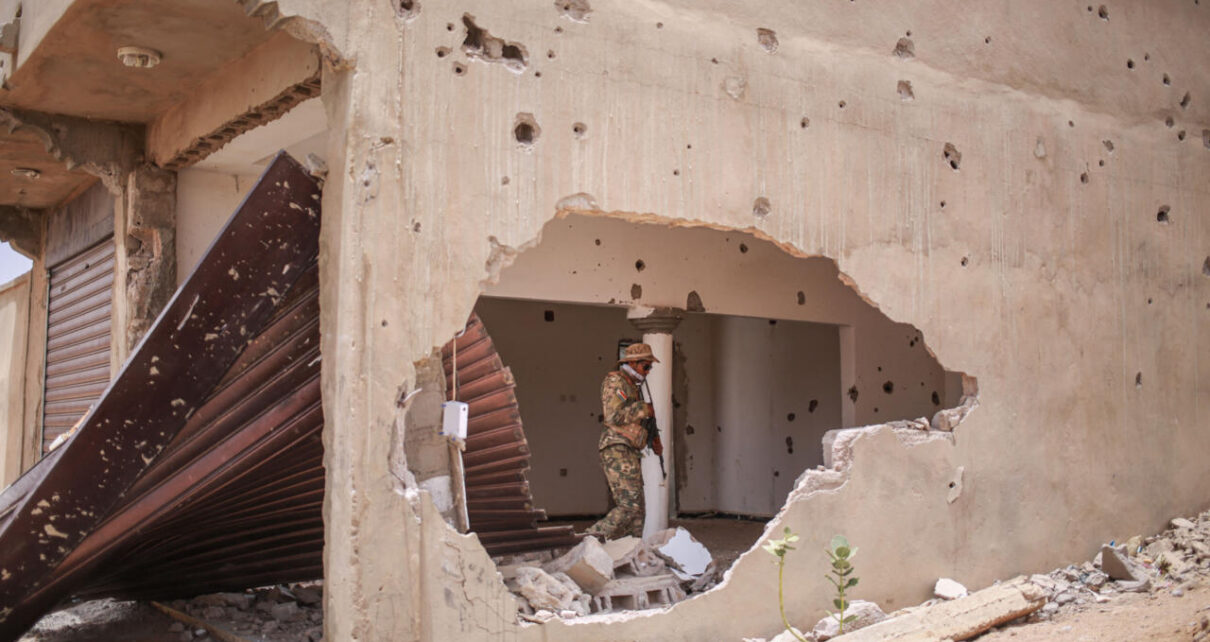
The recent coordinated attacks in northern Mali on April 25, which resulted in the death of Defense Minister General Sadio Camara and the fall of Kidal to armed groups, have exposed critical weaknesses in the country’s security framework. A new analysis released by the Timbuktu Institute, a Senegal-based African research center for peace, titled “Mali: Anatomy of a Security Earthquake”, questions the effectiveness of the Malian government’s reliance on external partners, particularly Russia’s Africa Corps, and the Alliance of Sahel States (AES).
Russia’s security outsourcing fails in Mali
Bakary Sambe, Director of the Timbuktu Institute in Dakar, argues that the April 25 attacks symbolize the collapse of the myth surrounding security outsourcing to Russia. The chaotic withdrawal of Africa Corps forces from Kidal and the death of General Camara highlight the inability of Moscow’s private military contractors to counter locally entrenched insurgencies. Sambe notes that after the withdrawal of France’s Barkhane force, which included civil-military and development aspects, outsourcing security to Moscow has proven ineffective against a guerrilla movement deeply rooted in Malian society.
The analyst points out that while Africa Corps remains present alongside Malian troops, recent events such as the debacle in Kidal and the retreat from Tessalit demonstrate the inadequacy of externalized security solutions. These failures underscore that security outsourcing has not worked in Mali, leaving the transitional regime in Bamako with a weakened strategic narrative centered on security restoration.
Alliance of Sahel States falls short in solidarity
The attacks have also tested the solidarity of the AES, a regional defense pact modeled after NATO’s Article 5. Sambe explains that despite declarations of support from leaders like Burkina Faso’s President Traoré, who referred to a “monstrous conspiracy,” no military assistance materialized. This lack of cohesion stems from the fact that AES member states—Burkina Faso, Niger, and Mali—are grappling with their own internal security crises, leaving little capacity to respond to external threats.
The analyst emphasizes that the AES’s failure to mobilize during the crisis reveals its limitations as a unified defense mechanism. While Mali faces mounting pressure from insurgent groups, neighboring countries are prioritizing their domestic stability, further straining regional security cooperation.
Paradoxical public support for the transitional regime
Despite the security setbacks, Sambe observes a paradoxical shift in public opinion in Mali. The attacks, reminiscent of the 2012 crisis when armed groups swiftly captured northern cities, have paradoxically reinforced national unity behind the transitional government led by General Assimi Goïta. The regime’s legitimacy hinges almost entirely on its security promises, and the crisis has temporarily consolidated support, creating a “rallying around the flag” effect that analysts outside the region struggle to comprehend.
Jihadist and separatist alliance: a fragile partnership
The April 25 attacks marked an unprecedented tactical alliance between jihadists from the Group for Support of Islam and Muslims (JNIM), linked to al-Qaeda, and separatists from the Azawad Liberation Front (FLA). While this collaboration presents a new strategic challenge for Bamako, Sambe questions its long-term viability. He describes the alliance as a tactical convergence rather than a lasting union, driven by a common enemy—the Malian regime—and pragmatic interests such as smuggling networks and the influence of key figures like Iyad Ag Ghaly.
The analyst highlights the fundamental differences between the two groups: JNIM seeks to impose Sharia law, while the FLA advocates for Azawad’s autonomy. Additionally, there is uncertainty about whether JNIM elements, dominated by the Macina Katiba from central Mali, will fully commit to the FLA’s separatist goals. Sambe concludes that the alliance is likely to remain fragile without a shared political vision.
Dialogue as a path forward?
Sambe argues that the dialogue with armed groups has become an unavoidable necessity to end the violence plaguing Mali. He notes that the nature of the insurgency has evolved, with jihadists now deeply embedded within Malian society rather than being foreign invaders. Public sentiment increasingly favors inclusive national dialogue, reflecting a growing recognition that the government must engage with all factions, even those considered lost.
The analyst contrasts this view with the transitional regime’s military-focused approach, emphasizing that dialogue is the only viable alternative to address the endogenization of jihadism and restore stability. The crisis has made it clear that military solutions alone are insufficient, and a negotiated settlement may be essential for Mali’s future.