The current political climate in Senegal transcends a mere disagreement between two prominent figures. It vividly illustrates a fundamental tension between the established legitimacy of state institutions and the powerful influence wielded by a charismatic leader. This dynamic, frequently observed in political science, often sets the stage for a phenomenon known as hubris, where an individual’s perceived invincibility can challenge the collective framework.
The remarkable journey of Ousmane Sonko warrants an objective examination. His meteoric rise was propelled by a desire for unprecedented change in Senegal’s recent political history. He adeptly channeled the frustrations of a youth often feeling overlooked, questioning a system widely perceived as opaque. Sonko introduced a political discourse centered on national sovereignty, dignity, and the pivotal role of the populace.
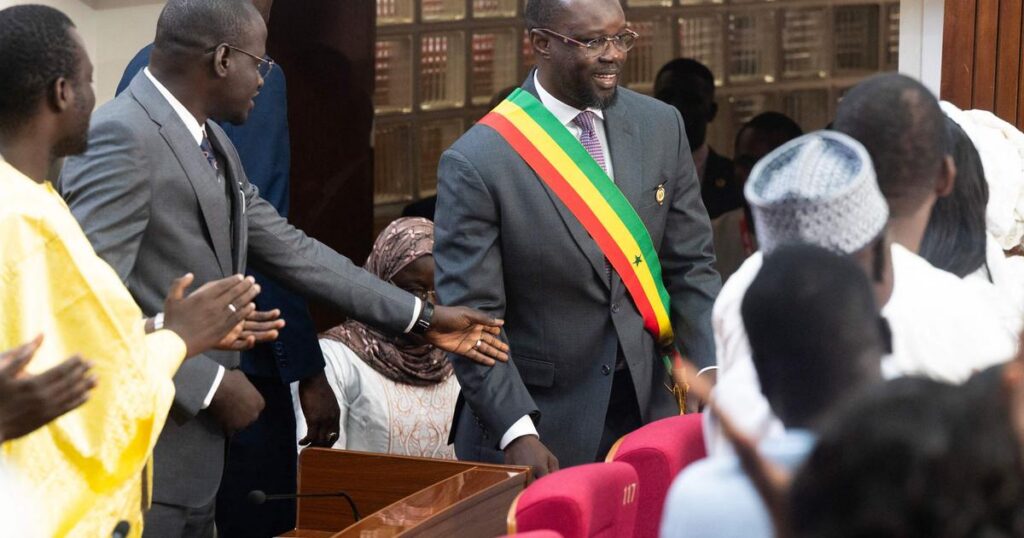
In the past, Ousmane Sonko had hinted at the potential for a “peaceful cohabitation” with the presidency. His recent election to lead the National Assembly, occurring just days after his removal from the Prime Minister’s office, could present an opportunity to realize this vision. The sequence of events leading to his election unfolded with striking speed. On May 22nd, President Bassirou Diomaye Faye dismissed Ousmane Sonko from his duties. By May 23rd, Malick Ndiaye, then President of the National Assembly, tendered his resignation, strategically vacating the speaker’s position. On May 25th, Ahmadou Alhaminou Mohamed Lô was appointed as the new Prime Minister. Finally, on May 26th, Ousmane Sonko was elected President of the National Assembly with overwhelming support, securing 132 out of 165 deputies’ votes, thereby reaffirming his command within Pastef, the majority party he founded. This election, hailed as historic by some and labeled an “institutional coup” by others, positions the former Prime Minister as a principal opposition figure to his former ally, President Bassirou Diomaye Faye, with whom he recently shared a complex duumvirate. Significant questions now emerge: will Pastef, having unanimously voted for Sonko, align with the new government formed by the technocratic Prime Minister? The ruling party has articulated its demands, emphasizing “fidelity to the program that led to the 2024 victory,” a platform largely crafted by Ousmane Sonko. Sonko himself has oscillated between signals of institutional appeasement and firm messages directed at the president. He notably cautioned that the National Assembly would “fully exercise its constitutional prerogatives” and expressed regret over the lack of consultation with Pastef regarding the new Prime Minister’s appointment. Amidst this political fervor, Senegal’s sovereign credit rating was downgraded from “stable” to “negative.”
This political influence is undeniable and has profoundly reshaped the national landscape. However, charismatic leadership carries an inherent duality: while it unifies crowds through a powerful figure, it sometimes risks eroding the impersonal foundations that uphold institutional democracy.
Popular or constitutional legitimacy?
When supporters perceive an individual as the sole driving force of a “revolution,” when the future of a collective endeavor appears inextricably linked to a single personality, and when the distinction between political loyalty and personal devotion blurs, that is precisely when the danger of hubris manifests. This is not merely an individual failing, but a structural phenomenon. The current political situation in Senegal starkly illuminates this contradiction.
For several months, Senegal navigated remarkable political uncertainty: where did the true locus of power reside? With the elected President Bassirou Diomaye Faye, or with Ousmane Sonko, the historical leader of Pastef – the African Patriots of Senegal for Work, Ethics, and Fraternity party – now in power? Was it the legitimacy bestowed by the ballot box or that stemming from militant engagement? Constitutional authority or raw charisma? Such a duality was destined to dissipate. Every democracy eventually requires its institutions to assert their preeminence. A state cannot long endure with two symbolic centers of command. Ousmane Sonko’s power was not confined to his role as Prime Minister; it primarily stemmed from his ability to simultaneously embody the head of government, the leader of a movement, a militant figure, and the emotional expression of a significant segment of Senegalese youth.
It is precisely at this juncture that the risk of hubris reveals itself: when a leader aspires to encompass the state apparatus, popular will, and the momentum of the movement all at once. The paradox lies in the fact that this configuration does not necessarily threaten democracy through overt brutality. More insidiously, it can erode it by subtly prompting institutions to recede in the face of a political personality’s symbolic aura.
Senegalese political formations largely remain structured around emblematic figures. The Parliament still struggles to establish itself as an independent and effective counter-power. While institutions demonstrate a certain resilience, they nonetheless remain vulnerable to the emotional impact of major political leaders.
A “trial of truth” for Senegal politics
The fundamental issue at hand is therefore not moral, but purely institutional. Will Ousmane Sonko be able to accept the preeminence of institutional legitimacy over charismatic legitimacy? Can he consent to the project he initiated no longer belonging exclusively to him? Is he prepared to evolve from a mere catalyst of historical protest into one actor among many within an institutional framework designed to endure beyond individuals?
This is undoubtedly the most challenging test for any leader who has embodied a significant break from the past. West Africa and African political history are replete with examples of movements that shone brightly in opposition before confronting the complex realities of state governance. Leading requires different skills than those needed for mobilization. It demands compromises, sacrifices, respect for institutional hierarchies, and sometimes even a form of personal effacement for the enduring benefit of the state.
The true measure of a leader’s greatness is not limited to their ability to attain power. It is also revealed in their capacity to accept the inherent constraints of institutional democracy. Senegal appears to be engaged in this crucial trial of truth today.
How this tension is managed will determine not only the future of the Pastef project but also a significant portion of the nation’s democratic stability and the broader outlook for Senegal politics.