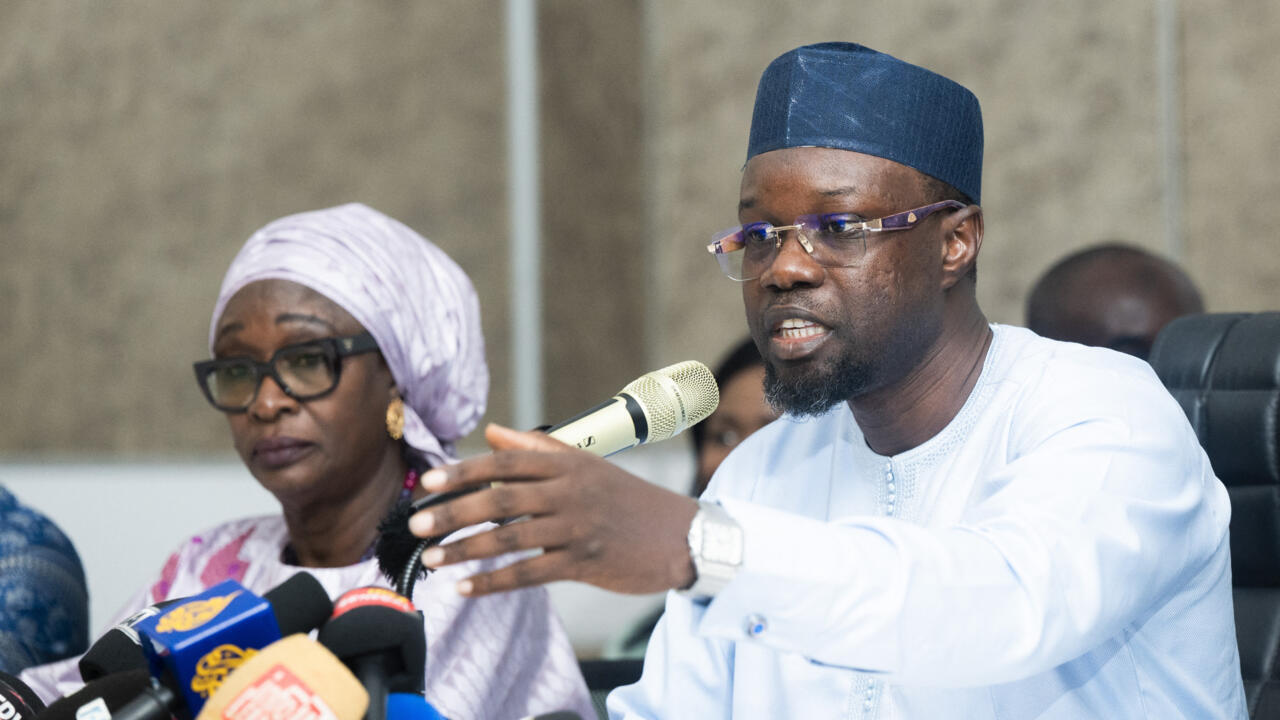
Just one week after his removal by President Bassirou Diomaye Faye, Ousmane Sonko, the former Prime Minister and influential leader of Pastef, has initiated a significant political offensive. He launched a severe critique against President Faye, emphasizing that while he aims not to destabilize state institutions, Pastef’s substantial parliamentary majority grants it the power to oust the current government through a motion of censure. Sonko characterized the prevailing situation as a unique form of political cohabitation, asserting that he had forewarned the President about this potential outcome months prior, but his concerns went unheeded.
Furthermore, Sonko did not mince words when evaluating the new government, which is headed by Prime Minister Al Amine Lô. The Pastef president declared that the executive body suffers from a fundamental lack of political legitimacy. He stated unequivocally that the government currently in place possesses no genuine political foundation, dismissing the notion of a broad coalition promoted by the presidency as meaningless. Sonko contended that labeling the administration as a “government of technocrats” merely serves as a thinly veiled admission of its political isolation. Ultimately, Sonko underscored Pastef’s exclusive claim to popular legitimacy within the majority, reiterating that his party remains the preeminent political force in the country, having emerged victorious from the ballot box. He argued that to govern without Pastef is tantamount to governing without the will of the people.
A significant challenge for the presidential camp
The Senegalese executive now finds itself in a precarious position. Pastef’s absence from the government poses a substantial political challenge for President Diomaye Faye’s administration. As the country’s dominant political party, Pastef commands a comfortable majority in Parliament. This configuration creates an unusual dynamic of cohabitation within the presidential majority itself. While Bassirou Diomaye Faye retains the constitutional powers of his office, the successful implementation of his agenda will heavily depend on his ability to foster a relationship of trust with Pastef’s parliamentary deputies.
Beyond the composition of the government, the critical question of political stability looms large. Observers are already questioning the executive’s capacity to secure the passage of its legislative proposals and enact announced reforms without the direct involvement of the majority party in governmental affairs.
In essence, President Bassirou Diomaye Faye appears to have distanced himself from the foundational narrative that brought him to power, thereby severing ties with his historical roots. He now governs within an unfamiliar space: a formally legitimate authority that is narratively orphaned. It is legitimate in its constitutional standing but orphaned because it has detached from the historical context that gave it meaning beyond mere state management.
Meanwhile, in the National Assembly, Ousmane Sonko, with his 130 deputies, maintains an unwavering voice, an intact memory, and overwhelming popular legitimacy. He waits not as a conventional adversary, but as the custodian of the original story, ready to declare at any moment, “we were here before, we will be here after.”
More than cohabitation, a political rupture
The political situation unfolding in Senegal is truly unprecedented in the nation’s history. It transcends a classic cohabitation scenario – typically an opposition between a president and an opposing parliamentary majority. Instead, it represents a more intricate and potentially hazardous rupture within the same political movement: a head of state at odds with a party that controls 130 out of 165 parliamentary seats, and which formally refuses to participate in the government.
The critical question remains: how can a technocratic government, lacking its own parliamentary base, effectively govern when Pastef holds an absolute majority in the Assembly, led by Sonko himself, and simultaneously orchestrates a nationwide mobilization of millions of supporters? The resolution to this complex power struggle will undoubtedly emerge in the coming weeks and months, playing out across the streets, within state institutions, and behind the closed doors of the Presidential Palace.