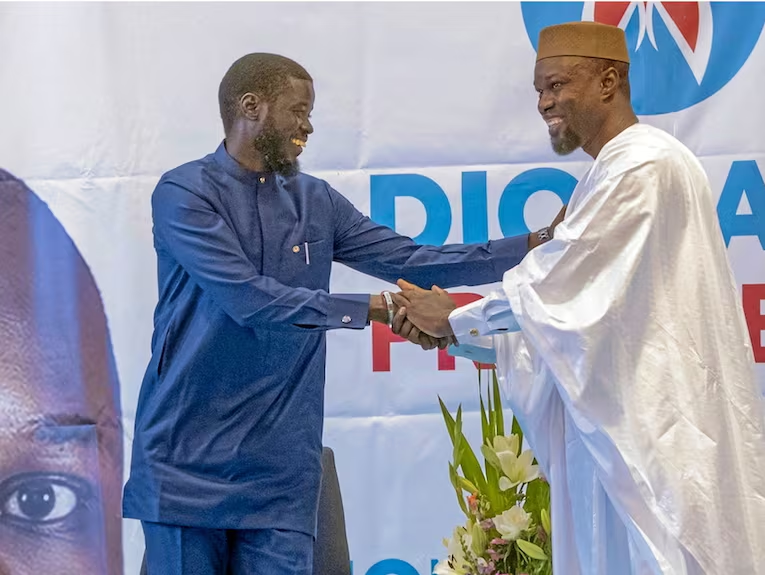
The Senegalese political landscape has been thrown into turmoil following President Bassirou Diomaye Faye’s abrupt dismissal of Prime Minister Ousmane Sonko late Friday evening. This decisive move has shattered the fragile alliance that brought both leaders to power after the February 2024 presidential election, exposing deepening rifts that have festered for months.
In a national address delivered by Presidential Secretary General Oumar Samba Ba, the Head of State «terminated the mandate of Mr. Ousmane Sonko as Prime Minister, along with those of the ministers and state secretaries». The outgoing executive team will continue handling «current affairs» until a new government is formed.
This rupture marks the end of a partnership forged in opposition to former President Macky Sall’s administration, which had faced escalating confrontations with Sonko’s camp. After being barred from the presidential race due to a defamation conviction that stripped him of civic rights, the former Ziguinchor mayor strategically backed Bassirou Diomaye Faye as their political movement’s candidate, playing a pivotal role in securing his victory.
Unresolved rivalries come to a head
Tensions between the two leaders have steadily escalated since their administration took office in Dakar. Competing spheres of influence and fundamental disagreements over governance have driven a wedge between them. Sonko’s outsized political presence—rooted in his appeal to Senegal’s youth through sovereign and pan-Africanist rhetoric—has consistently overshadowed the president, creating an uncomfortable dynamic for Faye, who owes much of his success to Sonko’s grassroots support.
The divide widened further after the November 2024 legislative elections, where the ruling party’s overwhelming victory was widely attributed to Sonko’s enduring popularity. Recent incidents in Dakar have revealed increasingly public disagreements between the presidency and the prime minister’s office, fueling speculation that a separation was imminent.
Within minutes of the announcement, Sonko took to Facebook with a terse, loaded statement: «Alhamdoulillah. Tonight I will sleep easy in Keur Gorgui», referencing his residence in this Dakar neighborhood. Soon after, social media videos showed dozens of supporters gathering outside his home, chanting his name in defiance.
A parliamentary majority at risk
The president’s decision has plunged Senegal into a period of profound political uncertainty. Sonko’s camp retains significant influence in the National Assembly, and the ruling party’s parliamentary dominance could transform this personal rift into a full-blown institutional confrontation. The former prime minister remains one of the country’s most influential political figures.
The meteoric rise of Bassirou Diomaye Faye and Ousmane Sonko was built on a shared rejection of the political elite, criticism of Senegal’s historical ties with France, and a promise of sweeping political renewal. For months, their movement energized urban youth, particularly through Sonko’s fiery discourse of systemic change.
By removing his former mentor from power, President Faye risks alienating a substantial segment of the militant base whose loyalty still hinges on Sonko’s leadership. In Dakar, the prospect of rapid reshuffling at the highest levels of government has already sparked intense political activity, threatening the institutional stability that has weathered crises in recent years.