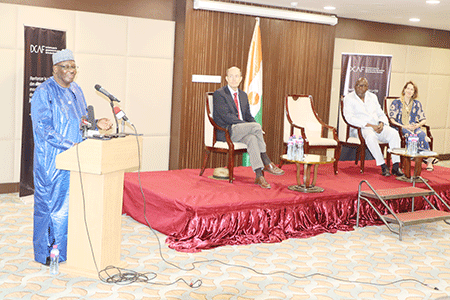
In Niamey, the President of the National Human Rights Commission (CNDH), Maty El Hadj Moussa, inaugurated a regional conference focused on human rights protection mechanisms within the volatile Sahel region. The summit specifically addresses the security challenges faced in the “three borders” area encompassing Burkina Faso, Mali, and Niger. High-level attendees included the Deputy Secretary General of the Ministry of Justice, the Africa Director of DCAF, and the German Ambassador to Niger.
Objectives of the regional summit
This two-day gathering is designed to educate stakeholders on best practices for safeguarding human rights. Key goals include enhancing the capacity of participants to use prevention tools against rights violations and fostering better governance. By strengthening both internal and external oversight institutions, the conference aims to ensure these bodies can effectively uphold the rule of law in a complex security environment.
The impact of insecurity on civilian populations
During the opening session, Maty El Hadj Moussa highlighted the gravity of the situation in the border zones. He noted that the region is plagued by massive human rights abuses perpetrated by unidentified armed groups and, occasionally, by members of the defense and security forces engaged in counter-insurgency operations. He described a brutal asymmetric conflict where civilians are trapped in a climate of fear, where even a suspicion of cooperation with authorities can lead to fatal consequences.
The CNDH President urged human rights defenders to develop innovative strategies that align with the public’s deep-seated need for security, peace, and regional stability.
Collaborative strategies and international support
Representing the Ministry of Justice, Moussa Sahirou Tchida emphasized that stabilizing the Sahel requires a unified approach from all regional actors. He acknowledged the vital role of international partners, particularly the European Union, in supporting such initiatives. He reiterated a strong commitment to working alongside partners to bring peace to the three-border region.
Anne Benette, the Africa Director for DCAF, observed that the Sahel is currently grappling with a convergence of political, social, and environmental crises that make governance increasingly difficult. She argued that the rise in extremist attacks and transnational crime is damaging the social fabric. This conference, she noted, provides a critical forum for sharing expertise and improving the collective response to threats against the rule of law.
Providing a diplomatic perspective, the German Ambassador to Niger, Herman Nicolai, pointed out that the Sahel has seen a faster increase in violence than any other part of the continent. He lamented the decade-long cycle of extremist activity and organized crime that has claimed thousands of lives and displaced countless families across the region.