Tchad boosts agricultural export skills to meet global standards
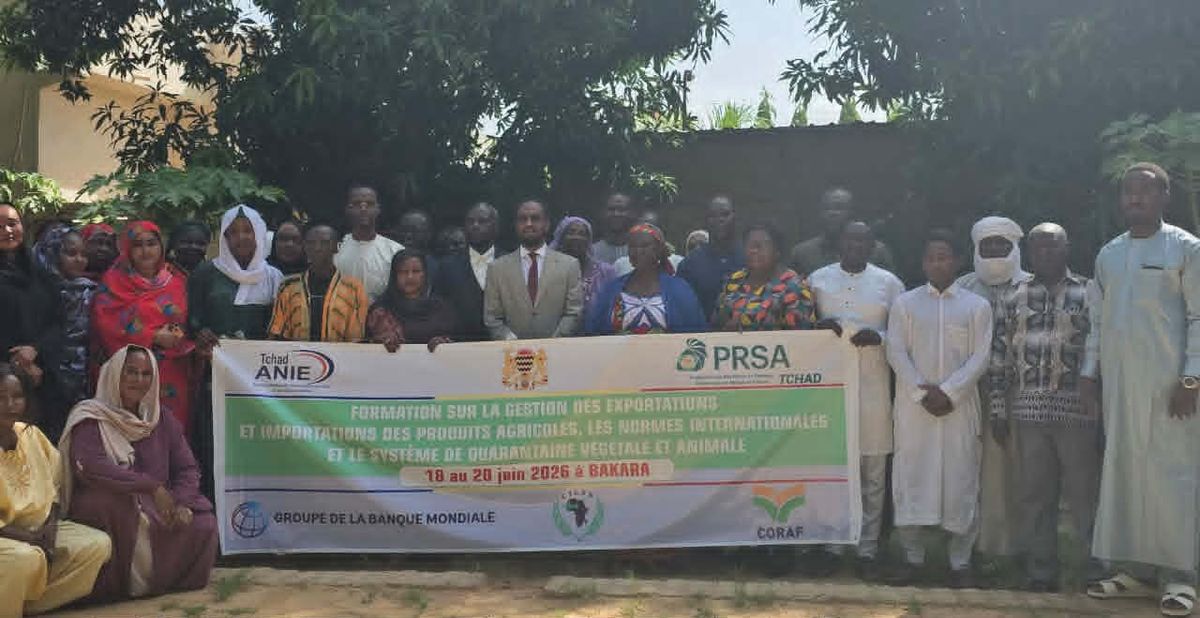
In a strategic move to enhance agricultural competitiveness, the World Bank and Chad’s National Agency for Investment and Exports (ANIE) recently concluded a capacity-building workshop in Bakara focused on streamlining agricultural export processes and aligning with international trade norms.
The initiative, held under the Agricultural Sector Resilience Program (PRSA), targeted key challenges faced by Chadian producers when entering foreign markets. Participants—including public and private sector stakeholders—received training on international certification, supply chain optimization, and compliance with sanitary and phytosanitary (SPS) measures.
Overcoming trade barriers through targeted training
During the opening session, Gotoraye Arnaud, coordinator of the PRSA-TD agricultural market dashboard, highlighted persistent obstacles in Chadian agri-exports. Producers grapple with convoluted export procedures, stringent quality controls, and the need to meet both phytosanitary and animal health regulations when shipping goods abroad.
The workshop aimed to equip attendees—ranging from exporters to customs officials—with the tools to navigate these complexities efficiently. Sessions covered risk mitigation in customs clearance, adherence to global food safety standards, and strategies to reduce post-harvest losses through better logistics.
Government vision aligns with continental trade ambitions
Dadi Adoum Arsin, ANIE’s deputy director-general, emphasized that this program reflects the Chadian government’s broader economic diversification goals. The initiative supports the Tchad Connexion 2030 national development plan, which prioritizes private-sector growth, local value addition, and export-led development as pillars for future prosperity.
« Boosting exports isn’t just about producing more—it’s about selling smarter, » Arsin stated. « The African Continental Free Trade Area (AfCFTA) now offers access to over 1.4 billion consumers. For Chad to seize this opportunity, our businesses must meet global benchmarks in quality, standardization, and compliance. »
The training underscores a shift toward proactive trade facilitation, where ANIE acts as both a technical advisor and a bridge between producers and international buyers. By consolidating market intelligence, export guidance, and regulatory support, the agency aims to position Chadian agricultural products as reliable, high-value offerings in regional and global value chains.
Building a sustainable export ecosystem
Workshop attendees represented diverse sectors critical to the export pipeline: agricultural producers, food processors, sanitary inspectors, logistics providers, and trade promotion agencies. The program’s hands-on approach included case studies on successful Chadian export ventures and simulations of cross-border trade scenarios.
As Chad positions itself to capitalize on AfCFTA’s potential, such capacity-building efforts are becoming indispensable. The country’s agricultural sector—dominated by crops like cotton, sorghum, and gum arabic—stands to gain significantly from improved access to markets in West and Central Africa, as well as beyond.
With these targeted interventions, Chad is not only addressing immediate trade hurdles but also laying the groundwork for a more resilient and globally integrated economy.