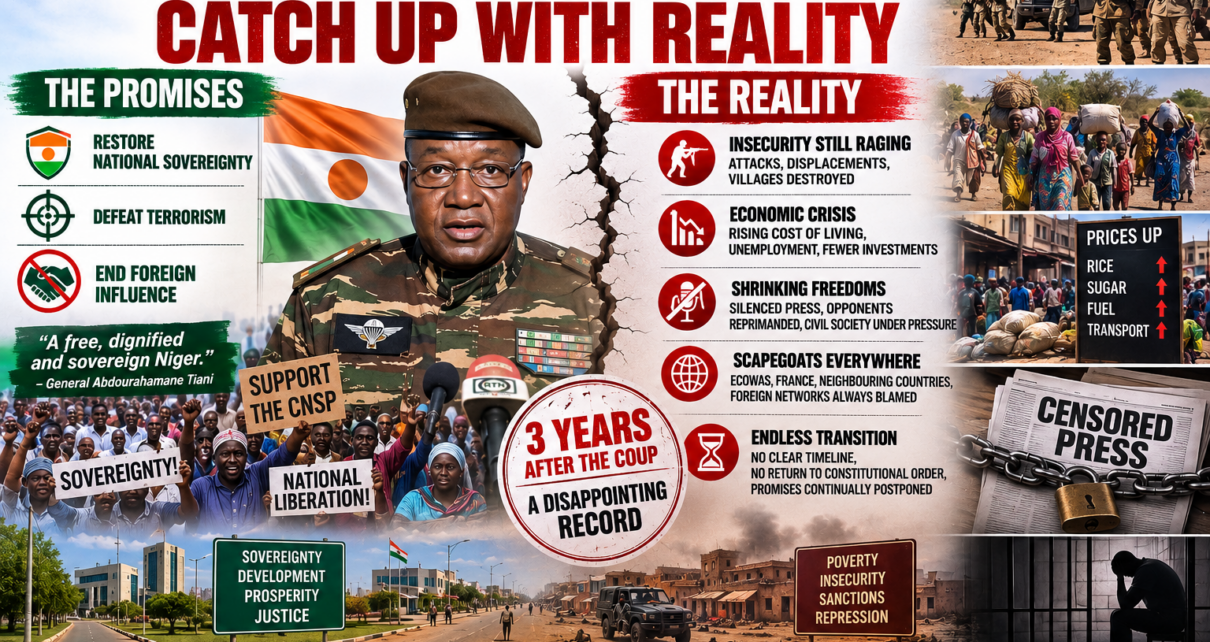
When General Abdourahamane Tiani seized power on July 26, 2023, his announcement of a military takeover was framed by three core promises: restoring national sovereignty, eradicating terrorism, and ending foreign interference in Niger’s domestic affairs. This narrative, amplified by regime-aligned media and pro-sovereignty movements, struck a chord with many Nigeriens, exhausted by chronic insecurity and economic hardship.
Sovereignty as a political tool
The National Council for the Safeguarding of the Homeland (CNSP), the ruling junta, has built its legitimacy on a discourse of regained sovereignty, portraying itself as a defender of national interests against external actors accused of undermining Niger’s autonomy. This strategy serves multiple purposes: uniting public opinion under a nationalist banner, deflecting internal criticism by framing it as foreign-backed dissent, and shifting focus away from evaluating governance performance.
Yet sovereignty extends beyond diplomatic ruptures or the withdrawal of foreign forces. It demands tangible outcomes security for citizens, functional institutions, preserved freedoms, and improved living standards. On these fronts, the results remain hotly debated.
A narrative rooted in public frustration
The junta has skillfully tapped into widespread disillusionment with years of insecurity, unemployment, inequality, and rising living costs. By framing the coup as a historic break from the past, the regime positioned itself as the solution to Niger’s woes. However, the emphasis on mobilizing patriotic support has overshadowed discussions of verifiable progress, with official communications dominated by political rallies, regime-supporting media, and allegations of foreign conspiracies rather than policy evaluations.
This shift has reframed political discourse: loyalty to the regime now often takes precedence over accountability, stifling open debate on governance effectiveness.
Security: the unfulfilled promise
The promise of improved security was the cornerstone of the junta’s justification for removing President Mohamed Bazoum. Yet, three years later, several regions continue to face armed attacks, mass displacements, and persistent insecurity. Civilians bear the brunt, with economic activities, social services, and community cohesion all suffering.
The Nigerien military continues its operations, but repeated strikes on military positions and villages highlight the resilience of armed groups. The conflict’s complexity cannot be resolved by regime change or shifting international alliances alone, and the lack of public metrics to assess progress fuels doubts about the efficacy of the current security strategy.
External blame as a default narrative
When faced with setbacks, the regime frequently points to external actors regional sanctions, former Western partners, neighboring states, or foreign networks as the root causes of Niger’s struggles. While regional tensions and geopolitical rivalries do influence the Sahel’s security landscape, they do not fully explain Niger’s domestic challenges.
This approach risks framing every crisis as a diplomatic confrontation, diverting attention from national responsibilities, institutional reforms, and governance improvements. Over time, such a strategy may weaken the country’s ability to self-critique and address its own shortcomings.
Economic strain and unmet expectations
The economic fallout from the coup has been severe. Regional sanctions, reduced investments, trade disruptions, and political uncertainty have battered key sectors. Households grapple with soaring living costs, restricted access to goods, and limited job opportunities. For many, the tangible benefits of political change have yet to materialize.
Economic sovereignty, often heralded in official speeches, requires long-term policies to boost domestic production, infrastructure, public finances, and business environments goals that demand sustained effort beyond rhetoric.
Shrinking civic space
Observers also warn of a tightening civic space. Criticism of the regime is increasingly met with scrutiny, while journalists, civil society activists, and opposition figures operate in an environment of heightened state vigilance. In many military-led systems, concentrated power often leads to the erosion of institutional checks and balances a trend Niger appears to be experiencing.
The lack of a clearly defined political timeline further fuels concerns about the transition’s duration and the prospects for a return to constitutional order.
Patriotism vs. tangible results
Nationalism can foster unity, but it cannot indefinitely substitute for concrete achievements. Sovereignty is not declared in speeches; it is built through robust institutions, resilient economies, credible justice systems, effective security, and transparent governance.
Recent Sahel history demonstrates that no government military or civilian can sustain legitimacy solely by denouncing external enemies. As time passes, citizens judge leaders not by their declarations but by their ability to improve daily life. For General Abdourahamane Tiani and the CNSP, the challenge is no longer convincing Nigeriens of the country’s sovereignty, but proving that this sovereignty translates into tangible benefits in security, development, justice, and freedoms. Without this, anti-imperialist rhetoric risks being perceived less as a national project and more as a tool for political survival.