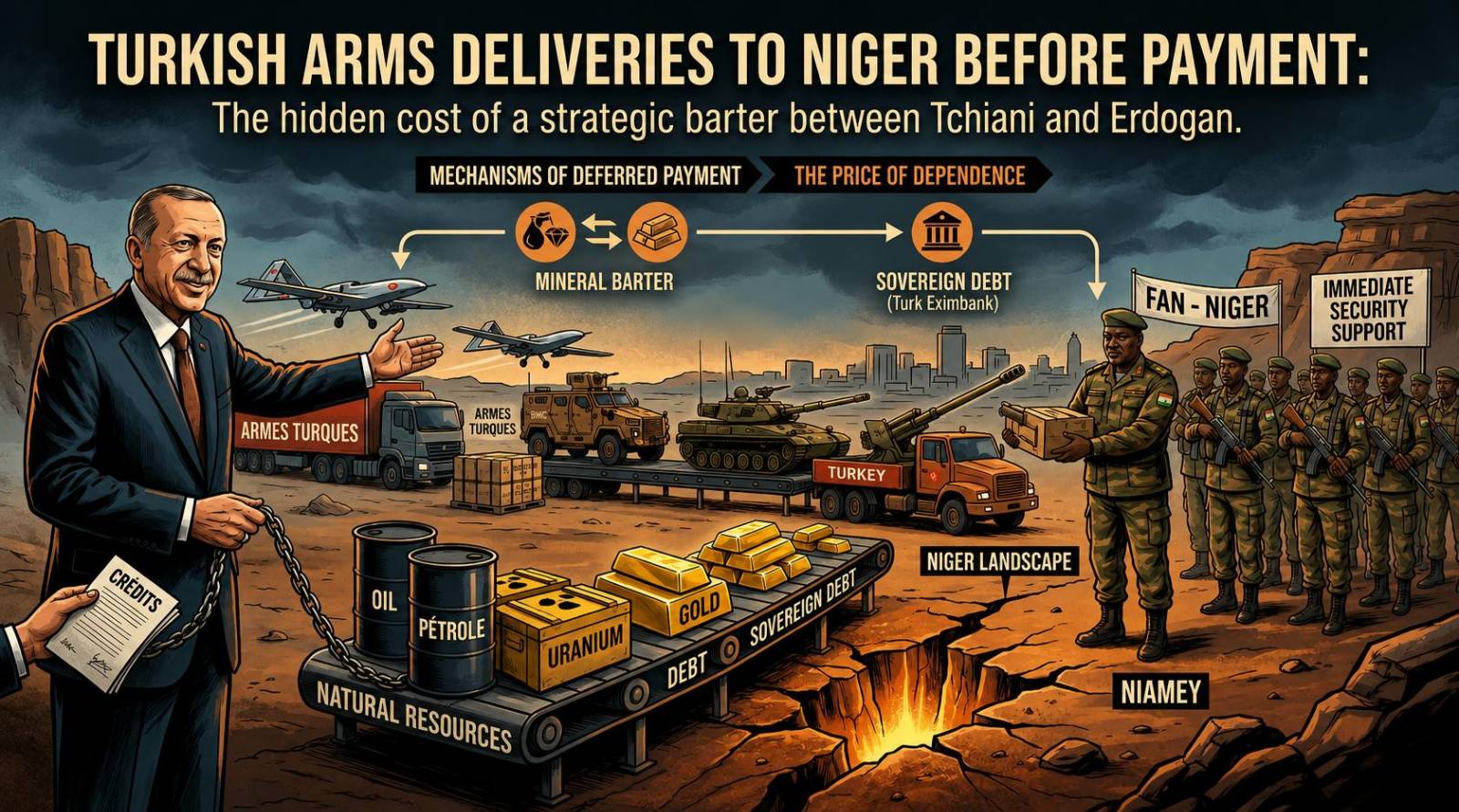
During his official visit to Ankara, General Abdourahamane Tchiani disrupted conventional diplomatic norms by disclosing that Recep Tayyip Erdogan had authorized the delivery of military equipment to Niger prior to any financial settlement. While Niamey’s leadership presents this as a gesture of solidarity, the deviation from standard international arms trade protocols reveals the underlying mechanics of a partnership that compromises a segment of Niger’s national sovereignty.
the financial undercurrents of deferred payment arrangements
The global defense procurement landscape operates on a fundamental principle: delivered equipment must ultimately be paid for, regardless of the payment schedule. The announcement made by Niger’s transitional president on June 4, 2026, masks a far more intricate economic and geopolitical reality where no transaction exists without consequence.
compensation mechanisms behind the facade
To offset Niamey’s immediate financial constraints, Ankara has implemented several covert compensation strategies:
- Resource-for-arms barter system: Niger’s subsoil holds some of West Africa’s most valuable deposits of uranium, petroleum, and gold. By advancing military deliveries, Turkey secures preferential rights to mineral exploration or exclusive mining concessions for its state-linked enterprises.
- Sovereign credit lines: The equipment is not a gift; payment obligations are structured through loans facilitated by institutions such as Turk Eximbank. Niger’s pressing security needs are thus converted into a long-term financial liability to Ankara.
the sovereignty trade-off: a short-term gain with enduring consequences
For General Tchiani, this alliance is essential to rearm the Nigerien Armed Forces (FAN) following the withdrawal of Western military contingents. Yet this pragmatic approach carries a steep long-term price for the nation.
The burden of over-indebtedness becomes evident when Niamey accepts advanced systems such as Bayraktar TB2 drones, armored vehicles, and communication networks on credit. The arrangement grants Turkey substantial influence over Niger’s future economic and mining policies.
potential strategic concessions
- Priority access to Niger’s uranium and petroleum reserves
- Establishment of Turkish logistical bases or installations
- Automatic diplomatic backing from Ankara in Sahelian affairs
Erdogan’s Sahel strategy: consolidating Turkish influence
For Recep Tayyip Erdogan, the financial flexibility extended to Sahel’s military regimes serves as a highly profitable geopolitical investment, fulfilling three key objectives:
- Permanently displacing Western powers from the region
- Countering Russian influence, particularly through the Africa Corps, by positioning Turkey as the indispensable technological supplier
- Creating new markets for Turkey’s defense industry, a showcase of modern national power
political victory, economic uncertainty
General Tchiani gains immediate domestic political capital by acquiring military assets without depleting state coffers. Yet the illusion of autonomy collides with the stark reality of material dependence. Whether through security arrangements with Moscow or technological debt to Ankara, Niger has not escaped the cycle of foreign influence—it has merely exchanged creditors, with the true cost yet to be borne by its citizens.