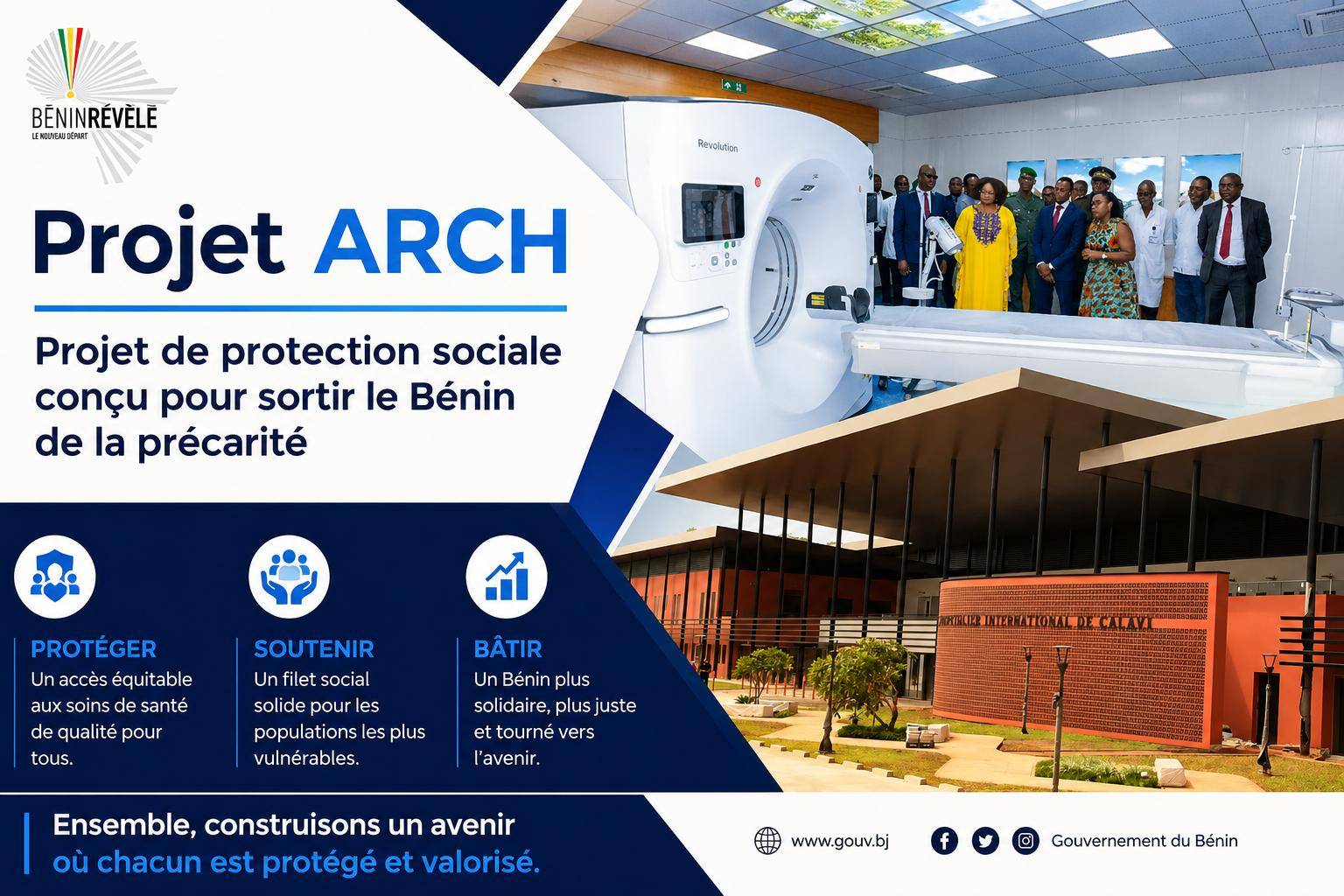
Over the past decade, Benin’s healthcare landscape has undergone a remarkable transformation. Spearheaded by President Patrice Talon and the Ministry of Health, the sector has been restructured around four key pillars: governance, infrastructure, technical capacity, and sanitation. Gone are the days of opaque, mass medical evacuations—replaced by state-of-the-art reference hospitals, strict regulatory oversight, and a universal healthcare approach that places the Beninese patient at the center of national priorities.
The bold vision behind the overhaul
For years, Benin’s healthcare system was synonymous with chronic challenges: crumbling infrastructure, outdated medical equipment, recurring strikes, and the unchecked growth of unlicensed medical facilities. Upon taking office, President Patrice Talon’s administration made a decisive choice: to abandon patchwork solutions and implement a sweeping reform agenda.
Today, the results of this political will are evident. Through bold legislative reforms and substantial investments, Benin is rapidly emerging as a leading medical hub in West Africa.
Strengthening governance: zero tolerance for deviation
The cornerstone of this healthcare revolution has been discipline and accountability. To oversee the transformation, the government established the Health Sector Regulatory Authority (ARS), a powerful body tasked with setting standards, ensuring care quality, and granting essential accreditations to healthcare facilities.
A historic and courageous measure was the strict prohibition of public health workers from practicing in the private sector. Previously unthinkable, this policy has restored dignity to public hospitals by ensuring doctors remain at the bedside of patients where they are most needed.
The crackdown extended to illegal medical practices. Hundreds of unauthorized clinics and practices, which posed daily risks to citizens, were shut down. The message was clear: healthcare in Benin is no longer a commercial enterprise—it is a matter of national security.
Building the hospitals of tomorrow
The transformation is most visible in the infrastructure sector. The flagship of this initiative is the International Hospital Center of Calavi (CHIC) in Abomey-Calavi, alongside the upcoming hospital complex in Togbin. These architectural and medical marvels rival European and Asian standards. Designed to deliver top-tier care, they symbolize Benin’s regained healthcare sovereignty.
« With the CHIC, we no longer need to look abroad for quality treatment. Benin now has the means to uphold its dignity, » shared a health official in Cotonou.
Modernization isn’t limited to new constructions. Historic hospitals have undergone major upgrades. The Hubert Koutoukou Maga National University Hospital Center (CNHU-HKM) in Cotonou, the Lagune Mother and Child University Hospital (CHU-MEL), and several regional hospitals have been renovated to bring high-quality care closer to every household.
High-tech medical excellence: the price of progress
Upgrading technical capacity was essential to curb the financial and human toll of medical evacuations abroad. To achieve this, the Beninese government invested heavily—allocating over 198 billion FCFA to healthcare in the national budget and mobilizing 275 billion FCFA for major projects.
Comprehensive upgrades to existing hospitals included advanced medical imaging equipment such as multi-slice CT scanners (up to 64 slices) for precise diagnostics, MRI machines, and cutting-edge digital radiology tables. Operating rooms and intensive care units were equipped with high-performance ventilators, multiparametric monitors for real-time vital sign tracking, ergonomic surgical tables, and minimally invasive surgery tools like laparoscopy devices. Laboratories and maternity wards benefited from automated medical analysis processes, modern neonatal incubators, and 4D ultrasound machines.
The CHIC: a 115 billion FCFA technological marvel
At the heart of this national strategy stands the International Hospital Center of Calavi (CHIC), funded with approximately 175 million euros (115 billion FCFA) through a groundbreaking financial partnership. This massive investment has enabled the installation of a truly revolutionary technical platform for West Africa.
The hospital boasts cutting-edge oncology facilities, including linear particle accelerators for targeted radiotherapy and laminar flow hoods for secure chemotherapy preparation. The cardiac and interventional surgery department features a digital angiography room for coronary procedures and integrated operating theaters equipped with heart-lung machines for open-heart surgeries.
The CHIC’s advanced imaging includes 3 Tesla MRI machines offering exceptional resolution, while fully automated molecular biology platforms enable rapid diagnosis and treatment of complex conditions. Thanks to this arsenal, Beninese patients can now receive advanced cancer care and major cardiovascular interventions locally—avoiding the emotional and financial burden of overseas medical travel.
Universal healthcare and community health: no one left behind
A reform is only meaningful if it benefits everyone. This is the focus of the social component of President Talon’s healthcare policy. The government has recruited thousands of healthcare professionals—doctors, nurses, midwives, and technicians—to address medical deserts in rural areas.
At the heart of this inclusivity is the Human Capital Strengthening Insurance (ARCH) project. Its health coverage component is gradually expanding to all municipalities, offering free or subsidized care to vulnerable populations. Complementing this is the revival of the National Community Health Policy, which deploys health workers directly in villages to provide prevention and primary care.
Benin is also embracing innovation. The digitalization of health services and the adoption of telemedicine platforms allow patients in remote areas to consult specialists in Cotonou without leaving their communities.
Measurable impact on everyday lives
How do ordinary Beninese citizens perceive this sweeping change? On the ground, the impact is tangible. Confidence in public hospitals is growing, wait times are shortening, and the availability of essential medicines has improved thanks to the reorganization of the Essential Medicines Procurement Center (CAME). The sense of healthcare security is stronger than ever.
For the first time, transparency is a priority. Monitoring and evaluation of these initiatives are rigorously centralized. The publication of Benin’s first-ever national health sector report—developed with technical support from the World Health Organization (WHO)—reflects this commitment to accountability. The report highlights a steady decline in maternal and infant mortality rates and improved efficiency in public health spending.
The road ahead: steady progress
The progress Benin has made in just a few years is striking. By addressing structural, material, and ethical weaknesses simultaneously, the Talon administration has laid a solid foundation for a modern, equitable, and high-performing healthcare system.
While challenges remain—such as maintaining advanced equipment and continuous staff training—the trajectory is undeniably positive. Benin has proven that with political vision, fiscal discipline, and a deep love for the nation, transforming a country’s healthcare system is not a distant dream, but an ongoing reality.