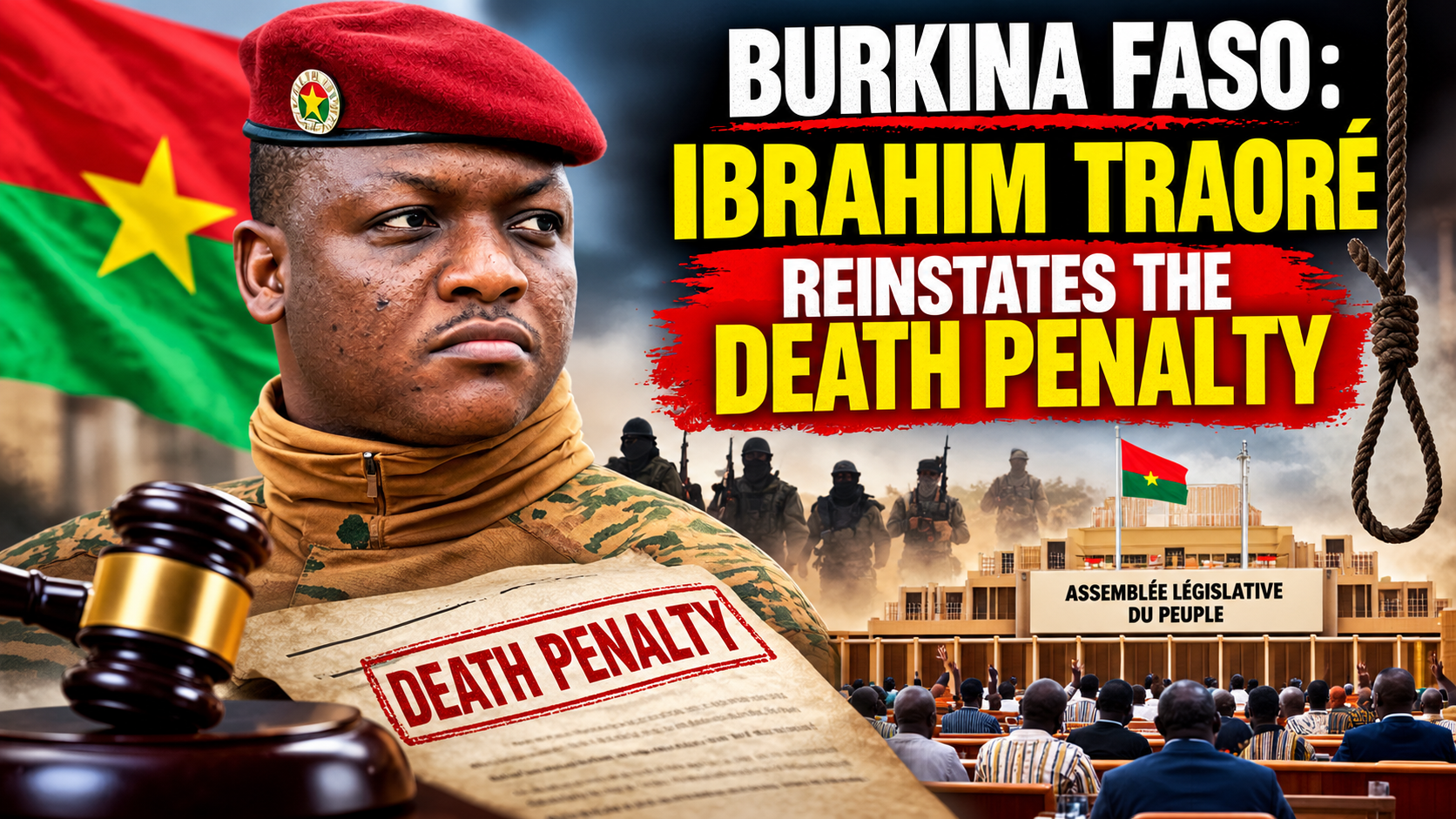
Reintroducing the death penalty: A gamble on security or a step into the unknown
In response to persistent insecurity, Burkina Faso has taken a decisive turn by reinstating the death penalty. But as the country grapples with escalating jihadist violence, a critical question looms: does the threat of extreme punishment truly bolster public protection, or does it risk plunging society deeper into fear and repression?
A legislative shift amid heightened security pressures
On October 20, 2026, the country’s legislative body, the People’s Legislative Assembly (ALP), unanimously approved a revised Penal Code, effectively ending a moratorium on capital punishment that had lasted since 2018. The move is framed by authorities as a necessary measure to restore order and safeguard civilians, but it also signals a significant shift in the justice system under Captain Ibrahim Traoré’s leadership.
The new legislation introduces the death penalty for a range of offenses, including terrorism, espionage, treason, and parricide. Additionally, the importation of expired or prohibited goods resulting in fatalities is now punishable by death. While the government presents these sanctions as a means to deter crime and reinforce sovereignty, the move raises concerns about the balance between harsh penalties and fundamental freedoms.
From deterrence to desperation: Can severity alone secure the nation?
The Burkina Faso government’s argument hinges on the idea that extreme measures will deter crime and restore public confidence. However, the relationship between punitive severity and actual security outcomes is far from straightforward.
Security in a conflict zone depends on multiple factors: intelligence gathering, the presence of defense forces in at-risk areas, fair investigations, and the ability of the state to prevent attacks before they occur. Simply increasing penalties does not address the root causes of terrorism or ensure that civilians are protected in vulnerable communities.
The reinstatement of the death penalty may serve as a political signal of strength, but it does not guarantee a reduction in violence. What Burkinabè citizens urgently need is not punitive symbolism, but tangible improvements in day-to-day safety the ability to travel, work, educate their children, and live without constant fear of attack.
Ibrahim Traoré’s firm hand: Authority over accountability?
The politics of punishment in a military-led state
Since assuming power, Captain Ibrahim Traoré has positioned himself as a leader unafraid to impose unwavering consequences for acts deemed threats to national stability. His public statements on espionage and treason suggest a zero-tolerance approach, emphasizing the irreversibility of justice when the state’s sovereignty is challenged.
Yet, the introduction of the death penalty also raises urgent concerns about judicial guarantees in Burkina Faso. For crimes punishable by execution, the stakes could not be higher. A wrongful conviction under such a system is irreparable a mistake cannot be undone. The new Penal Code must therefore be scrutinized for its safeguards, including the independence of courts, the strength of evidence required, and the rights of defendants throughout the legal process.
Justice must not only be severe; it must also be fair. Without robust protections, the risk of abuse of power intensifies. A military regime already operating under scrutiny for democratic backsliding now faces an added layer of accountability: ensuring that the fight against terror does not morph into an instrument of political repression.
Human rights at a crossroads: Where security meets silence
A climate of repression or justified control?
The death penalty’s return coincides with a broader tightening of public freedoms. Reports have highlighted cases of enforced disappearances targeting critics, journalists, and magistrates, as well as allegations of forced conscription into counterterrorism efforts. While the government frames these measures as necessary for national cohesion, they contribute to a climate of intimidation that extends beyond criminal justice.
The revised Penal Code also includes the re-criminalization of certain press offenses, a move that has drawn criticism for potentially stifling dissent. In a functioning democracy, criticism of authority is not a crime it is a safeguard against tyranny. The challenge for Burkina Faso now is to reconcile the imperative of security with the preservation of open dialogue and the protection of civic space.
When laws are used primarily to enforce silence rather than to uphold justice, the distinction between state security and regime preservation blurs dangerously. The real test for Traoré’s administration lies in proving that this reform serves the public good, not just the consolidation of power.
Fear as a tool: The limits of governance through coercion
Governments faced with existential threats often resort to ever-more drastic measures. But history demonstrates that coercion alone rarely fosters long-term stability. Fear may suppress public dissent in the short term, but it cannot substitute for trust, legitimacy, or the tangible protection of citizens.
For Burkinabè citizens, the question is not whether the state can impose extreme punishments but whether it can prevent attacks, secure villages, and restore a sense of normalcy to daily life. Can a regime that governs through fear truly win the confidence of a population living under the shadow of violence?
Ultimately, the success of this reform will not be measured by the harshness of its penalties, but by its tangible impact on safety and the protection of civil liberties. Burkina Faso’s future hinges on finding a balance: a state that is strong enough to protect its people, but restrained enough to respect their rights.
A pivotal moment for Burkina Faso’s democratic and legal future
The reinstatement of the death penalty is more than a legal adjustment it is a defining choice about the kind of state Burkina Faso aspires to become. Will it prioritize punitive justice at the expense of individual freedoms, or will it demonstrate that security and liberty can coexist under an accountable, transparent legal system?
The burden now falls on the authorities to prove that this reform is not merely a symbolic assertion of power, but a genuine step toward protecting civilians without eroding the foundations of democracy. For a nation confronting terrorism on multiple fronts, the stakes could not be higher.
By AMINA SALEY — Journalist