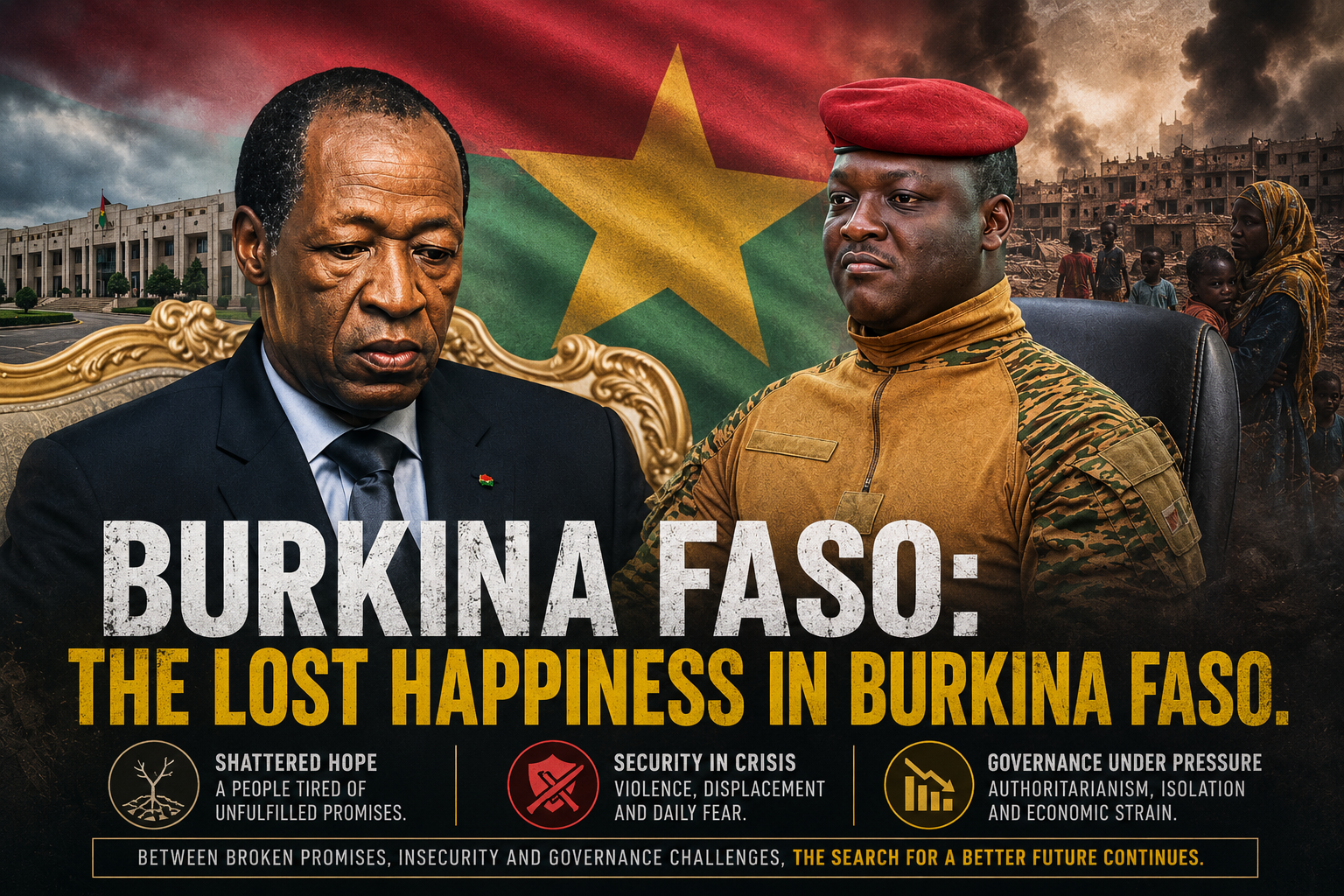
There was a time when Burkina Faso garnered more attention for its stability than its misfortunes. This era was not without its detractors; far from it. Blaise Compaoré faced accusations of centralizing power, stifling political life, and restricting democratic transitions. For twenty-seven years, his leadership was contentious, frequently criticized by segments of the opposition and the international community.
Yet, in retrospect, a crucial question emerges: what purpose does political discourse serve when citizens can no longer live safely? This query now permeates discussions among many Burkinabè, who draw parallels between the stability of Blaise Compaoré’s period and the current circumstances under Captain Ibrahim Traoré.
Under Blaise Compaoré, Burkina Faso was not a country where its people lived in constant dread of armed assaults. Citizens moved freely between regions, farmers cultivated their land, merchants supplied markets, and families traveled without the fear that each journey might culminate in tragedy. Terrorism, which would later destabilize the Sahel, had not yet plunged the nation into a security crisis of such magnitude.
This reality does not erase the criticisms leveled against his administration. However, it underscores a fundamental truth: the primary duty of a state is to guarantee the security of its populace. Without safety, freedoms, reforms, and political promises largely lose their significance.
Following Captain Ibrahim Traoré’s ascent to power via a military coup, Burkinabè harbored hopes for a profound shift on the security front. The new authorities pledged to reclaim national territory, bolster national sovereignty, and mount a more effective response against armed groups. Several years on, it is evident that these aspirations continue to clash with a particularly harsh reality on the ground.
Under Ibrahim Traoré’s governance, official communiqués frequently highlight military operations and the successes of the defense forces. Nevertheless, in numerous regions, attacks persist, localities remain cut off, and roadways continue to be perilous. For some observers, these declared victories have yet to translate into a sustained improvement in the daily lives of the population.
Perhaps the most telling tragedy is not merely the ongoing violence. It lies in the fact that thousands of Burkinabè now believe their safety is better assured away from their homes. Each week, families abandon their villages, their lands, their businesses, and their residences to seek refuge in safer areas or to cross borders into neighboring countries. No people willingly choose exile when their own nation offers them the conditions for peaceful living.
This quiet exodus of populations undeniably constitutes the most severe judgment on the efficacy of security policies. When a citizen opts to become internally displaced or a refugee rather than remain in their village, it signals a profound loss of faith in the state’s capacity to provide protection.
Meanwhile, Ibrahim Traoré continues to champion a discourse heavily focused on sovereignty, a break with former partner powers, and patriotic mobilization. These themes resonate with a segment of the population. Yet, sovereignty cannot be solely a political slogan; it is also measured by a government’s ability to exert authority across its entire territory and to guarantee the security of those who reside there.
Another striking aspect is the silence of many who once vehemently denounced Blaise Compaoré. Those who vigorously criticized his mode of governance now appear considerably more restrained when assessing the outcomes achieved under Ibrahim Traoré. This disparity fosters a perception of inconsistent judgment, where some leaders are scrutinized with far greater severity than others.
Comparing the Compaoré and Traoré eras is not to idealize the past or to overlook the limitations of the former regime. It is to pose a straightforward question: what is the absolute priority of a state? For many Burkinabè, the answer is clear. Before speeches, before symbols, and before grand declarations of sovereignty, a government is expected to demonstrate its capacity to protect its citizens.
The well-being of a nation is not defined by slogans or a leader’s popularity. It is measured by the tranquility of its villages, the safety of its roads, the openness of its schools, the functionality of its markets, and the confidence families place in their future.
As long as Burkinabè continue to leave their country or regions in search of security elsewhere, the debate over the results of Ibrahim Traoré’s leadership will remain unresolved. For history will remember deeds more than words, and actual capacity more than promises, especially regarding a state’s ability to offer its people what they desire above all else: to live freely, with dignity, and in security.