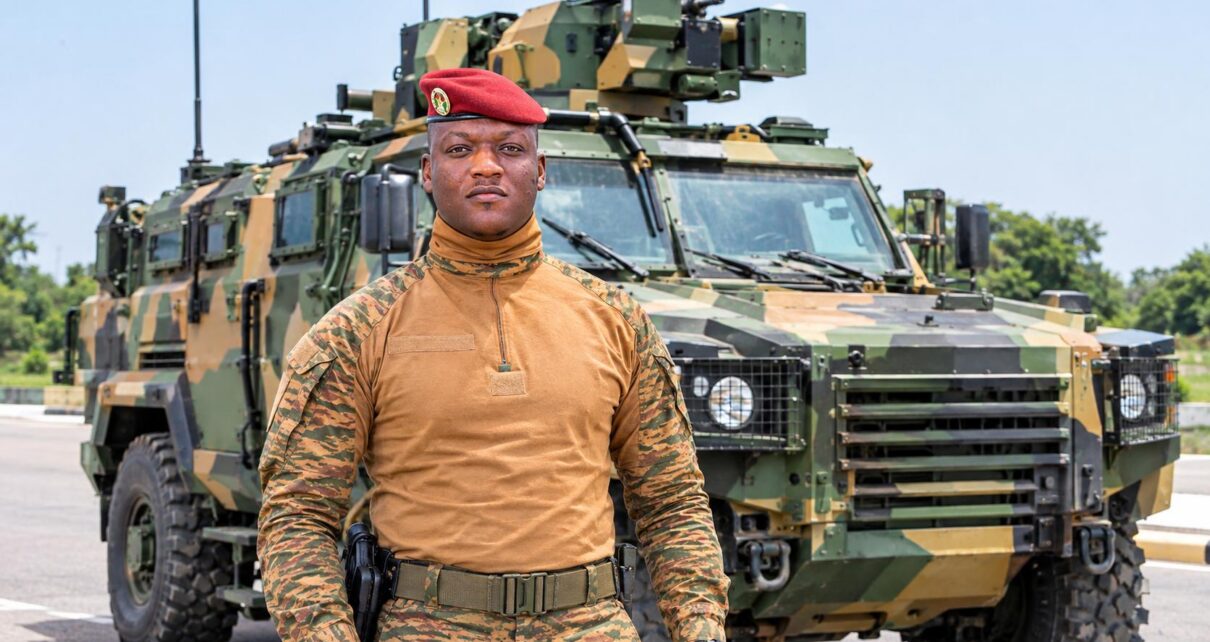
What was presented as a landmark achievement in Burkina Faso’s push for military self-reliance is now raising serious doubts. Nearly 300 armored vehicles, dubbed “Nanga” (scorpion), were announced as locally produced or adapted since November 2025, a claim made directly by Transition President Captain Ibrahim Traoré. The state or mixed company “Faso Armored” was hailed as the backbone of the nation’s military autonomy. Yet the most glaring issue remains: no one has ever seen the factory. Assembly lines are said to be strictly confidential, and the government invokes a convenient “secret defense” to block any independent verification.
The reality behind the ‘Made in Burkina’ label
Building a genuine armored vehicle is far more complex than welding steel plates onto a commercial chassis. It requires specialized foundries, certified ballistic steel, reinforced engines, and heavy precision engineering. According to several defense industry analysts, the vehicles branded “Nanga” may simply be modified commercial utility vehicles—mainly adapted Toyota chassis—imported cheaply from third countries and reinforced hastily in makeshift workshops.
Claiming the production of 300 armored vehicles in under a year, without pre-existing industrial infrastructure, defies technical logic. For comparison, major arms manufacturers with automated plants take years to deliver such volumes.
How ‘secret defense’ blocks budget scrutiny
Why keep the Faso Armored plant in total darkness? If such an industrial feat were real, a controlled media tour—even a partial one—would serve the regime’s narrative. Instead, the secret defense argument is being used to:
- Avoid any budget oversight: Tens of billions of CFA francs are injected into military equipment orders with no public tender and no audit by the Court of Accounts.
- Conceal the true origin and cost of materials: Masking intermediary suppliers and the exorbitant commissions taken by regime-linked middlemen.
- Escape ballistic certification audits: No certified resistance tests (such as STANAG standards against mines or IEDs) have been produced, directly exposing the lives of Volunteers for the Defense of the Homeland (VDP) and soldiers sent to the front in vulnerable vehicles.
Communication versus the reality on the ground
The Nanga armored vehicle announcement comes amid a tense political climate where authorities need symbolic victories to maintain popular support. After the grand inauguration of military textile complexes like TEXFORCES-BF, the narrative of “total independence” demanded a high-profile move in heavy weaponry. But on the ground, the numbers don’t add up. Persistent security deterioration across several regions shows that a surge in announcements of “revolutionary” equipment cannot compensate for the deep strategic and logistical gaps facing the armed forces.
A dangerous financial opacity for the state
By elevating financial and industrial opacity to a mode of governance under the seal of “secret defense,” the regime is drifting into troubling territory. Between the reality of large-scale mechanical improvisation and the myth of self-proclaimed industrial sovereignty, the financial and human cost could weigh heavily on the Burkinabè people.