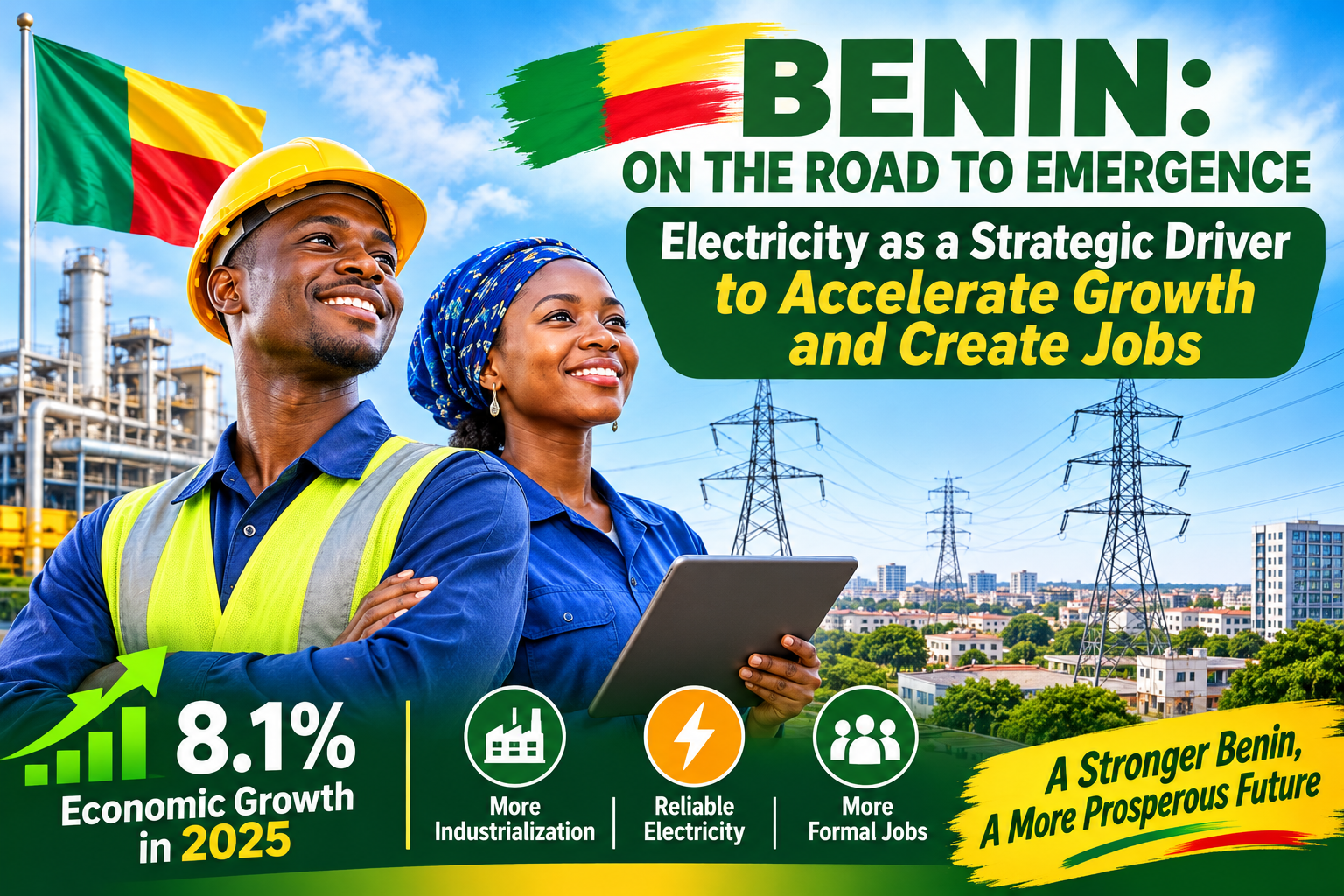
Can rapid growth alone fuel Benin’s future without reliable electricity?
With an 8.1 % economic growth rate projected for 2025, Benin stands out as one of West Africa’s fastest-growing economies. Between 2021 and 2025, the country has averaged 7.1 % annual growth, driven by investments in infrastructure, industrialization, and economic modernization. Yet behind these impressive figures lies a pressing challenge: this economic expansion has yet to translate into meaningful, stable employment for the majority of its workforce.
The paradox was highlighted in a 2026 economic outlook report, which revealed that in 2022, 96.3 % of workers operated in the informal sector. Worse still, eight out of ten new jobs were self-employed ventures. By 2024, only 19.8 % of the labor force held formal employment dropping to just 9 % among young people. The issue isn’t the absence of growth, but the economy’s inability to convert it into productive jobs with security, regular income, and social protection.
The path forward hinges on one critical factor: electricity. Without reliable power, Benin’s industrial ambitions risk stalling and so does its job creation potential.
Electricity shortages: The silent barrier to business expansion
Nearly half of Beninese businesses cite electricity access as a major obstacle to operations, with 86.1 % reporting frequent outages. For manufacturers, these interruptions mean lost production time, damaged raw materials, and missed shipment deadlines. Small-scale textile workshops and agro-processing units face rising costs as they increasingly rely on expensive diesel generators to stay operational. In 2024, the country’s electricity grid suffered losses of 24.7 %, while nearly half of its transmission lines and substations exceeded 25 years of age. Gas supply constraints further complicate the energy mix, pushing businesses toward more costly alternatives like heavy fuel oil.
The energy crisis extends beyond production. Poor infrastructure, aging equipment, and inefficient distribution networks prevent reliable access even where supply exists. For entrepreneurs especially young graduates and small-business owners these constraints translate into stalled growth, reduced profitability, and limited hiring capacity.
Mission 300: A regional gamble with local stakes for Benin
To break this impasse, the World Bank’s Mission 300 initiative partnered with the African Development Bank aims to connect 300 million additional Africans to electricity by 2030. For Benin, participation means leveraging targeted investments to upgrade production capacity, modernize transmission and distribution systems, and attract private financing.
Several projects are already underway. Four solar plants in Natitingou, Djougou, Bohicon, and Parakou are expected to add 50 MW of capacity, diversifying energy sources away from fossil fuels. A proposed 128 MW thermal plant in Onigbolo is also in development to bolster national supply. Together, these efforts could help stabilize the grid and reduce reliance on costly backup systems.
Crucially, the Mission 300 pledge in Benin isn’t just about kilowatts it’s about job creation. Analysts estimate the initiative could generate or improve nearly 159,000 jobs by 2030. But this outcome depends on more than just new power plants. It requires stronger energy governance, reduced technical and commercial losses, stable fuel pricing, and faster connections for businesses and households.
From macroeconomic wins to microeconomic opportunities
The industrial zone of Glo-Djigbé (GDIZ) offers a glimpse of what’s possible. With 22,798 jobs in 2025 a 28.8 % increase from 2024 the zone demonstrates how large-scale investments can create formal employment in local processing, textiles, and manufacturing. Yet for this model to scale, electricity must become a non-negotiable pillar of economic strategy.
For the millions of informal workers and young entrepreneurs across Benin, reliable power could mean the difference between survival and growth. It could allow small agribusinesses to extend operating hours, enable local craftsmen to expand workshops, and help startups access stable energy to innovate and hire. The goal isn’t just economic growth it’s inclusive growth that translates into real livelihoods.
Measuring success beyond GDP: What truly counts for Benin’s future
Benin’s 8.1 % growth in 2025 is a strong signal of resilience. But GDP numbers alone won’t define the nation’s trajectory. The real test lies in three key areas: the number of new formal jobs created, the productivity gains in local enterprises, and the stability of the electricity supply. For a generation seeking stable careers and for businesses aiming to compete regionally, electricity isn’t just infrastructure it’s opportunity.
The challenge ahead is clear: harness Benin’s economic momentum not just for headline numbers, but for transformation one that lights up homes, powers businesses, and secures jobs for all.
By IBRAHIM OUMAROU — Journalist