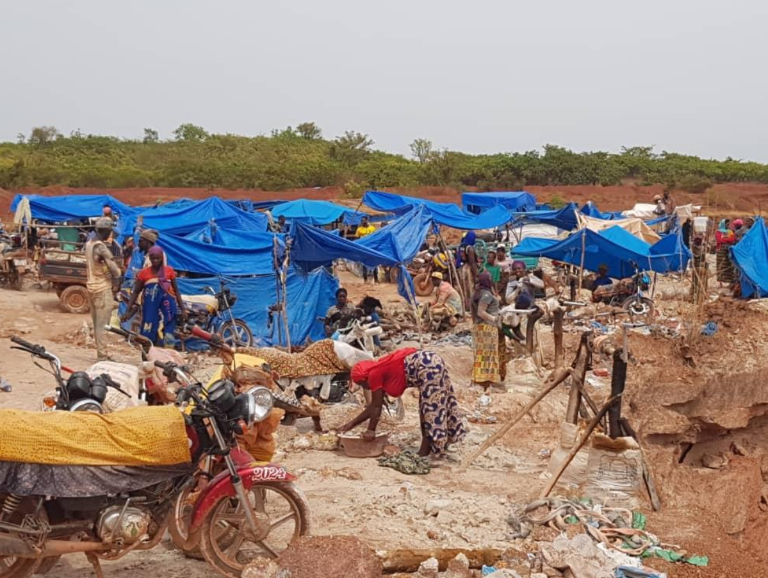
As Guinea ramps up its crackdown on illegal gold mining, one hard truth has emerged: the faces behind these operations are not just locals—they include a growing number of foreign workers, particularly from Burkina Faso. What drives thousands of Burkinabè to abandon their homeland in search of gold in neighboring Guinea? The answer lies in the worsening economic struggles gripping Burkina Faso, where instability, unemployment, and dwindling opportunities have pushed many to take extreme risks.
Guinea’s crackdown reveals a deeper crisis
On November 10, 2026, Guinean authorities announced the prosecution of 1,263 individuals arrested in a sweeping operation targeting illegal gold mining sites. Just days before, 149 more were detained in Kérouané and Siguiri, bringing the total to 1,412 arrests. Yet beyond the staggering numbers, this crackdown exposes a complex web of migration and economic desperation.
Among those detained, a significant portion hails from Burkina Faso, where years of insecurity, internal displacement, and economic decline have left many with few alternatives. For these miners, Guinea’s goldfields represent a last resort—a place where they can scrape together a livelihood despite the dangers and legal risks.
The Guinean government’s response is clear: enforce mining regulations, punish illegal operations, and restore order in resource-rich zones. But is repression alone enough to address the root causes of this migration?
Burkina Faso’s economic sovereignty under scrutiny
Under Captain Ibrahim Traoré’s leadership since 2022, Burkina Faso has prioritized economic sovereignty, particularly in the mining sector. The goal? To assert control over natural resources, renegotiate mining contracts, and boost state revenues. Yet the exodus of Burkinabè miners to Guinea’s illegal gold pits raises a critical question: if Burkina Faso sits on vast gold resources, why are its people still fleeing to work in neighboring mines?
The answer cuts to the heart of Burkina Faso’s struggles. Despite its mineral wealth, the country grapples with persistent insecurity, damaged infrastructure, and limited job opportunities, especially in rural areas. For many, illegal mining in Guinea—though hazardous—offers a chance to earn income when domestic options have vanished.
The irony is stark: a nation rich in gold cannot provide stable livelihoods for its own people, while neighboring Guinea, facing pressure from illegal mining, becomes an unintended escape valve. Can Burkina Faso’s sovereignty ambitions translate into real economic relief for its citizens, or will its people continue to seek survival elsewhere?
Can repression solve a migration driven by poverty?
Guinea’s approach is unambiguous—crack down on illegal mining to protect its environment and resources. The fallout from unregulated gold extraction is severe: soil degradation, water pollution, and health risks for nearby communities. Prosecuting offenders is a necessary step, but will it deter those driven by desperation?
History suggests no. As long as Burkina Faso’s economic challenges persist, illegal mining will resurface in new forms. The solution demands more than penalties—it requires addressing the structural issues fueling migration. For Guinea, this means collaborating with Burkina Faso to understand the networks behind these movements. For Burkina Faso, it means turning sovereignty rhetoric into tangible opportunities: creating jobs, stabilizing rural economies, and ensuring mining benefits local communities.
One critical gap remains: the Guinean authorities have not released a breakdown of the 1,412 arrested by nationality. Without knowing how many are Burkinabè, the full scale of this migration stays unclear. Yet even without exact figures, the trend is impossible to ignore.
Beyond the numbers: the human cost of economic failure
Each arrest in Guinea represents more than a legal case—it tells the story of a worker, a breadwinner, and a family clinging to hope in the face of adversity. These individuals are not criminals by choice, but victims of a system failing to provide for them. Their migration underscores a harsh truth: economic sovereignty is meaningless if it doesn’t translate to better lives.
The challenge now is twofold. Guinea must balance environmental protection with compassion, recognizing that its crackdown could push desperate migrants into even more dangerous situations. Burkina Faso must confront the gap between its gold wealth and its people’s struggles, asking why its citizens cannot find opportunity at home.
The real measure of economic sovereignty isn’t how much gold is extracted from the ground—it’s whether a nation can offer its people the dignity of work and the security of survival.