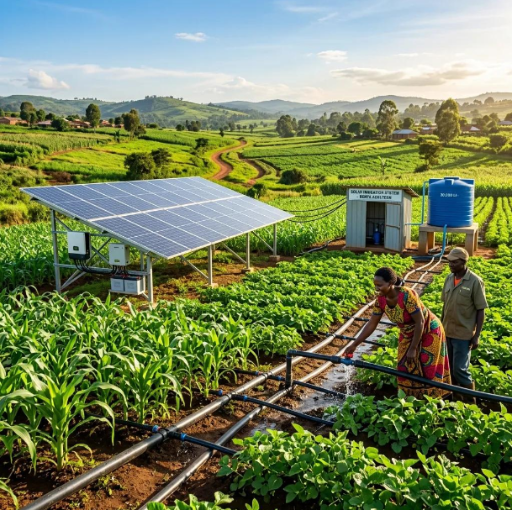
In Benin, where agriculture remains the backbone of the economy, farmers face an existential question: how can rural livelihoods be safeguarded when droughts, floods, and unpredictable rainfall become the new norm? With nine vulnerable municipalities on the frontline of climate risks, the government has launched a groundbreaking initiative to rewrite the future of local agriculture—and secure the well-being of thousands of households.
The stakes couldn’t be higher. From the arid expanses of northern regions like Malanville to the flood-prone lowlands of Sèmè-Kpodji, communities are grappling with collapsing crop yields, eroded soils, and dwindling water supplies. Traditional farming methods, once reliable, now falter under the weight of a rapidly changing climate. But beyond immediate relief, Benin is betting on a long-term strategy—one that integrates climate resilience directly into agricultural systems, local economies, and community governance.
Why these nine municipalities are on the climate frontline
The $12 million Climate Resilience Initiative (CRI) targets some of Benin’s most exposed areas: Sèmè-Kpodji, Sakété, Kétou, Savalou, Dassa-Zoumè, Djougou, Copargo, Ouaké, and Malanville. These municipalities weren’t chosen at random. They represent a cross-section of Benin’s climate vulnerabilities—ranging from severe droughts in the north to erratic monsoons and flooding in the south. In each, agriculture is deeply tied to rainfall patterns, land quality, and water access—three pillars now under siege.
The consequences are visible in the fields. Farmers report plummeting maize and groundnut yields due to delayed rains and flash floods. Women-led cooperatives struggle to maintain year-round production as shallow wells dry up and soil fertility declines. Without intervention, projections suggest that by 2030, up to 40% of smallholder farms in these areas could become economically unviable.
From crisis response to climate-proof agriculture
Recognizing that short-term aid is no longer sufficient, the initiative shifts focus toward structural adaptation. The goal is not just to survive the next drought—but to build farming systems that thrive despite it. At the core of this transformation are three interconnected strategies: water security, renewable energy integration, and digital agriculture.
>The CRI tackles water scarcity head-on with a network of small reservoirs, rehabilitated wetlands, and low-cost drip irrigation systems. By the end of 2031, the project aims to deliver:
- Three new water retention dams to capture and store rainfall during wet seasons
- Two wetland restorations to restore natural flood retention and recharge groundwater
- Five drip irrigation systems in peri-urban and rural plots
- Twelve solar-powered pastoral wells to support livestock rearing in drought-prone areas
Coupled with this infrastructure push is a shift toward clean energy. Solar-powered water pumps are being installed across irrigation networks, cutting dependency on diesel generators and reducing operational costs for farmers. Early calculations suggest these systems could reduce energy expenses by up to 40% in participating farms.
Digitizing resilience: farmers in the data age
But infrastructure alone won’t turn the tide. What will? Information. The CRI embeds climate-smart agriculture (CSA) tools into local farming routines. Through SMS-based weather alerts, soil moisture sensors, and digital market platforms, producers gain real-time insights into planting windows, pest risks, and market prices. The initiative aims to train 20,000 farmers in climate data interpretation and adaptation techniques by 2029—a step toward making every decision evidence-based.
Building back better: local materials and economic diversification
The project extends beyond crops and livestock. A bold experiment is underway to revive and modernize traditional construction using local earth-based materials. Bamboo-reinforced compressed earth blocks and stabilized soil bricks are being produced locally, offering a low-carbon alternative to imported cement. This not only cuts construction costs by up to 30% but also creates new income streams for masons, women’s cooperatives, and youth-led enterprises—especially in regions like Djougou and Copargo where unemployment among young men remains high.
For Switzerland and Belgium, partners in the initiative, this component represents a dual win: reducing carbon footprints while boosting inclusive growth. Early pilots show that earthen construction homes use 50% less energy for cooling, a critical advantage during Benin’s increasingly intense heatwaves.
Who benefits? A ripple effect across communities
The numbers tell a story of ambition—and hope. The CRI aims to reach 31,687 direct beneficiaries, including over 12,300 women, whose roles in food processing and small-scale trade make them pivotal to household stability. Indirectly, up to 1.5 million people—nearly 10% of the rural population in these municipalities—could see improved food security and income stability.
The economic ripple extends further:
- 20,000 farmers trained in climate-resilient techniques
- Agricultural productivity increased by 20% through better water and soil management
- 30% rise in household incomes for 10,000 rural families
- 5,000 direct jobs created in agriculture, renewable energy, and digital services
- 15,000 indirect jobs in processing, transportation, and maintenance
These targets reflect a broader vision: turning climate adaptation from a survival strategy into a driver of rural transformation.
The real test: turning promises into progress
Yet, as with any large-scale initiative, the challenge lies not in the plan—but in the execution. Success demands more than financing. It requires:
- Timely delivery of infrastructure across nine dispersed municipalities
- Strong local ownership from municipal leaders and producer groups
- Transparent fund management to prevent mismanagement and leakage
- Continuous monitoring using digital dashboards tied to community feedback
The CRI’s funding—led by the UNDP with contributions from Benin’s government, Switzerland, Belgium, and local authorities—totaling $15.5 million is substantial. But in a region where past projects often faltered due to weak follow-through, the true measure of success won’t be the number of dams built or solar panels installed. It will be in every farmer who plants with confidence, every child whose meal is no longer at risk, and every village that becomes a model of adaptive resilience.
For Benin’s rural communities, the question is no longer theoretical: survival depends on turning climate threats into opportunities—before it’s too late.