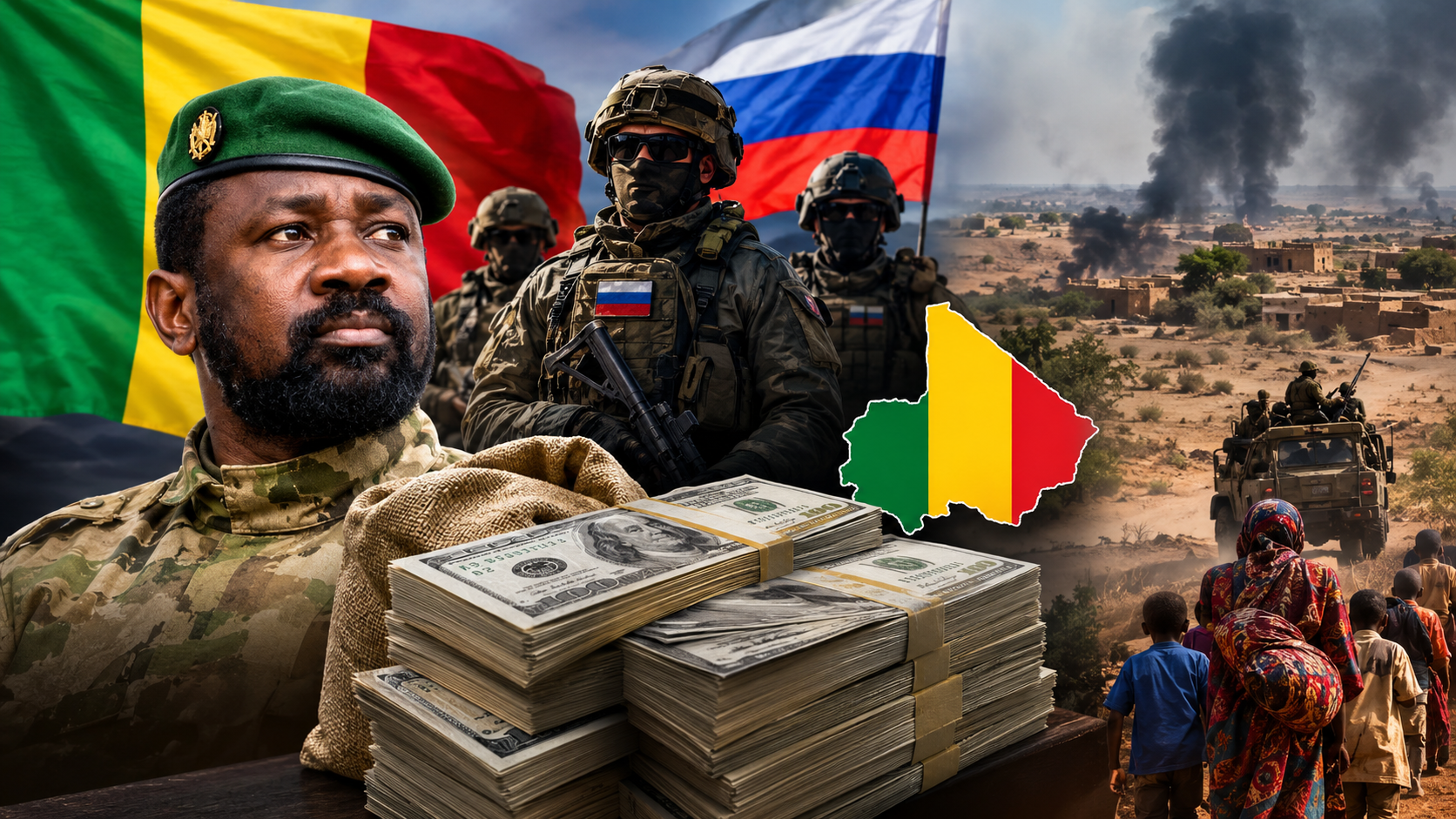
Could a partnership aimed at restoring security come at the cost of a billion dollars in public funds? This is the dilemma facing Mali’s transitional authorities as they evaluate their decade-long cooperation with Russian forces, initially linked to Wagner and later reorganized under Africa Corps. With expenditures estimated at approximately $10,000 per combatant per month, the financial burden of this military partnership raises pressing questions: what tangible benefits has Bamako secured in return for such an investment, and does the arrangement truly serve the nation’s long-term security interests?
From Wagner to Africa Corps: A strategic gamble
Following the rupture with Western partners, particularly France, Mali’s transitional government positioned its alignment with Russian military forces as a sovereign-driven alternative. The promise was clear: regain control over the nation’s security landscape through a cooperation framework heralded as more respectful of Mali’s autonomy. Yet strategic decisions must be measured not by the rhetoric of partnership, but by their outcomes on the ground namely, the protection of civilians, the safety of key infrastructure, and the restoration of state authority across contested territories.
The paradox of high costs and enduring insecurity
The billion-dollar expenditure on Russian forces is not merely a military line item it is a diversion of critical public resources that could otherwise have strengthened health systems, rebuilt schools, or restored damaged infrastructure in regions ravaged by conflict. While no military partnership can yield instant results against entrenched insurgencies, the scale of funding engaged by Bamako demands rigorous accountability. Citizens are entitled to clarity: what precise objectives have been met, and how have these expenditures translated into measurable improvements in safety and stability?
Current realities challenge the narrative of progress. Persistent attacks on civilian targets, the vulnerability of military outposts, and the continued displacement of populations suggest that the partnership despite its financial magnitude has yet to deliver on its central promise. The Malian government’s decision to rely heavily on external forces raises a fundamental question: can lasting security be outsourced at such a scale, or does it require the development of a self-sufficient national defense infrastructure?
Sovereignty beyond rhetoric: Accountability in military partnership
The justification for severing ties with Western allies hinged on regaining control over Mali’s security architecture. Yet sovereignty is not merely a matter of choosing allies it is measured by the ability to assess costs, evaluate performance, and accept responsibility for outcomes. Transparency regarding financial flows, operational scopes, and effectiveness reports remains a democratic necessity. A billion-dollar investment without clear public accounting or verifiable results risks undermining public trust and turns security policy into a liability rather than an asset.
What the Africa Corps brings and what it does not
The transition from Wagner to Africa Corps represents a structural rebranding of Russian military presence in Africa, but rebranding alone does not equate to improved performance. For Mali, the critical test lies in whether this partnership has enhanced coordination with national forces, improved intelligence capabilities, or secured vulnerable communities more effectively. External support can provide tactical advantages, but it cannot substitute for the development of a robust, well-trained, and adequately equipped national army capable of holding territory and protecting civilians over the long term.
The untold cost of a political choice
The decision to pivot toward Russia was framed as a bold assertion of national independence. However, when public funds are allocated on such a scale, the ethical and fiscal duty of leadership is to demonstrate tangible returns. Citizens deserve to know: who pays, who benefits, and whether the security promised is being delivered. The absence of clear, accessible data on costs, casualties, or operational outcomes fosters speculation and erodes the credibility of the government’s stated goals.
Moreover, the partnership must not escape scrutiny on ethical grounds. Reports of human rights violations linked to Russian-affiliated forces have surfaced across the Sahel. While not the focus of this financial analysis, such concerns only intensify the need for Mali’s authorities to justify their engagement not just economically, but morally.
Measuring success: Beyond speeches, toward action
At its core, Mali’s security crisis demands more than military announcements it requires visible improvements in the daily lives of its people. Farmers must safely tend their fields, traders must move freely along national roads, displaced families must have the prospect of returning home, and state services must function in regions currently under threat. These are the real metrics of success, not the volume of rhetoric or the scale of foreign deployments.
A billion dollars invested should yield palpable dividends in safety and stability. If attacks continue unabated, if civilians remain under siege, and if territorial control remains contested, then the partnership’s effectiveness must be questioned. The true failure would be to regard this costly shift in alliance as a victory in itself while leaving the cost, both financial and human, unanswered.
The path forward: Transparency and expectation management
To restore public confidence, Mali’s leaders must go beyond defending their strategic choice and provide concrete proof of its results. This demands:
Full financial disclosure: Clear accounting of payments made to Russian forces, including per-combatant costs, contract durations, and payment schedules.
Independent assessment: Third-party evaluation of operational effectiveness, civilian protection outcomes, and territorial stabilization.
Strategic timeline: A public roadmap showing how this partnership integrates with broader security and development goals.
National capacity building: A commitment to invest in Mali’s own armed forces, ensuring long-term autonomy regardless of the fate of foreign alliances.
The future of Mali’s stability cannot rest solely on military partnerships. It must be anchored in institutions, credibility, and the tangible protection of its people. A billion dollars spent in good faith should produce results that every Malian can see and feel. Until then, the justification for this costly gamble remains incomplete.
Conclusion: Security is not a slogan
Mali stands at a crossroads. It has chosen a path of military cooperation that has cost its treasury dearly. Now, it must demonstrate that this investment has meaning beyond the pages of political discourse. The question is not whether Russia was the right partner it is whether the billion dollars spent has made Mali safer. And for the families living under constant threat, for the villages still awaiting protection, for the nation seeking to reclaim its sovereignty in deed as well as word this is the only judgment that truly matters.
By AMINA SALEY — Journalist