Is Africa’s gold the price of Moscow’s military protection?
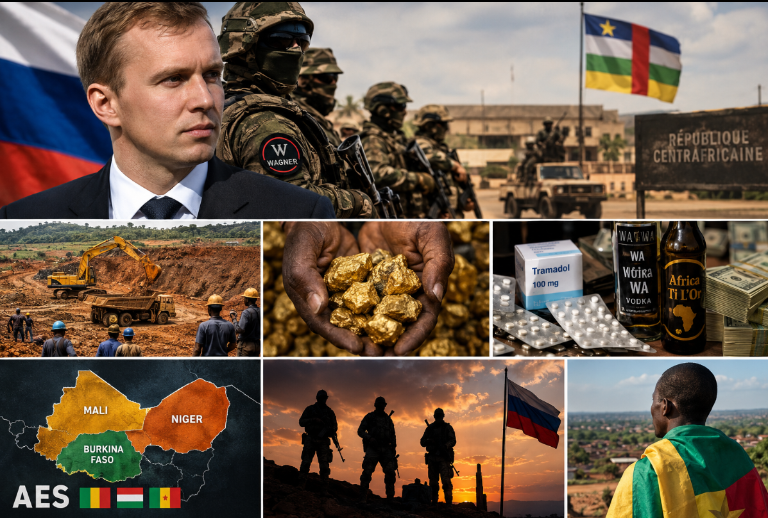
Across the Sahel, governments grapple with a strategic dilemma: how to secure their territories while safeguarding national sovereignty. In the Central African Republic, a model of cooperation with Russian security contractors has raised a troubling question—does the protection offered by these forces come at the cost of mineral concessions and economic control? Reports suggest that Pavel Prigojine, son of the late Wagner founder, has maintained a vast economic network generating over $400 million annually, blending military support with resource extraction and alleged illicit trade. Now, as Mali, Burkina Faso, and Niger deepen ties with Moscow, could the same exchange of security for gold repeat itself?
From Bangui to Bamako: the shadow of Wagner’s economic legacy
In Bangui, the Wagner Group established itself as a pillar of President Touadéra’s security apparatus. Recent assessments indicate that Pavel Prigojine, now leading part of the former empire, has expanded operations beyond military protection into gold mining, transport, and commercial ventures. Estimates place the annual output of the largest affiliated mining site at $250 million—raising concerns about the destination of profits and the true beneficiaries of this cooperation.
But the Central African case is more than an economic story; it reveals a fusion of interests. The same forces that secure government installations now influence trade routes, mine ownership, and even pharmaceutical markets. Allegations of involvement in alcohol distribution, arms trafficking, and the unregulated sale of tramadol highlight how military partnerships can evolve into commercial empires with far-reaching consequences—including public health risks.
Why the Sahel must scrutinize Russian military partnerships
The Central African model is already resonating in Bamako, Ouagadougou, and Niamey. In Mali, Russian security deployments have sparked debate over cost, effectiveness, and unintended outcomes. In Burkina Faso and Niger, negotiations for deeper cooperation continue amid rising jihadist threats and strained relations with Western allies. The critical issue is not whether these nations should seek alternatives to Western security support, but how they can structure agreements to avoid trading sovereignty for short-term protection.
The Sahel’s governments face a choice: accept Russian military assistance and risk embedding foreign commercial interests in their economies, or insist on transparent contracts, independent oversight, and equitable revenue-sharing from mineral extraction. Without clear terms, the security partnership may become a Trojan horse—delivering protection today while consolidating foreign influence tomorrow.
What sovereignty really means in a gold-for-safety deal
At its core, this dilemma reflects a fundamental challenge: can a state preserve full autonomy when its survival depends on a partner that also holds stakes in its economy? In the Central African Republic, the Wagner-linked network maintained control through a combination of military presence, local alliances, and mining concessions. Even after Russia’s official restructuring of Wagner operations into the Africa Corps, these economic networks persisted, illustrating how private and state-backed interests can intertwine.
For the Sahel, the lesson is clear. Military cooperation must be evaluated not only by battlefield results but by its long-term impact on governance. Transparent concession agreements, public revenue audits, and civilian protection mechanisms are essential. Governments must demand measurable outcomes—reduced violence, strengthened institutions, and tangible benefits for local communities—not just the removal of immediate threats.
Will gold replace oil as the new currency of geopolitical influence?
The Central African experience shows how a security arrangement can morph into an economic foothold. Wagner’s transformation from a mercenary force to a multifaceted commercial actor underscores a dangerous trend: when security services become profit centers, strategic decisions may prioritize financial returns over national interests. If the Sahel follows this path, gold—long a symbol of wealth and resilience—could become the price tag for national survival.
The real cost, however, is not measured in ounces of gold. It is counted in lost control over resources, diluted accountability, and weakened institutions. The choice is no longer between Moscow and the West. It is about determining whether partnership brings true protection—or just another layer of dependence.