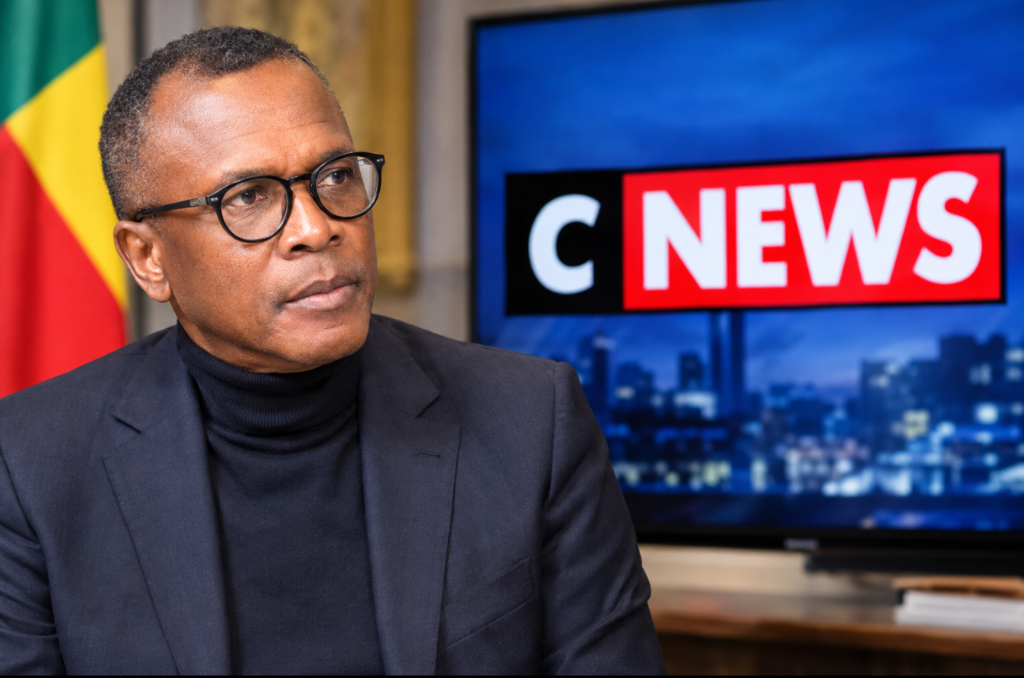
When foreign media content crosses ethical lines: a question of national dignity
As debates on media ethics and racial discrimination intensify across Africa, Benin now faces a crucial strategic dilemma: how should a sovereign nation respond when foreign news outlets, accessible within its borders, consistently broadcast material considered derogatory toward its people and the broader African diaspora? The bold move by Claudy Siar, presidential envoy and former RFI host, has thrust this dilemma into the spotlight, sparking urgent discussions on dignity, regulation, and the limits of cross-border media influence.
Claudy Siar’s call to action: protecting African identity in a globalized media landscape
In a public statement widely circulated in Beninese media, Claudy Siar, special advisor to President Romuald Wadagni, condemned what he described as a pattern of discriminatory and dehumanizing rhetoric against Africans on CNews. He emphasized that such content is not merely a matter of French domestic discourse—it directly affects Beninese citizens and the wider African community. “Every segment targeting Africans on CNews perpetuates a narrative of exclusion that we cannot tolerate in our homes or on our screens,” he stated.
Siar’s campaign is rooted in a broader vision of African dignity and representation. He argues that Benin cannot remain a passive recipient of media content that undermines the identities of its people. By demanding the removal of CNews from Canal+’s pay-TV bouquets in Benin, he seeks to reassert national sovereignty over cultural and ethical standards in audiovisual broadcasting.
A matter of legal precedent and shared identity
The Beninese official also referenced recent regulatory actions taken against CNews in France. In 2024, France’s audiovisual regulator issued substantial fines—totaling €80,000—for violations tied to specific broadcasts containing hate speech and discriminatory language. While these sanctions targeted particular segments and procedural breaches, they underscore a growing intolerance toward such content in Europe, reinforcing Siar’s claim that CNews’s editorial line falls outside acceptable public discourse.
For Siar, the implications are clear: if France is taking steps to curtail such rhetoric, Benin—whose population is deeply connected to the African diaspora—must act decisively to protect its citizens from similar harm. His initiative challenges both Canal+ Benin and the national regulator, the HAAC, to take responsibility for the content entering Beninese homes.
The regulatory path: mobilizing institutions to address a transnational issue
Siar’s approach is not limited to public advocacy. He has formally announced plans to engage directly with Canal+ Benin’s management to request the removal of CNews from its local broadcast packages. Additionally, he is pursuing a meeting with the president of the High Authority for Audiovisual and Communication (HAAC), Édouard Loko, a key figure in media regulation within the country. This coordinated action signals a strategic move to leverage both private sector accountability and national regulatory oversight.
While a direct request to a distributor does not constitute an administrative ban, it places pressure on all parties to evaluate the ethical and legal implications of broadcasting CNews. The HAAC’s potential involvement could lead to formal reviews of content compliance with Beninese media laws—especially those protecting against hate speech and racial discrimination. Yet, the legal landscape remains complex: any restriction must align with constitutional guarantees of freedom of expression, even when addressing concerns over harmful narratives.
Balancing freedom of expression with the fight against racism
At the heart of this controversy lies a fundamental tension between two principles: the right to free expression and the obligation to prevent racial discrimination. This tension is not unique to Benin—it is a global challenge as digital broadcasting and satellite TV enable media from one nation to influence audiences across borders. The question now arises: when does the diffusion of foreign content that degrades a people’s dignity override the principle of unrestricted opinion sharing?
Siar’s initiative forces a reckoning with this paradox. On one side, there is undeniable value in a free and pluralistic media environment. On the other, the normalization of racist or dehumanizing language—even within foreign markets—carries a cost that nations like Benin can no longer ignore. The challenge lies in devising regulatory mechanisms that are both effective and legally sound, protecting citizens without stifling legitimate debate.
What’s next? A test of wills in media regulation
As of now, no official decision to remove CNews from Benin’s television offerings has been confirmed. The outcome will depend on several factors: the responsiveness of Canal+ Benin, the stance of the HAAC, and the broader public and political momentum behind Siar’s campaign. Yet one thing is certain—the debate he has ignited will resonate far beyond the corridors of power in Cotonou.
For many observers, this case could set a precedent for how African nations respond to harmful foreign media content. It raises urgent questions: Can regulation adapt to the realities of transnational broadcasting? What role should cultural dignity play in media policy? And how can nations balance moral responsibility with legal constraints?
Claudy Siar’s stand may be just the beginning. Whether it leads to concrete action or remains a bold statement of values, it has already reshaped the conversation—placing Benin at the forefront of a continental movement toward reclaiming media narratives and asserting cultural self-respect.