The future of education in Niamey is at a crossroads. As armed violence forces school closures and a severe shortage of qualified teachers cripples classrooms across Niger, Mali, and Burkina Faso, the first AES Education Ministers’ Conference in the capital is being watched closely. Will delegates rise to the challenge of building an integrated, resilient school system—or will systemic failures leave generations behind?
In a high-stakes gathering convened in Niamey, ministers of Education from the Alliance of Sahel States (AES) opened a two-day conference today. The opening ceremony was led by Niger’s Prime Minister, Ali Mahamane Lamine Zeine, alongside CNSP members, government officials, and foreign dignitaries. Delegations from Mali and Burkina Faso attended, each led by their respective education ministers. The stated aim: to forge a unified, sovereign, and resilient educational framework for the Sahel.
Why an integrated school system under AES leadership faces an existential test
Behind the diplomatic announcements and policy pledges lies a stark reality: the region’s education systems are buckling under the weight of multiple crises. A chronic lack of qualified teachers, widespread school closures due to insecurity, and mass population displacement are not just disrupting learning—they are eroding the very foundations of educational sovereignty. At the heart of the debate in Niamey: Can a nation build an education system it controls when classrooms are empty and teaching posts go unfilled?
Teacher shortages: the silent collapse of classroom standards
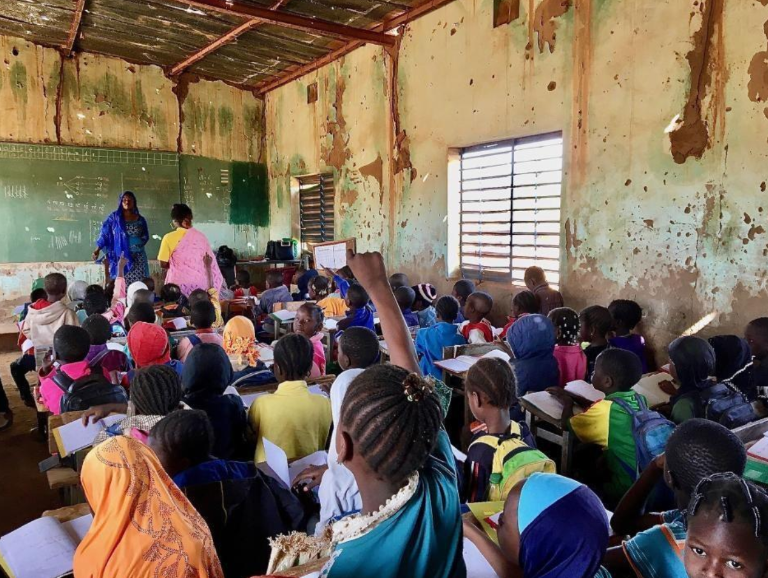
Numbers don’t lie. In Niger’s 2023–2024 school year, over 3 million primary students were taught by fewer than 70,000 educators—an average of 43 pupils per teacher, far exceeding recommended limits. This imbalance strains both infrastructure and teaching quality. The problem isn’t just about quantity. According to the same figures, many teachers are underqualified or lack pedagogical training. As late as 2026, the Minister of Education acknowledged that the shortage of trained teachers remained one of the system’s gravest internal weaknesses.
These challenges are not new. A 2017 UNESCO study revealed that 78.5% of Niger’s 70,491 public school teachers were contractual—some without prior training. This legacy of precarious hiring continues to undermine educational standards across the region.
In Burkina Faso and Mali, the crisis is compounded by security constraints. Teachers are reluctant to serve in remote or high-risk zones, and many flee areas under attack. This brain drain leaves rural schools empty of educators, forcing students into overcrowded classrooms or abandoning their studies altogether.
Insecurity and school closures: a generation in the balance
Violence doesn’t just uproot families—it closes schools and darkens futures. In Burkina Faso, over 5,300 schools shut their doors in early 2024, denying education to more than 820,000 children and forcing 24,000 teachers out of work. Despite government efforts to reopen some institutions, insecurity continues to block access in vast areas.
Mali faces a similar plight. By mid-2026, nearly one in five schools—2,444 in total—remained non-operational, leaving 733,200 children without teachers and 14,604 educators idle. In Niger, nearly 1,100 schools closed by the end of 2025, affecting 93,676 students—half of them girls. The Tillabéri region alone accounted for 1,032 of these closed facilities.
Each closed classroom represents a dream deferred. Each displaced child is a statistic of hope lost.
Displacement: when fleeing war means leaving education behind
Forced migration isn’t just a humanitarian issue—it’s an education emergency. When families flee attacks, they often leave behind not only homes and livelihoods, but also school records and enrollment status. In 2026, over 2 million people were internally displaced in Burkina Faso, 414,524 in Mali, and 548,386 in Niger. These families resettle in safer areas, overwhelming local schools that lack the space and staff to accommodate new arrivals.
Many children face prolonged school interruptions. Some never return. Others are enrolled in makeshift classes with no textbooks, no desks, and no qualified teachers. The result? A generation growing up without the tools to shape its own future.
AES education summit: from vision to action or hollow pledges?
Niamey’s conference is more than a diplomatic exercise—it’s a test of political will. The agenda includes harmonizing curricula, sharing teaching materials, recognizing diplomas across borders, training teachers, and expanding technical education. These are critical steps toward regional cohesion.
But declarations alone won’t rebuild schools or recruit teachers. Real change demands emergency action: reopening closed institutions, securing campuses, prioritizing teacher deployment to high-risk zones, and creating alternative learning programs for displaced children. Failure to do so risks turning the AES alliance’s educational vision into a hollow ideal, disconnected from the reality in classrooms.
According to Niger’s Education Minister, nearly five million children in the country remain out of school. That number is both a warning and a call to action. The true measure of AES’s educational sovereignty won’t be found in ministerial statements—but in the reopened doors of Sahelian classrooms, where every child, regardless of origin or circumstance, can learn, grow, and lead.