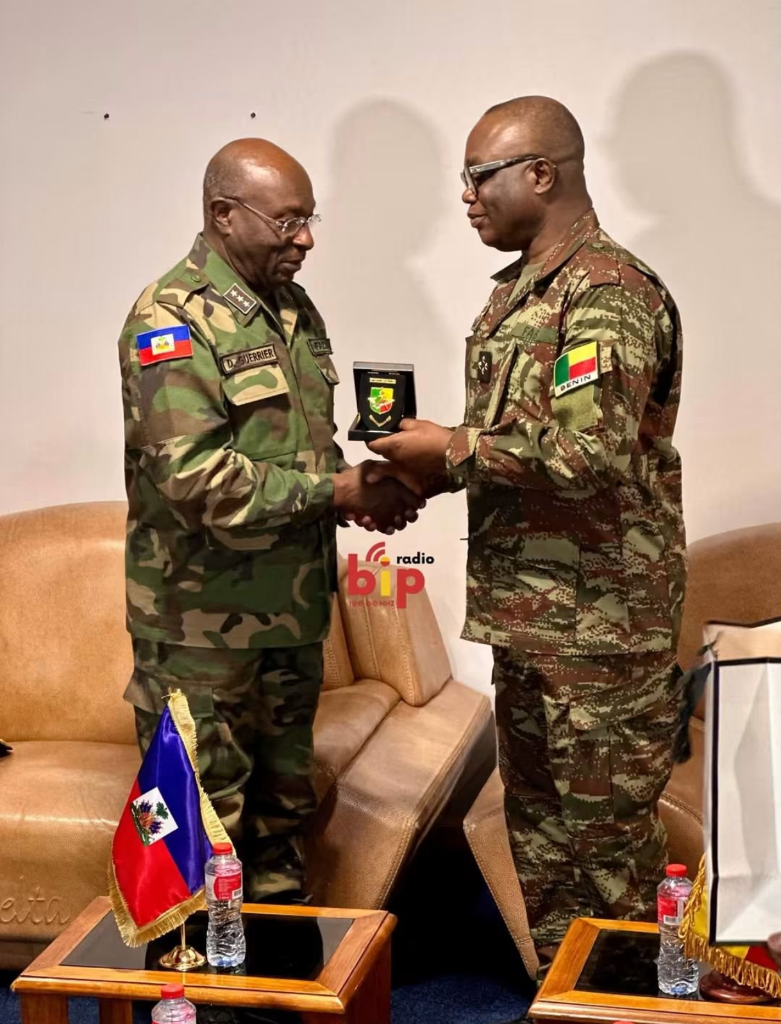
Can Cotonou turn its 2024 pledge into action against Haitian insecurity?
Port-au-Prince, Cotonou — 3 November 2026 — A single question hangs over this week’s high-stakes military talks: will Bénin finally deploy its 1 500-troop offer to stabilise Haiti, first tabled in February 2024 but never executed? Lieutenant-General Derby Guerrier, Chief of Staff of Haiti’s Armed Forces (FAd’H), is in Cotonou this week for closed-door meetings with his Béninois counterpart, General Fructueux Gbaguidi. Their agenda: translating a shared sense of urgency into concrete defence cooperation.
Why the timing of this visit is critical
The trip lands during a pivotal moment for both nations. In Haiti, armed gangs now control entire districts of Port-au-Prince, public institutions are on the brink of collapse, and the national police are overwhelmed. Simultaneously, Bénin faces its own northern flank under pressure from Sahel-linked jihadist movements, making its armed forces acutely aware of the operational gaps that rapid-deployment partnerships can fill.
The Haitian delegation arrives fresh from last month’s UN Security Council briefing, where the deteriorating situation was described as “a powder keg”. Cotonou’s original 2024 offer—up to 2 000 troops under a Kenyan-led multinational mission—has remained on paper ever since. Today’s meetings at the Béninois Joint Staff headquarters are intended to clarify whether that pledge can now move from memorandum to movement.
What changed since the 2024 military blueprint?
The February 2024 pledge was a diplomatic first. President Patrice Talon publicly pledged Béninois soldiers to the UN-backed Multinational Security Support Mission (MSS), signalling Cotonou’s willingness to share security burdens beyond its immediate borders. Yet two years later, the troops remain in barracks. Sticking points included:
- Operational command under a Kenyan police officer rather than a military chain of authority
- Uncertainty over financing once Kenyan and Jamaican contingents withdraw
- Rules of engagement that did not clearly define the threshold for lethal force
- Logistical risks linked to medical evacuation from Port-au-Prince’s gang-controlled zones
General Gbaguidi and General Guerrier are now reviewing whether those obstacles can be overcome through bilateral annexes, or if a different command structure is required.
Where common ground could reshape Caribbean–West African defence
Even if troop numbers are not on the table this week, the visit is already yielding offline benefits:
Shared lessons in counter-gang operations
Bénin’s experience dismantling jihadist networks in Atacora and Alibori departments offers tactical insights into intelligence-led raids and night interdiction techniques—tactics Haitian forces are scrambling to master.
Joint training pipelines
Discussions have begun on a reciprocal secondment programme: Béninois officers would train Haitian commandos in urban reconnaissance; Haitian non-commissioned officers would refresh Béninois units in civil–military relations, a critical discipline when operating in densely populated areas.
Regional intelligence fusion
Both general staffs are exploring a discreet fusion cell that would pool satellite imagery and community-level early-warning networks, reducing the blind spots that currently allow gangs to relocate unchecked.
South–South solidarity or pragmatic partnership?
Relations between Port-au-Prince and Cotonou are framed by historical ties—Haiti’s founding fathers drew inspiration from early-19th-century Béninois resistance fighters. Yet today’s cooperation is less about nostalgia and more about hard security calculus.
The Béninois delegation is studying Haiti’s new draft procurement law, which fast-tracks defence acquisitions in emergency zones. If enacted, it could allow future ammunition and medical resupply convoys to reach Haiti via a Cotonou–Abidjan maritime corridor already patrolled by regional navies.
Conversely, Haitian civil engineers briefed their Béninois hosts on rapid bridge-building techniques that helped restore supply routes after the August 2025 floods in Artibonite and Nord departments. Such exchanges demonstrate how mutual vulnerabilities can become catalysts for deeper collaboration.
What comes next: signals to watch
No communiqué is expected before tomorrow’s closing press conference. However, four indicators will reveal whether today’s talks have moved beyond protocol:
- A joint statement mentioning a technical assessment mission to Port-au-Prince within 30 days
- Announcement of a working group on command-and-control protocols
- Any indication that Bénin will contribute to the MSS logistics fund, even without immediate troop deployment
- Release of a time-bound training schedule for Haitian special forces in Cotonou
The lieutenant-general’s departure on Friday will mark only the first chapter. The true test will be whether these conversations produce actionable roadmaps—or if another two years pass before the next round of corridor diplomacy.