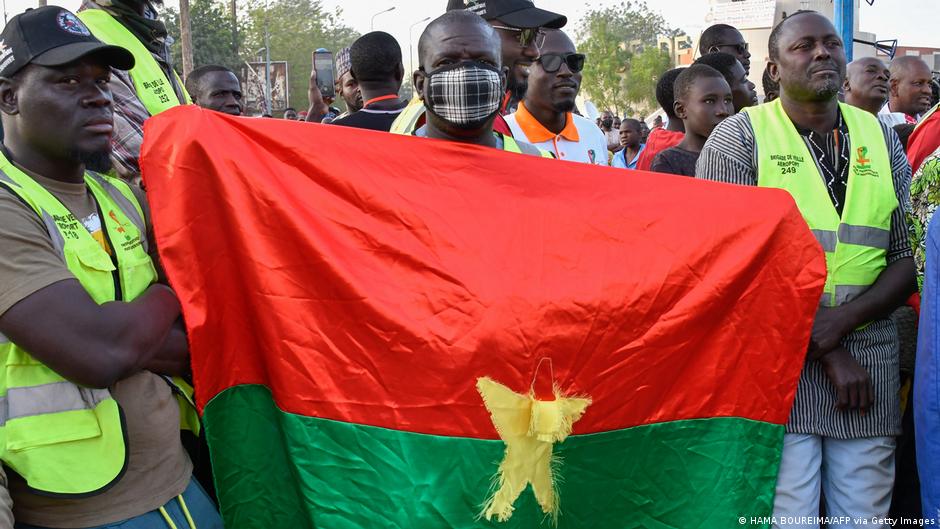
In Burkina Faso, the arrest of influential Imam Mohamed Ishaq Kindo and the suspension of the country’s main student union, the UGEB, signal a sharp escalation in repression under the current military leadership. This week has been particularly tense, revealing deepening cracks in civic freedoms across the Alliance of Sahel States (AES).

Imam Kindo’s arrest: a chilling warning
Just days before Eid al-Adha, witnesses reported seeing masked men—police and military—detain Imam Mohamed Ishaq Kindo at his Ouagadougou residence. The imam, a respected voice in Burkina Faso’s Muslim community, had publicly criticized a draft law regulating religious practices, particularly public prayers. His detention sparked immediate outrage, with protests turning violent and dozens arrested.
The Federation of Islamic Associations of Burkina (FAIB) repeatedly called for calm as misinformation spread. A fake statement claiming the imam’s death circulated online before being swiftly debunked by prosecutors. Some videos allegedly showing abuses were flagged by fact-checkers for inconsistencies, raising suspicions of AI-generated content.
Distinct from Mali’s Imam Dicko
While some observers draw parallels with Mali’s Imam Mahmoud Dicko, Burkinabè journalist Newton Ahmed Barry dismisses the comparison. “Kindo was not driven by political ambition like Dicko,” Barry explains. “He focused on civic vigilance, particularly safeguarding Islamic doctrine through his role in the FAIB.”
UGEB suspension: students targeted as dissent grows
The military government took another drastic step by suspending the Union of Burkinabè Students (UGEB) for three months—renewable. UGEB’s president, Bazo Wilfried, and members face accusations of “terrorism glorification” and “demoralizing security forces” after criticizing the government’s inability to curb insecurity, describing the situation as a “civil war.”
Mahamadou Idder Alghabid, deputy secretary-general of the Sahel Democrats Alliance (SDA), condemns the tactic: “Accusing unarmed students of terrorism is laughable. But this pattern is now familiar across the Sahel—where any dissent is crushed with terrorism allegations, a tactic embraced by Burkina Faso, Mali, and Niger’s military juntas.”
Regional crackdown on freedoms
Burkina Faso’s repression mirrors trends in neighboring Mali and Niger, where civil society organizations are dissolved, judicial pressure mounts, and free speech is increasingly criminalized. The SDA warns that the line between political critique, union activism, and criminal offense is disappearing.
Despite risks—arrests, abductions, and violence—voices of opposition persist, often from exile. Alghabid asserts: “We know the fight is uphill against three military regimes. But every day, we gain ground while they lose it. Their propaganda initially worked, promising sovereignty and anti-imperialism. Today, those promises lie shattered. Saharans are waking up to the reality of broken commitments.”
A regime’s vulnerability
Newton Ahmed Barry believes the junta’s heavy-handed tactics may backfire: “Excessive force is the downfall of any regime. Ibrahim Traoré’s government is no exception. But the people are not broken. Burkina Faso’s society will respond—mark my words.”
Global calls to defend civic space
Human rights defenders urge international support for civil initiatives. “Condemning junta abuses isn’t counterproductive—silence and ambiguity only legitimize authoritarianism,” argues Ilaria Allegrozzi of Human Rights Watch. “Partners must stop hiding behind false pragmatism. The international community must name these violations for what they are: unacceptable.”