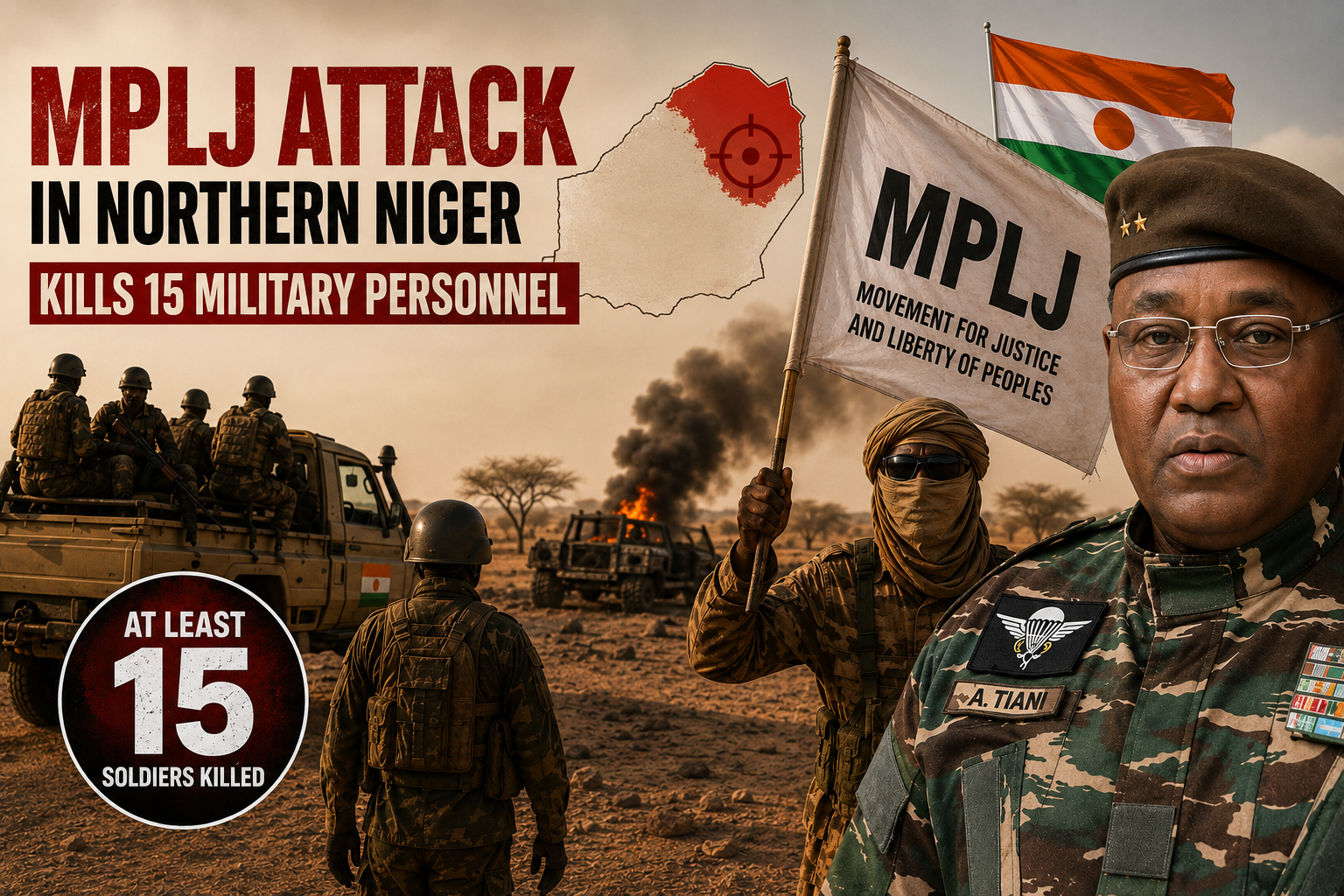
In Niger, the escalating insecurity continues to undermine the military government’s sovereignist rhetoric. A recent dual assault in the country’s north, claimed by the Movement for Justice and the Liberation of Peoples (MPLJ), resulted in the deaths of at least 15 soldiers. This incident starkly illustrates a harsh reality: the junta, led by General Abdourahamane Tiani, struggles to fulfill the fundamental duty of any state – protecting its own citizens and extending its authority across the territory.
Beyond the tragic human toll, this attack once again raises critical questions about the operational capacity of Nigerien forces to control the nation’s vast desert and border regions. Niger encompasses an immense territory, inherently difficult to monitor, characterized by extensive borders shared with several neighboring states that themselves grapple with armed threats. Under such conditions, any weakly controlled area can become a strategic base for groups capable of movement, regrouping, striking, and then dispersing.
The challenge, therefore, transcends that of an isolated incident. It reveals the inherent difficulties of a security strategy that appears to remain largely focused on immediate military responses. However, the nature of the threat demands a comprehensive approach encompassing robust intelligence gathering, a permanent administrative presence, effective cross-border cooperation, and the capacity to prevent armed groups from establishing lasting footholds.
A new security setback and rhetorical limits
Following this latest security setback, a crucial question emerges: towards whom will the regime under Abdourahamane Tiani direct its accusations this time? After previously denouncing France, severing ties with ECOWAS, and pointing fingers at several regional neighbors, the official discourse appears to be running out of external scapegoats. Will it now target Algeria, a bordering nation and indispensable partner, or will it begin to question its newly forged strategic alliances? The strategy of assigning blame now confronts its structural limitations.
Since the July 2023 coup d’état, the military government has largely built its legitimacy upon the promise of a decisive break from previous security policies. Sovereignty, the condemnation of foreign interference, and the pursuit of new partnerships have been central tenets of its official narrative. Yet, for the populations directly exposed to these relentless attacks, the primary indicator remains far more tangible: the ability to live, move freely, work, and sleep without the constant dread of another armed offensive.
The paradox confronting the authorities in Niamey lies in this striking disparity: an asserted mastery of international geopolitical stakes contrasting with a troubling lack of understanding of local geographical and security dynamics. While the sovereignist discourse resonates on diplomatic platforms globally, the nation’s border and desert territories are sinking into a security vacuum, readily exploited by various armed factions.
Defining true sovereignty
This situation also underscores a fundamental contradiction. Sovereignty is not solely measured by a government’s capacity to denounce foreign influences or alter its diplomatic alliances. Primarily, it is gauged by the state’s ability to effectively exercise its authority over its territory, secure its borders, and guarantee the protection of its citizens.
The proliferation of attacks in areas distant from the capital thus constitutes a major test for military governance. The longer the violence persists, the more the authorities must demonstrate that the diplomatic and military shifts implemented since 2023 are yielding concrete results on the ground. The Nigerien populace can hardly be expected to remain indefinitely satisfied with political pronouncements when human casualties continue to mount.
The question of alliances also warrants an impartial examination. The pursuit of new partners is not inherently problematic. Indeed, it can represent a legitimate strategy if it genuinely enhances national defense capabilities. However, a mere change of partners does not automatically constitute a new security doctrine. What truly matters are the demonstrable outcomes: effective intelligence, anticipation of attacks, protection of populations, secure transportation routes, and the maintenance of a state presence in vulnerable zones.
In this context, Niger’s diplomatic isolation from certain regional partners could also become a significant handicap. The armed threat disregards political boundaries. Groups operating across the Sahel precisely leverage cross-border spaces for movement and reorganization. Combating them therefore necessitates robust mechanisms for cooperation, intelligence exchange, and coordination—mechanisms that diplomatic tensions can severely weaken.
It would also be an oversimplification to attribute every military setback solely to the soldiers on the front lines. Armed forces operate within an exceptionally complex environment. Their effectiveness hinges on the quality of intelligence, logistics, the chain of command, available air and ground assets, as well as the political capacity to define a coherent long-term strategy. The losses sustained should thus prompt a serious evaluation of the entire security apparatus rather than a systematic search for external blame.
In a scenario where institutional order has been disrupted without the promise of enhanced security being fulfilled, the responsibility of national actors becomes paramount. To achieve lasting stability for the country and protect its people, both the military and civil society would benefit from scrutinizing the current trajectory and contemplating a swift return to constitutional order. This framework alone can offer democratic legitimacy and foster robust alliances essential for confronting the persistent terrorist challenge.
Ultimately, security cannot sustainably rest solely on the popularity of a sovereignist discourse. It demands strong institutions, a clear national strategy, pragmatic regional cooperation, and an administration capable of maintaining a presence even in the most remote territories. The attack attributed to the MPLJ is, therefore, far more than just another bloody episode in the Sahelian conflict. It serves as a stark reminder of an undeniable truth that political slogans cannot erase: true sovereignty begins when the state effectively protects those living under its authority.