DRC government strengthens case against Rwanda and m23 with human rights and conflict mineral reports
- Sécurité
The government of the Democratic Republic of Congo (DRC) has declared its intention to intensify its legal and economic countermeasures following the recent reports from Human Rights Watch and Global Witness. These critical reports shed light on the dire security and humanitarian situation, along with the exploitation of natural resources, in the areas of Eastern DRC currently under the control of the AFC/M23 rebellion.
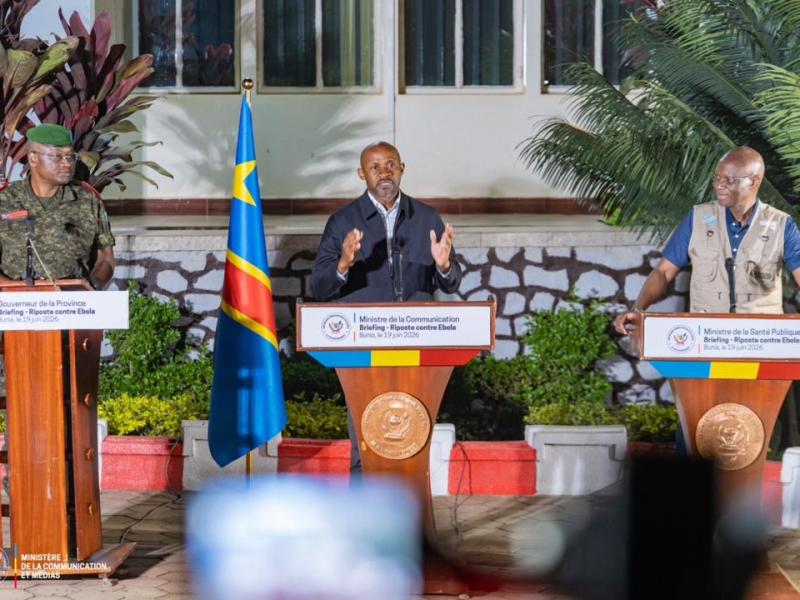
During a press briefing, government spokesperson Patrick Muyaya, alongside his colleague Samuel Roger Kamba of Public Health, Hygiene, and Social Welfare, indicated that these findings were not unexpected by Congolese authorities. Kinshasa, Muyaya explained, is actively engaged on both a “judicial front” and an “economic front.” He further announced that the Ministry of Justice would soon initiate new legal proceedings.
“Regarding the recent reports by Human Rights Watch and Global Witness, these are not surprising to us, as we have our own intelligence services. Moreover, it is precisely why our strategy to counter this aggression involves action on multiple fronts. There is a judicial front and an economic front. In the coming days, new legal actions will be launched by the Ministry of Justice. For us, particularly concerning minerals, it is insufficient to merely point fingers at those who exploit resources directly. We must scrutinize the entire supply chain,” Patrick Muyaya stated to the press.
Addressing the illicit exploitation and trade of minerals in Eastern DRC, Patrick Muyaya emphasized the necessity of examining the entire commercial circuit, rather than solely attributing responsibility to local actors. He recalled a significant meeting held in Geneva several months prior, involving the Prime Minister and various traders implicated in these commercial networks.
“These reports corroborate information we already possessed. They also furnish supplementary details that can bolster the cases we have already compiled. As I mentioned, there is both a judicial component and an economic aspect. We are specifically targeting the war economy sustained by Rwanda, which benefits from the prolonged instability in the Eastern part of the Democratic Republic of Congo,” the government spokesperson, Patrick Muyaya, elaborated.
Another critical issue highlighted by Patrick Muyaya concerned allegations of forced child recruitment, notably documented by Human Rights Watch. The government spokesperson revealed that Congolese authorities have been receiving alerts on this matter for several months. He attributed the use of such coercive tactics to the unpopularity of the AFC/M23 rebellion in the occupied territories, where they purportedly seek to enforce their presence through intimidation.
<“The reports also raise the issue of forced child recruitment, particularly in the Human Rights Watch document. We are aware that the M23 and its backers are unpopular in the areas they occupy. Since they govern through fear and violence, they resort to coercive methods, especially targeting children, mirroring practices seen in Rwanda. On numerous occasions, we have received alerts from parents. At one point, some hesitated to send their children to school due to fears of forced recruitment. Staged events are sometimes organized to present so-called volunteers recruited from certain camps,” he asserted during his intervention.
He added: “The conclusions reached by Human Rights Watch validate our long-standing denunciations. They will further strengthen existing legal proceedings. The documented facts constitute grave offenses, including war crimes, for which national and international justice mechanisms have already been engaged or will be in the near future.”
Continuing his address, Patrick Muyaya reiterated the government’s unwavering resolve to pursue its actions against Kigali and the AFC/M23 on multiple fronts, aiming to restore the Democratic Republic of Congo’s sovereignty and rights.
“We understand the nature and methods of the aggressor; we will pursue them relentlessly. Furthermore, the reports from Human Rights Watch and Global Witness do not necessarily encompass the entirety of what transpires on the ground. This is why we continue to rely on the work of our own services, and when such reports are released, they complement our ongoing investigations and further strengthen our response,” affirmed Patrick Muyaya.
Patrick Muyaya underscored that the government’s response transcends mere public statements, manifesting primarily through concrete actions. He referred to recent sanctions imposed by US authorities on certain Rwandan army officials, suggesting these measures align with efforts to combat illicit networks linked to mineral exploitation.
“The government’s response is not confined to declarations or communiqués. It is, above all, translated into concrete actions. If US authorities recently sanctioned certain Rwandan army officials, it is precisely because this army is deemed involved, complicit, or responsible for illicit circuits connected to the exploitation and trade of minerals. All these matters are already subject to legal proceedings and actions that will continue in the coming weeks,” Patrick Muyaya stated.
These report findings reinforce prior investigations into human rights violations and the systematic looting of natural resources in Eastern DRC. They emerge amidst the ongoing offensive by the AFC/M23, a movement that, according to Congolese authorities and several international reports, receives support from Rwanda and controls vast territories across the North Kivu and South Kivu provinces. The revelations by Global Witness once again raise serious questions about the effectiveness of international mechanisms designed to prevent strategic conflict minerals from entering global supply chains.
For several years, the government of the Democratic Republic of Congo has maintained that the persistent instability in the country’s East is driven by economic interests tied to the illegal exploitation of mineral resources. Kinshasa frequently characterizes this conflict as an “economic war” aimed at plundering Congolese minerals. Kigali, however, consistently rejects these accusations, denying any involvement in the illegal exploitation of DRC’s natural resources or the destabilization of its eastern region.

Related Articles