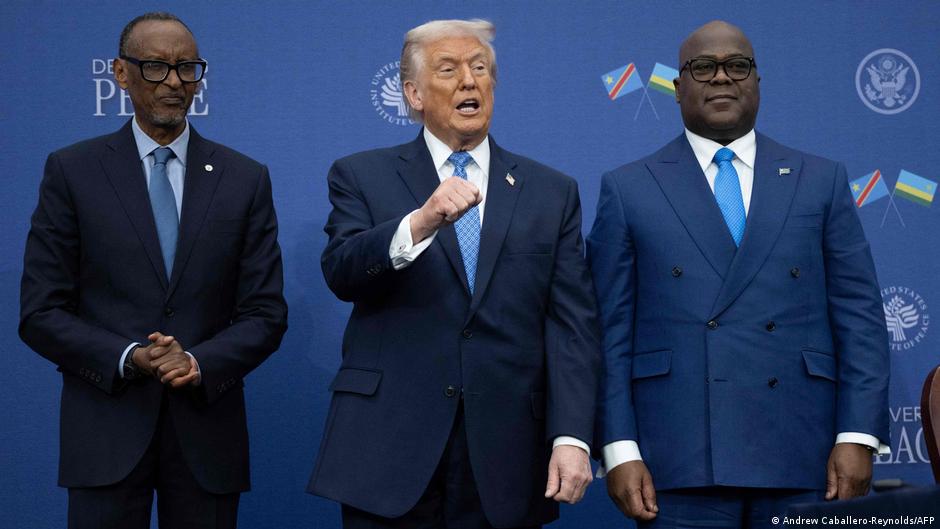
One year after the Washington peace deal, the Democratic Republic of the Congo (DRC) has escalated its legal battle against Rwanda, accusing Kigali of sustained backing for armed factions in the eastern provinces. The move comes as fighting rages on between Congolese forces and the M23 rebel alliance, which Kinshasa claims receives direct military and logistical support from neighboring Rwanda.
The escalation in diplomatic tensions follows Washington’s recent sanctions against Rwandan entities linked to illegal mineral trade from rebel-held zones. The measures target Gasabo Gold refinery and several mining firms, alleging their involvement in financing rebel operations through illicit resource extraction.
Broken promises and unending conflict in eastern DRC
Residents of Bukavu, the capital of South Kivu, describe a stark contrast between the 2025 Washington accord—signed by Congolese President Félix Tshisekedi, Rwandan leader Paul Kagame, and a U.S. mediator—and the grim reality on the ground. Markets remain shuttered, airports closed, and civilian life continues to unravel under persistent rebel control.
« We were told the agreement would bring change—banks reopening, flights resuming—but nothing has changed. The suffering continues as if nothing happened. »
« Why does Washington’s pressure not extend to our neighbors who invade our land? The world watches, but justice never arrives. »
Kinshasa demands accountability at the Hague
The DRC’s petition to the International Court of Justice seeks reparations for victims and formal recognition of Rwanda’s alleged role in fueling decades of violence through proxy militias. Kinshasa argues that Kigali’s support for groups like the M23 has systematically violated Congolese sovereignty and international humanitarian law.
Meanwhile, Washington’s sanctions, while symbolic, have drawn skepticism from conflict analysts. Yvon Muya, a conflict studies expert at the University of Saint Paul in Canada, warns that without addressing the root strategic incentives, punitive measures may fail to alter the status quo.
« The current sanctions do not appear to shift the cost-benefit calculus for key actors. As long as the risks of confrontation remain lower than the perceived gains of maintaining proxy control, the cycle of violence persists. »
Military buildup signals deeper confrontation ahead
Military observers warn that both sides are using the fragile peace period to reinforce positions. Professor Bob Kabamba of the University of Liège in Belgium suggests that neither Kinshasa nor Kigali is negotiating in good faith, but rather preparing for a decisive showdown.
« This is a moment of tactical regrouping. The government seeks to reclaim lost territories, while the M23 aims to expand its influence toward Katanga, putting unprecedented pressure on the Tshisekedi administration. »
Since mid-2025, M23 rebels have maintained control over critical cities including Goma and Bukavu, along with vast swaths of North and South Kivu. The prolonged occupation has displaced hundreds of thousands, deepening a humanitarian crisis marked by food insecurity and collapsed infrastructure.