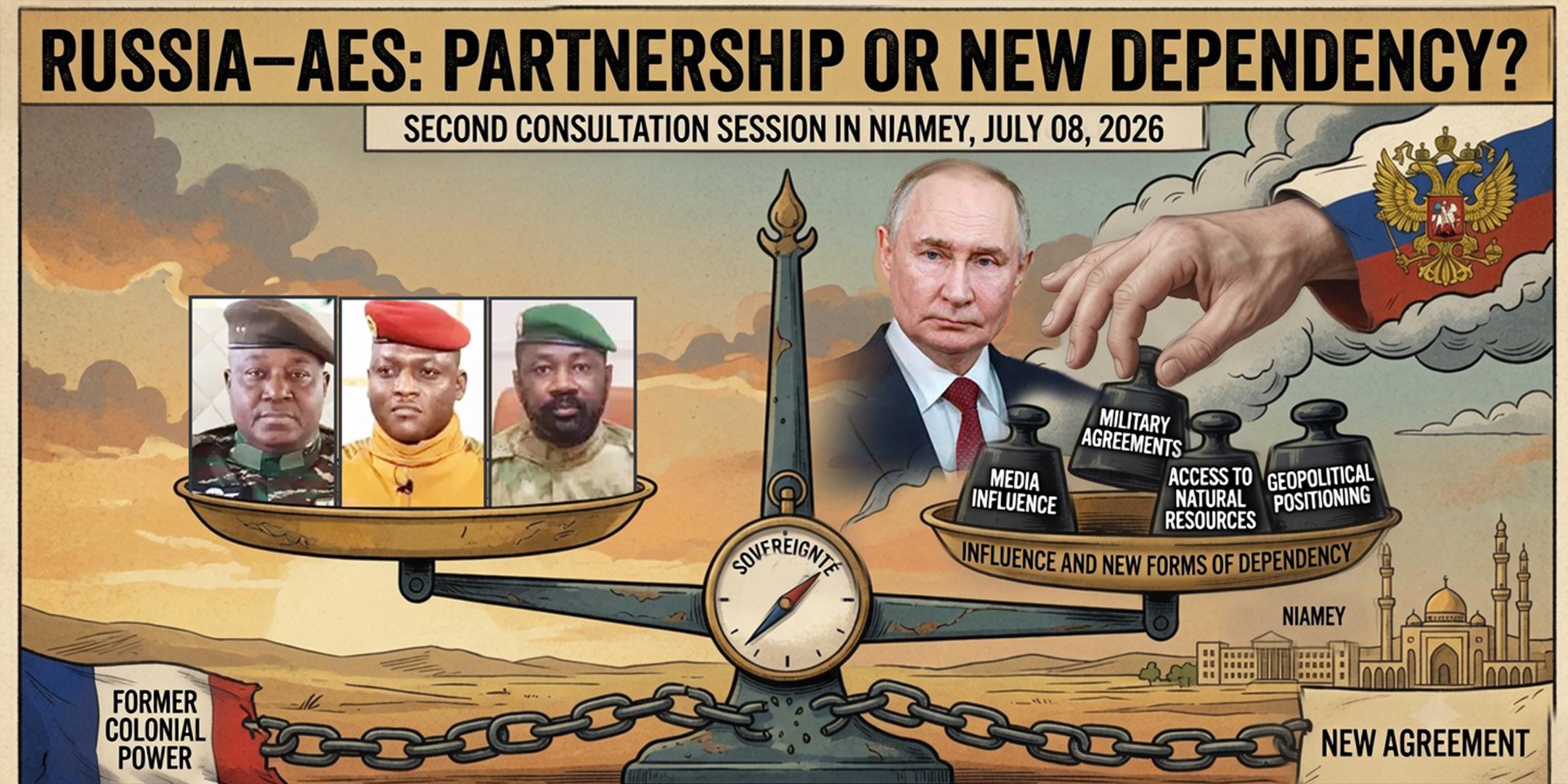
On July 8, 2026, Niamey hosted the second round of high-level consultations between the foreign ministers of the Alliance of Sahel States (AES) and Russian counterpart Sergey Lavrov. The event was framed by officials as a pivotal step toward fostering a relationship rooted in sovereignty and mutual respect. Yet beneath the official narrative lies a pressing question: could this growing alignment, rather than liberate the region, merely substitute one form of external dependency for another?
From historical grievances to new alliances
For years, the governments of the AES have criticized the long-standing influence of former colonial powers—particularly France—on the grounds of national sovereignty. However, replacing one foreign power with another does not inherently guarantee greater independence. Historical precedents demonstrate that interstate relations are frequently shaped by geopolitical, economic, and strategic interests, regardless of stated ideals.
Expanding russian influence across the Sahel
The Russian presence in the Sahel has intensified through multiple channels. Defense cooperation agreements, diplomatic engagements, economic exchanges, and cultural and media outreach now define a broad spectrum of collaboration. While AES governments portray this diversification as an assertion of sovereign choice, critics warn of a critical concern: at what point does such engagement risk fostering a new and potentially burdensome dependence?
What drives Russia’s engagement in west africa?
Major global powers rarely engage in regions like the Sahel without expecting substantial returns. Whether securing access to strategic resources, expanding diplomatic leverage, or securing geopolitical positioning in Africa, each partnership serves national objectives. Russia, in this context, is no exception to the broader pattern of power-driven diplomacy.
Geopolitical risks of over-reliance
A deepening partnership with a single external power carries significant political risks. It can narrow diplomatic maneuverability, limit the ability to cultivate diverse alliances, and expose states to greater international tensions. In a global landscape increasingly defined by great-power rivalry, the Sahel may find itself transformed from an autonomous actor into a contested battleground rather than a region of independent agency.
Sovereignty beyond rhetoric
Sovereignty cannot be measured solely by the selection of a new partner. True independence lies in the capacity to preserve decision-making autonomy, maintain balanced relationships, and defend national interests without defaulting to rigid alignment. The AES leadership emphasizes a vision of “mutually beneficial” cooperation. Yet such claims must be assessed against tangible outcomes: sustainable security improvements, economic growth, employment generation, skills transfer, and institutional strengthening. Without visible progress in these areas, declarations of sovereignty risk appearing as empty political posturing rather than lived reality for citizens.
An uncertain trajectory
The long-term implications of this partnership remain uncertain. Will closer ties with Moscow enable the Sahel states to achieve genuine autonomy, or will they merely represent a shift from one sphere of influence to another? For many analysts, the hallmark of true independence is not the substitution of one dominant partner for another, but the ability to engage with the world through a balanced, non-aligned diplomacy—one that avoids dependency on any single external actor.