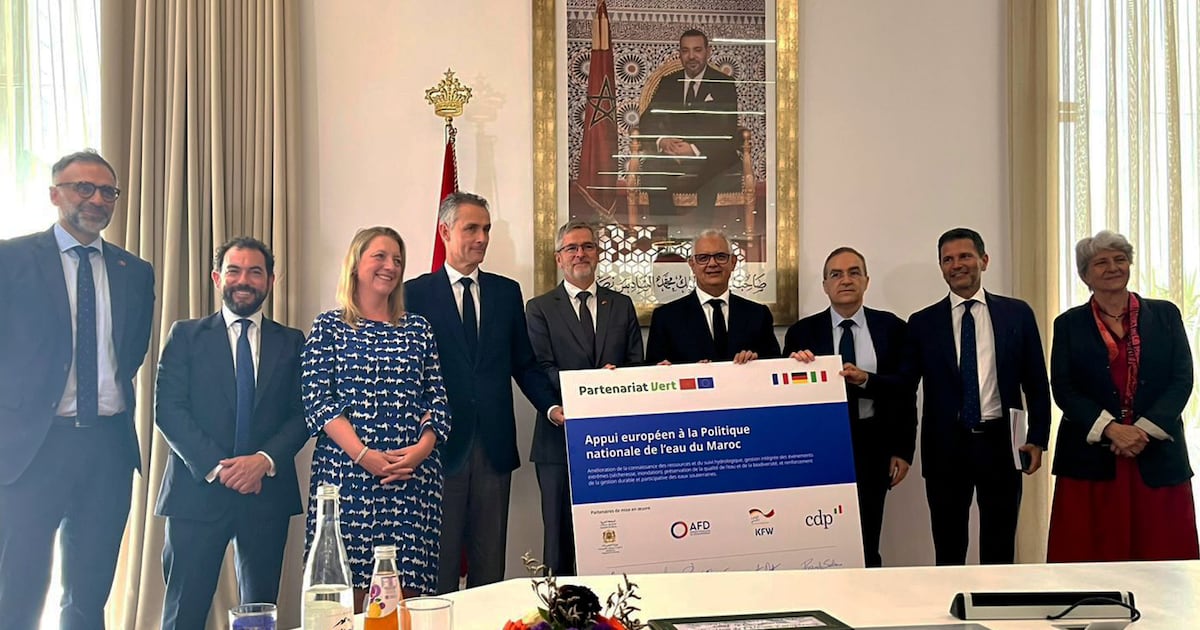
European Union officials alongside key European development agencies formalized a landmark funding agreement in Rabat, channeling €348 million—approximately 3.7 billion Moroccan dirhams—into Morocco’s nationwide water infrastructure initiative.
The landmark accord was signed at the Ministry of Equipment and Water headquarters, with Nizar Baraka, the country’s Minister of Equipment and Water, joining forces with the European Union’s ambassador to Morocco and counterparts from France, Germany, and Italy.
A three-year commitment, this financial infusion builds on an earlier pact inked in November 2024, following high-level talks in Rabat between King Mohammed VI and the French President.
Leading the European consortium is the French Development Agency (AFD), alongside Germany’s public development bank KfW and Italy’s Cassa Depositi e Prestiti. The AFD, designated as the project’s lead agency, has spearheaded coordination efforts, drawing contributions from multiple European partners.
Freshly appointed French Ambassador to Morocco Philippe Lalliot marked his inaugural official engagement in the Kingdom by praising the AFD’s pivotal role. He revealed that France has already contributed €1 billion to Morocco’s water sector, commending the European Union’s collaborative framework for its progress.
Speaking at the signing ceremony, European Union Ambassador to Morocco Dimiter Tzantchev emphasized the bloc’s prioritization of water security amid climate challenges. He confirmed that the €348 million will be channeled into rural water access—both potable supplies and agricultural irrigation—underscoring Brussels’ commitment to sustainable water governance.
Nizar Baraka, Morocco’s Minister of Equipment and Water, outlined the Kingdom’s bold national water strategy, driven by the vision of King Mohammed VI. “Our strategy currently relies on 26 operational dams, irrigating about 1.5 million hectares,” he stated, adding that Morocco aims to derive 60% of its potable water from desalination plants in the near term.
“He who does not control his water supply cannot control his destiny,” Baraka declared, reaffirming the urgency of water security for Morocco’s future.
The Minister also outlined plans to implement the new program with enhanced governance mechanisms designed for measurable impact, expressing gratitude to the ambassadors for their steadfast support.
Germany’s outgoing ambassador to Morocco highlighted the robust nature of Moroccan-German cooperation, noting that through KfW, Berlin is actively engaged in a critical sector: water. His remarks came as he prepared to conclude his diplomatic mission in the Kingdom.
This European financing reinforces Morocco’s resolve to tackle water scarcity and expedite its national water strategy. From desalination and dam construction to rural water access and agricultural irrigation, the initiative is more than infrastructure—it is a cornerstone of the country’s hydrological, agricultural, and social stability.