Military ascendancy and the abandonment of constitutional legitimacy
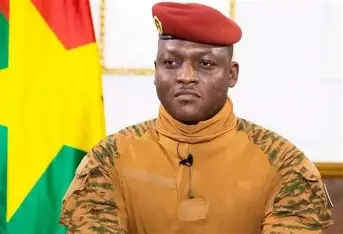
The recent pronouncements by Captain Ibrahim Traoré in Burkina Faso have intensified scrutiny over the foundations of his authority and the trajectory of the nation since the September 2022 coup. Observers note that his statements no longer leave room for ambiguity—they openly endorse a seizure of power achieved outside constitutional bounds, framing this rupture as a legitimate political precedent.
The facts are incontestable. Ibrahim Traoré did not ascend to leadership through electoral suffrage. His ascent followed a military putsch that ousted Lieutenant-Colonel Paul-Henri Sandaogo Damiba, who himself had come to power through an earlier coup against President Roch Marc Christian Kaboré. This chain of military overthrows signals a profound departure from the democratic principles that traditionally underpin a head of state’s legitimacy.
Legitimacy through force: a perilous precedent
Critics argue that the issue extends beyond the circumstances of his rise. More troubling is the emerging discourse that treats military force itself as a source of legitimacy. By publicly embracing this rejection of constitutional order, Traoré, they contend, normalizes the notion that power can be seized whenever armed factions command fleeting popular support.
Such a precedent carries grave consequences. If political legitimacy no longer derives from institutions, elections, or the rule of law but from the ability of armed groups to impose their will, future grievances could similarly justify further military interventions. This cycle erodes state institutions and fosters chronic instability, where the authority of the ballot box is steadily eclipsed by that of the rifle.
Sovereignty narratives versus governance realities
Proponents of the current regime often highlight restored sovereignty, a break from certain foreign influences, and a resurgence of national pride as central achievements. While these themes resonate with segments of the population, they cannot, in isolation, constitute a credible governance record. History demonstrates that nationalist rhetoric, however compelling, cannot substitute for tangible outcomes in economic performance, security, or institutional functionality.
Instead, critics point to an overreliance on political messaging. Speeches, patriotic symbols, and curated displays of support dominate the public sphere, amplified through digital platforms. Yet, amid this orchestrated narrative, persistent doubts linger over progress in the very domains that justified the coup in the first place: counterterrorism, territorial recovery, and the alleviation of civilian hardship.
Security failures and humanitarian crises persist
The most pressing expectation placed upon Traoré’s leadership remains security. Despite announced reforms and military restructuring, numerous regions continue to endure deadly attacks, mass displacements, and a deepening humanitarian crisis affecting hundreds of thousands. In several communities, civilians remain under the shadow of armed groups, while access to healthcare, education, and basic services remains severely constrained.
Economic conditions also remain dire. Persistent insecurity has crippled agriculture, domestic trade, and investment. The population’s foremost demands—stable employment, improved purchasing power, reliable access to essential services, and a climate conducive to rebuilding livelihoods—have yet to be met. The gap between these expectations and the reality on the ground continues to widen since the events of 2022.
Centralization of power and the stifling of dissent
Additional concerns arise over the growing concentration of authority. Public spaces for dissent are shrinking, and critics—including journalists, civil society actors, and opposition figures—face an environment where questioning the regime is increasingly equated with disloyalty to the nation. This conflation of patriotism with uncritical support for the leadership represents a troubling deviation from democratic norms. In a functioning democracy, allegiance to the country does not necessitate unqualified endorsement of its rulers.
The adage “power corrupts, and absolute power corrupts absolutely” finds resonance here—not as a personal indictment, but as a universal observation on how authority can distort judgment. History is replete with leaders who, convinced of their indispensability, have dismissed criticism, marginalized opponents, and conflated their personal survival with the nation’s fate. Traoré’s trajectory risks mirroring this pattern if unchecked.
As power becomes more centralized and presented as beyond reproach, the risk of losing touch with the population’s lived realities grows. Public applause, orchestrated narratives, and staged displays of allegiance cannot replace an honest assessment of results. The true measure of leadership lies not in rhetoric or defiance, but in adherence to institutions, protection of citizens, preservation of fundamental freedoms, and sustainable improvement in living conditions. It is against these standards that Traoré’s tenure will ultimately be judged. Until tangible progress is made in addressing the security, economic, and social crises, questions surrounding the legitimacy and durability of his rule will persist in Burkina Faso’s political discourse.