The Bold Slogan and the Financial Reality
In the official discourse of Burkina Faso’s military leadership under Captain Ibrahim Traoré, the phrase « Y’a pas crédit dedans » has become a rallying cry for economic sovereignty. Repeated endlessly across social media and echoed by regime supporters, it claims that every major infrastructure project—from road rehabilitation to state modernization—is funded solely by domestic resources, with no reliance on foreign borrowing.
At first glance, the message is compelling: Burkina Faso is forging ahead independently, free from the grip of international creditors. Yet, beneath the bold rhetoric lies a far more nuanced financial landscape.
A Vision of Sovereignty, But at What Cost?
Few would argue against the principle of economic independence. Strengthening domestic revenue collection, reducing reliance on external aid, and investing in national capacity are objectives shared by all nations. The challenge, however, arises when official narratives present these achievements as entirely self-financed, despite documented evidence to the contrary.
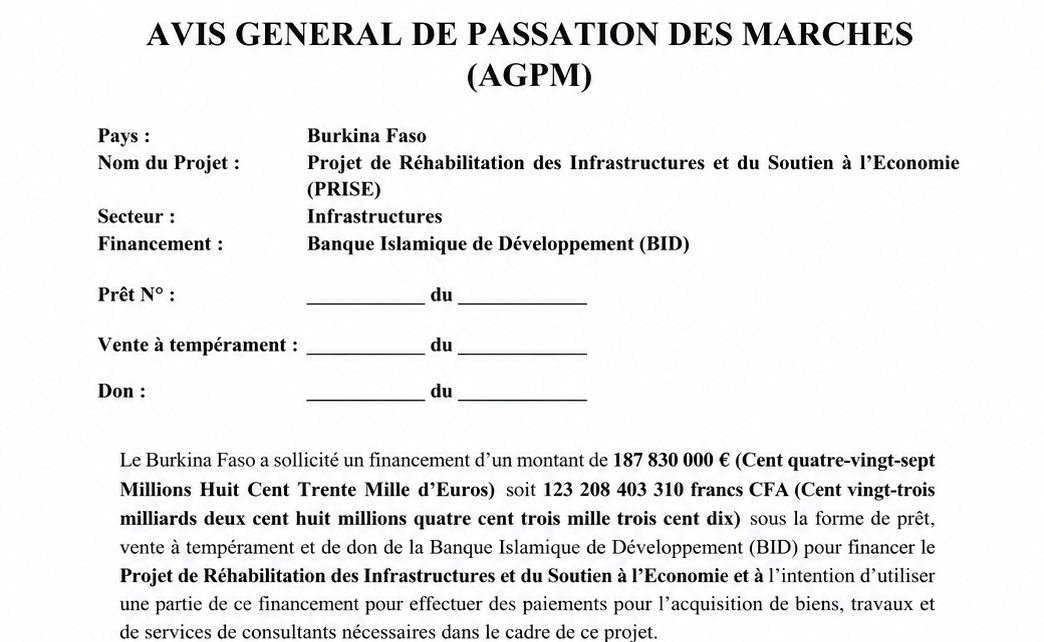
Recent agreements with multilateral institutions, such as the Islamic Development Bank, reveal a different story. These partnerships, while offering concessional terms, still involve borrowed funds that must be repaid according to agreed schedules. The claim that « there’s no credit in it » thus sits uncomfortably with the reality of public debt obligations.
The Contradiction That Fuels Distrust
The disconnect between the government’s messaging and actual financing mechanisms raises critical questions. Why insist on absolute self-financing when international partnerships remain a cornerstone of major projects? Borrowing is a standard tool for governments worldwide, particularly in developing nations where budgetary gaps are common. What stands out here is not the use of loans, but the refusal to acknowledge them openly.
This inconsistency has fueled skepticism about the transparency—and credibility—of the current administration’s financial governance.
An Economy Under Strain
Burkina Faso’s economic challenges further complicate the narrative of self-sufficiency. The country grapples with a multi-faceted crisis that includes:
- A worsening security situation draining public resources;
- Rising military expenditures;
- Shrinking fiscal space due to declining economic activity in key regions;
- Large-scale population displacements straining social services;
- Urgent infrastructure needs across the territory.
In such a context, financing multi-billion-franc projects without external support appears highly implausible to many economists and financial analysts.
Transparency Over Slogans
Public borrowing is not inherently problematic—when used wisely, it can accelerate development. The real issue lies in the lack of clarity surrounding these financial engagements. Citizens deserve to know:
- The exact sources of funding;
- The total loan amounts and interest rates;
- The repayment schedules and conditions;
- The long-term financial guarantees provided;
- The true cost of each infrastructure project.
A responsible financial governance model prioritizes openness, allowing taxpayers to assess whether borrowed funds are being used productively and whether future generations will bear an unsustainable burden.
A Political Strategy in Disguise
Beyond its economic dimensions, the « Y’a pas crédit dedans » slogan serves a clear political purpose. It reinforces the image of a regime breaking from past dependencies, presenting every completed project as proof of regained autonomy. This narrative also stokes nationalist sentiment, tapping into widespread public desire for self-determination in a time of geopolitical uncertainty.
Yet when political messaging eclipses fiscal accountability, the risk is real: unrealistic expectations are set, and the public may grow disillusioned when the limitations of domestic financing become apparent.
The Burden on Future Generations
Every loan contracted today will require repayment tomorrow, funded by future tax revenues. While new infrastructure may benefit coming generations, so too will the debt incurred to build it. This makes transparency in borrowing not just an economic necessity, but a democratic imperative.
Citizens must be able to judge whether these financial commitments are sustainable and whether borrowed funds are generating sufficient economic returns to justify their cost.
True Economic Sovereignty Is Not Debt-Free
Sovereignty is not measured by the absence of debt, but by the ability to manage it wisely. A truly sovereign nation demonstrates strength not through denial, but through:
- Prudent public finance management;
- Effective investment in productive sectors;
- Transparent reporting of financial obligations;
- Accountability to citizens;
- Strategic use of borrowing to reduce long-term dependency;
- A competitive, resilient economy.
A nation’s financial integrity is measured not by slogans, but by its willingness to confront reality—and to build a future based on truth, not illusion.
Conclusion: From Rhetoric to Responsibility
The « Y’a pas crédit dedans » slogan has captured public attention, but sustainable economic governance cannot rest on catchphrases alone. The reality is clear: Burkina Faso continues to rely on international financing for key projects, just as other developing nations do. The critical debate should not pit borrowing against sovereignty, but instead focus on the quality of financial management, the integrity of public spending, and the long-term impact on the nation’s future.
In the end, it is today’s taxpayers—and tomorrow’s citizens—who will bear the consequences of today’s financial decisions. The question is not whether the country borrows, but whether it borrows wisely—and whether it has the courage to tell the truth about it.