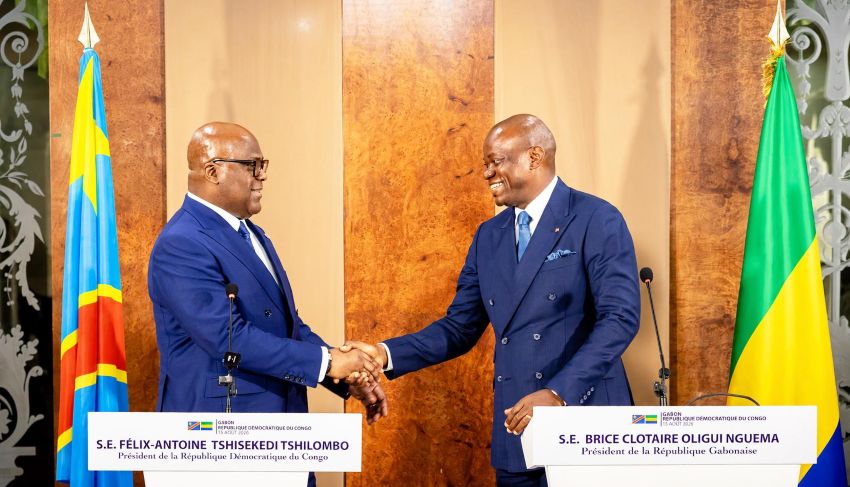
Gabon – RDC : Des actes à l’occasion de la visite du président Tshisekedi à Libreville
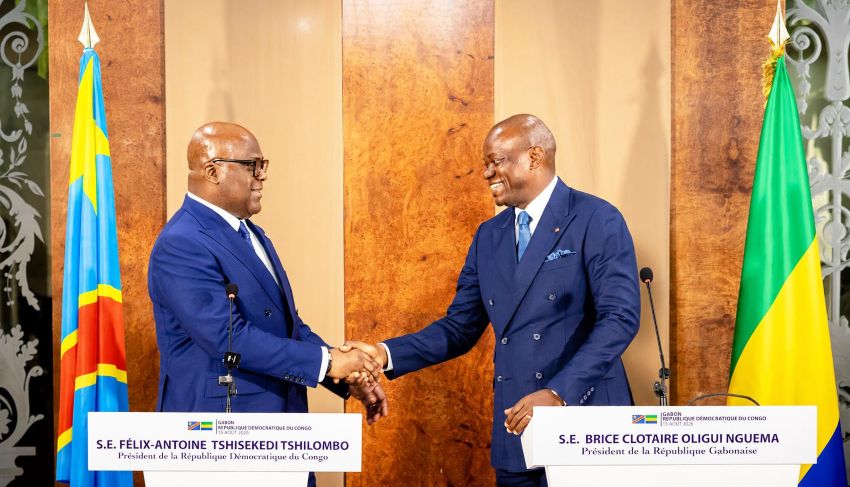
Libreville, Saturday, August 15, 2026 – The official visit of President Félix-Antoine Tshisekedi Tshilombo to Libreville transcended typical diplomatic formalities. Discussions between the head of state of the Democratic Republic of Congo (DRC) and his Gabonese counterpart, Brice Clotaire Oligui Nguema, revealed a profound political ambition: to transform the relationship between their nations into a powerful catalyst for economic growth, regional stability, and broader African solidarity.
Following these high-level talks, three concrete agreements were signed, translating this shared vision into actionable commitments.
President Tshisekedi’s presence in Libreville, coinciding with Gabon’s 66th independence anniversary, held particular significance. It served not only as a testament to the enduring bond between the Gabonese and Congolese peoples but also as a clear signal of both leaders’ dedication to forging a lasting and robust cooperative partnership. Key discussion areas encompassed a wide array of sectors, including agriculture, infrastructure development, transportation, energy, mining, healthcare, education, vocational training, digital technologies, and culture.
Underlying this extensive agenda was a singular conviction: while Gabon and the DRC are endowed with vast natural resources, their ultimate strength will hinge on their collective ability to process these resources domestically, generate employment opportunities, and facilitate the greater circulation of African expertise, capital, and know-how.
Boosting economic synergy: from resources to value
Both heads of state underscored the imperative to accelerate the local transformation of natural resources. This strategic orientation is crucial for two economies striving to lessen their reliance on raw material exports and to build greater value within their own territories.
President Brice Clotaire Oligui Nguema outlined the comprehensive reforms underway in Gabon, particularly in digitalization, women’s empowerment, youth employment initiatives, improving living standards, and enhancing the value of natural resources. President Félix Tshisekedi commended these efforts and expressed Kinshasa’s strong desire to deepen its ties with Libreville.
The envisioned cooperation, however, extends beyond purely economic considerations. The two presidents also addressed critical issues such as combating transnational organized crime, advancing regional integration, and ensuring the conditions of peace and stability essential for sustainable development. Their convergence of views also encompasses the vital Congo Basin, a major ecological zone whose protection now demands cross-border solutions.
Climate finance, especially concerning carbon taxation, could also open new avenues for collaboration. In an international landscape where African nations seek to better leverage their contributions to climate protection, a unified approach from Gabon and the DRC could significantly bolster their negotiating power.
This alignment extends to the continental stage. Libreville actively seeks Kinshasa’s support for its candidacy to the Council of the International Telecommunication Union (ITU) during the elections scheduled for Doha in November 2026, as well as for its bid to host the African Union Summit in 2027. For Gabon, this prospect would mark a significant return to organizing a major continental event, nearly half a century after the previous summit hosted in Libreville in 1977.
Formalizing cooperation: three pivotal agreements
The true impact of this meeting lies in the formal commitments made between the two nations. The first agreement establishes a broad framework for cooperation across various domains, including justice, environmental protection, public health, and the mining sector, with a specific emphasis on the local transformation of resources. The second accord introduces a visa exemption for holders of diplomatic and service passports. The third agreement formalizes a mechanism for regular diplomatic and political consultations between the two countries.
A Joint Commission has been tasked with overseeing the implementation of these commitments. This commission will likely serve as the real test of this renewed diplomatic phase. While African agreements are abundant, what often proves challenging is their translation into identifiable, adequately financed, diligently monitored, and rigorously evaluated projects.
Gabon and the DRC now possess a robust framework for progress. The immediate challenge is to transform signatures into active projects, declarations into tangible investments, intentions into new jobs, and diplomatic relations into visible benefits for both populations.
The visit concluded with a moment of reflection at Sainte-Marie Cathedral, a prominent religious site in Libreville. This stop, however, resonated with a particular Congolese memory, recalling a mass celebrated there in February 2018 in tribute to Étienne Tshisekedi.
Beyond this symbolic gesture, the core message remains clear. Gabon and Congo now have a unique opportunity to convert their historical proximity into a collective strength. The two presidents have paved the way, the three signed agreements provide the structure, and the Joint Commission is now poised to set the pace.
Africa no longer solely needs to proclaim its solidarity; it must organize it, finance it, and transform it into concrete results. Between Libreville and Kinshasa, the focus has now definitively shifted to action.