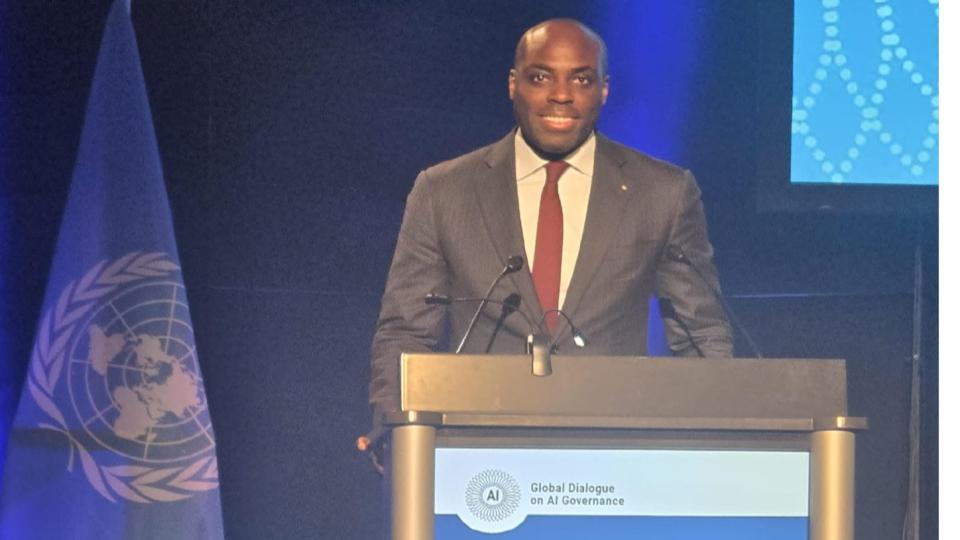
As global powers engage in an intense race for algorithmic supremacy, Gabon is charting a distinct course. During the Global Dialogue on AI Governance, convened in Geneva under the auspices of the United Nations, Mark Alexandre Doumba, Gabon’s Minister of Digital Economy, urged the international community to undertake a profound re-evaluation. For Libreville, the paramount concern is not to engineer the fastest technology, but rather to construct a tool that is genuinely accessible to all.
Confronting the tech giants’ relentless focus on model size and computational prowess, the Gabonese minister proposed a transformative paradigm shift. “It’s not about being the first in AI. It’s about deploying AI widely,” he emphasized forcefully.
In his view, the current fervor overlooks the fundamental issue. The true challenge is no longer technical; it is inherently political and human. It lies in determining who will establish the essential institutions and regulations for responsible deployment. This perspective firmly places governance and ethical discernment at the core of the discussion.
Embracing ‘small AI’ for localized impact
For Gabon, the future of this technology resides in transitioning from “big AI” to specialized solutions, carefully tailored to local realities. This is what Mark Alexandre Doumba refers to as “small AI.” “The frontier isn’t about having perpetually larger models. It’s local adaptation that will empower an African farmer to utilize this technology within their specific context,” he underscored.
Whether optimizing harvests, modernizing public services, or enhancing access to healthcare, the added value will be measured by the tangible benefits delivered to populations in the Global South, who are all too frequently confined to the role of mere consumers of imported technologies.
Redefining the system to prevent a new global divide
Beyond its technical utility, the minister perceives AI as a potent catalyst for systemic transformation. It should not merely optimize existing frameworks, but rather drive a redefinition of economic and social rules to foster greater inclusion.
While humanity possesses unprecedented financial and technological capital, the risk of a new global fracture remains substantial. In conclusion, the Gabonese emissary issued a clear warning: without a collective commitment to equitably distribute these innovations, the chasm between AI designers and its users will become the defining fault line of the 21st century. The success of this revolution will not be quantified in teraflops, but in improved human lives.