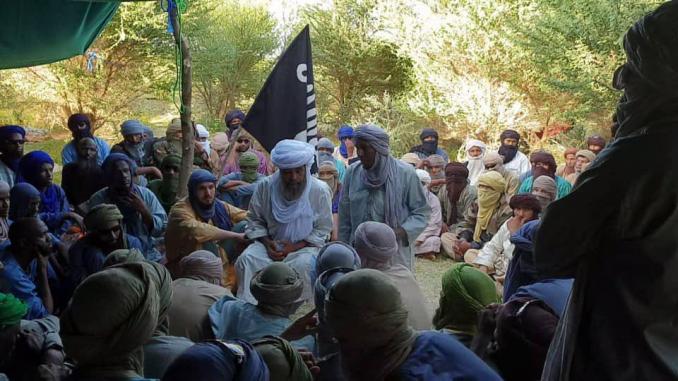
The Group for the Support of Islam and Muslims (JNIM), an Al-Qaeda affiliate, is rapidly expanding its operational reach across Mali, intensifying attacks despite ongoing military operations in the country. Recent ambushes against army units, targeted strikes on military outposts, and systematic pressure on key road corridors underscore the group’s growing influence in multiple regions.
Beyond Mali: a spreading jihadist threat
While the JNIM’s offensive remains most visible in Mali, its impact is resonating across the Sahel. Regional governments and neighboring African nations are increasingly concerned as the group exploits porous borders and fragile state structures. The combination of political instability and deepening economic crises in several Sahelian countries is creating fertile ground for further jihadist expansion.
From mobility to territorial control
Contrary to the perception of a purely mobile and clandestine organization, the JNIM has been methodically building territorial roots. In the Bandiagara region, five villages were attacked on May 21, 2026, with the group claiming responsibility—a move that sent shockwaves through Bamako’s military leadership. Rather than focusing solely on large-scale confrontations, the JNIM is capitalizing on local conflicts, exploiting weak governance, and filling voids left by the absence of state services. In some rural areas, it has established parallel taxation systems, imposed movement restrictions, and even created alternative dispute resolution mechanisms.
This strategy of de facto governance highlights the limitations of purely military responses. Even when operations reclaim territory, they often fail to restore essential state functions—administrative, judicial, or economic—leaving communities vulnerable to renewed jihadist influence.
The Malian junta’s security gamble
Mali’s transitional authorities have shifted their security strategy since the departure of French forces and the deepening partnership with Russia. The government frames this pivot as a move toward greater sovereignty, reducing reliance on Western security support. However, the persistence of violence and the JNIM’s continued mobility suggest that military partnerships alone may not suffice.
International observers have also documented allegations of human rights abuses involving Malian armed forces and their allied Russian partners. Bamako has repeatedly dismissed these claims, accusing foreign entities of orchestrating destabilization campaigns. The resulting polarization has further narrowed the space for political dialogue and mediation.
Geopolitical fault lines in the Sahel
The Sahel crisis has become a battleground for competing international interests. Russia, Turkey, the United Arab Emirates, Western powers, and regional actors are all vying to shape the region’s future. Jihadist groups are capitalizing on these divisions, weakened cross-border cooperation, and the erosion of regional alliances.
The danger now is the normalization of chronic insecurity. Entire regions exist in a limbo where neither the state nor armed groups exercise full control. With Bamako’s military support from the Africa Corps showing signs of wavering, the question looms: what happens if these forces withdraw entirely?