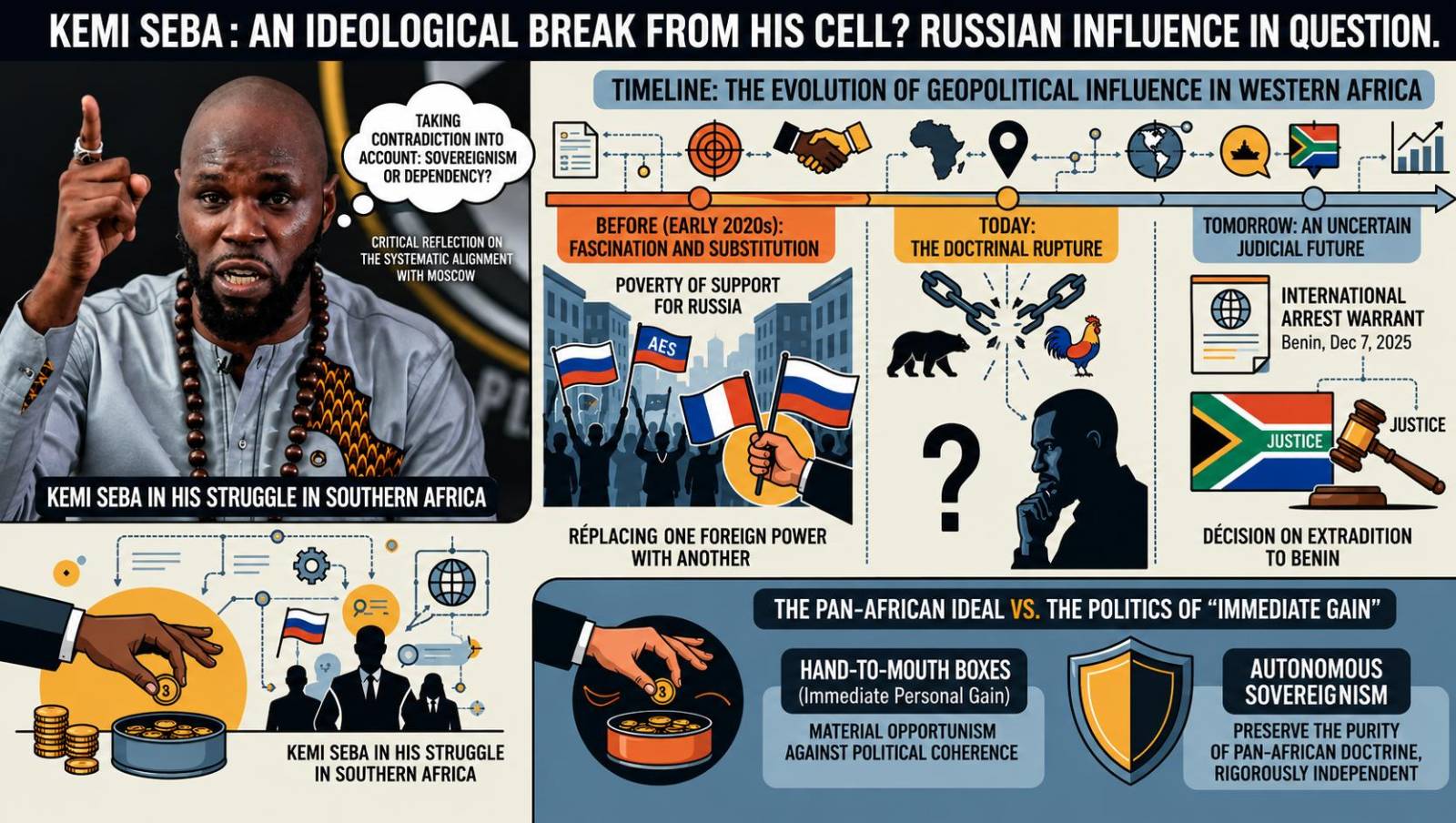
The geopolitical dynamics across the Sahel region, particularly within the countries of the Alliance of Sahel States (AES), have recently been characterized by highly symbolic public demonstrations. In numerous gatherings advocating for full sovereignty, crowds have waved Russian flags and chanted slogans unmistakably in favor of Moscow. For a vocal segment of activists, Russia has emerged as the indispensable alternative to historical Western powers, positioning itself as the ultimate champion of a new, independent Africa.
Yet this growing affinity raises fundamental questions, especially when it stems from movements that claim to champion total independence. Today, a leading figure of contemporary Pan-Africanism, Kemi Seba, appears to be undergoing a major doctrinal shift from behind the bars of a South African prison, challenging the very movement he once helped define.
From sovereignty to a new form of dependency: the paradox of allegiance
The pursuit of international partnerships is a legitimate diplomatic strategy for any state or political movement. However, replacing one foreign influence with another is widely regarded as a profound ideological inconsistency. Many observers argue that merely substituting France’s historical dominance with that of Russia does not constitute true emancipation—merely a transfer of dependency.
Kemi Seba now seems to recognize this contradiction. The Pan-African thinker has begun to critically examine the limitations of an unconditional alignment with Moscow, refusing to endorse any form of new protectorate, even one that opposes the West.
The clash between idealism and short-term gains
This shift underscores a growing divide within sovereignist movements. While some support for Russia stems from a genuine desire for geopolitical rupture, other dynamics appear driven by more immediate material interests rather than ideological conviction.
Kemi Seba has forcefully rejected this opportunism, frequently denouncing what he describes as the mentality of the ‘stew pot’—a metaphor for prioritizing personal and immediate gains to ‘fill one’s belly’ at the expense of long-term political coherence. By refusing to engage in this form of ideological mercenarism, the activist seeks to uphold the doctrinal purity of a Pan-Africanism that demands absolute autonomy.
Legal uncertainty in Pretoria: what lies ahead for Seba’s legacy
This period of doctrinal introspection coincides with a critical juncture in the activist’s personal life. Facing an international arrest warrant issued by the government of Bénin following the December 7, 2025 coup attempt in Cotonou, Kemi Seba remains incarcerated in South Africa. His fate now rests not only in the realm of ideas but also before the courts. The South African judiciary is expected to rule soon on Bénin’s extradition request.
Will this enforced imprisonment mark the definitive end of Seba’s influence, or merely a recalibration of the Pan-African discourse he championed? The coming weeks will prove decisive—not only for his political future, but also for the direction of the movements he has inspired.