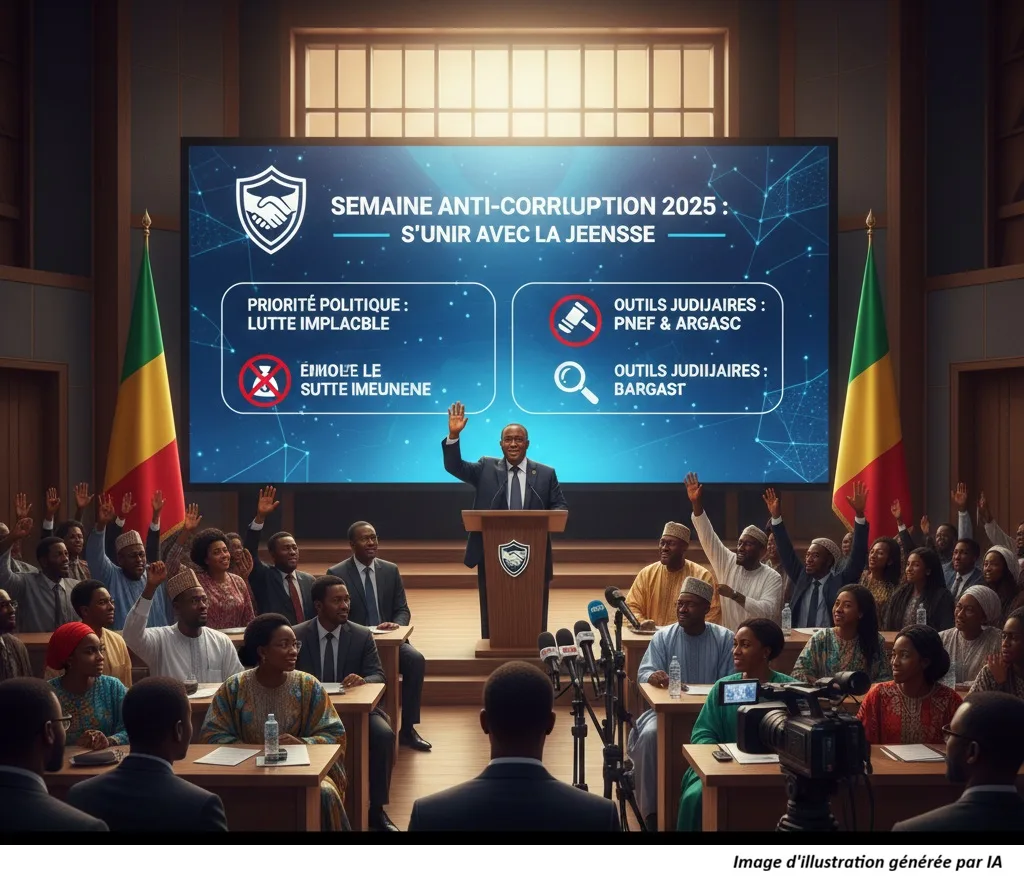

The National Anti-Corruption Week for 2025 officially commenced on December 9, 2025, in Bamako. The launch event, designed to inform the public about ongoing anti-corruption initiatives in Mali, was spearheaded by Mamoudou Kassogué, the Minister of Justice and Human Rights. This year’s observance reiterated the crucial theme from the previous year: “Uniting with youth against corruption: shaping tomorrow’s integrity.”
During his address, Minister Kassogué underscored the profound necessity for collective action against the “immeasurable” repercussions of corruption. He referenced former UN Secretary-General Kofi Annan, who characterized corruption as an “insidious evil” that erodes democratic principles, undermines the rule of law, and paves the way for organized crime and terrorism.
🎯 Transition Government’s Core Policy
The annual celebration of this International Day, designated by the UN on December 9, serves as a clear demonstration of the political will emanating from Mali’s highest Transitional Authorities, particularly General Assimi Goïta. Their commitment to an “unrelenting and irreversible” campaign against this pervasive scourge is unequivocal.
This week of awareness forms an integral part of the broader state reconstruction process, which mandates a fundamental shift in public administration paradigms. It also aims to foster the emergence of citizens deeply committed to integrity and patriotism.
Youth: The Vanguard of Transformation
The chosen theme spotlights the generational responsibility of Malian youth, positioning them as the “vanguard” essential for overcoming resistance and spearheading the process of change. Minister Kassogué expressed satisfaction with the “significant mobilization” of youth movements rallying around this vital cause.
🛡️ Judicial Measures: PNEF and ARGASC for Deterrence
The Ministry of Justice is steadfast in its resolve to implement comprehensive judicial reforms aimed at enhancing the effectiveness of the battle against economic and financial offenses. Key initiatives include:
The National Economic and Financial Hub (PNEF): Focused on prosecuting financial criminals through advanced techniques and modern resources.
The Agency for the Recovery and Management of Seized or Confiscated Assets (ARGASC): Prioritizes the repatriation of substantial sums and assets illicitly removed from state coffers.
A Potent Deterrent: “The synergistic operation of the PNEF and ARGASC will significantly strengthen the deterrent effect against corruption and economic and financial delinquency, ensuring that the proceeds of crime can no longer benefit their perpetrators.”
Innovations in the New Penal Code
New provisions within the updated Penal Code are poised to bolster judicial action, notably:
The imprescriptibility of criminal offenses related to economic and financial crimes involving public assets.
The abolition of parliamentary privileges and immunities.
Enhanced protection for whistleblowers, witnesses, experts, and victims.
Modernization Instruments
Further tools are being implemented to optimize anti-corruption efforts:
The free green hotline “Binkani Kunafoni” (3611), enabling citizens to report corrupt practices.
The imminent launch of the justice IT platform, following a successful test phase, aimed at the dematerialization of judicial files and further combating corrupt activities.
🤝 Call for Inter-Institutional Synergy
The minister emphasized the critical need for enhanced collaboration and cooperation among various state entities with complementary mandates, including:
The Central Office for Combating Illicit Enrichment (OCLEI).
The Office of the Auditor General (BVG).
The Court of Accounts (established from the former Accounts Section of the Supreme Court following the adoption of the 2023 Constitution).
He reiterated that plans to establish a framework for consultation and coordination among these structures would be advanced “as swiftly as possible.”